
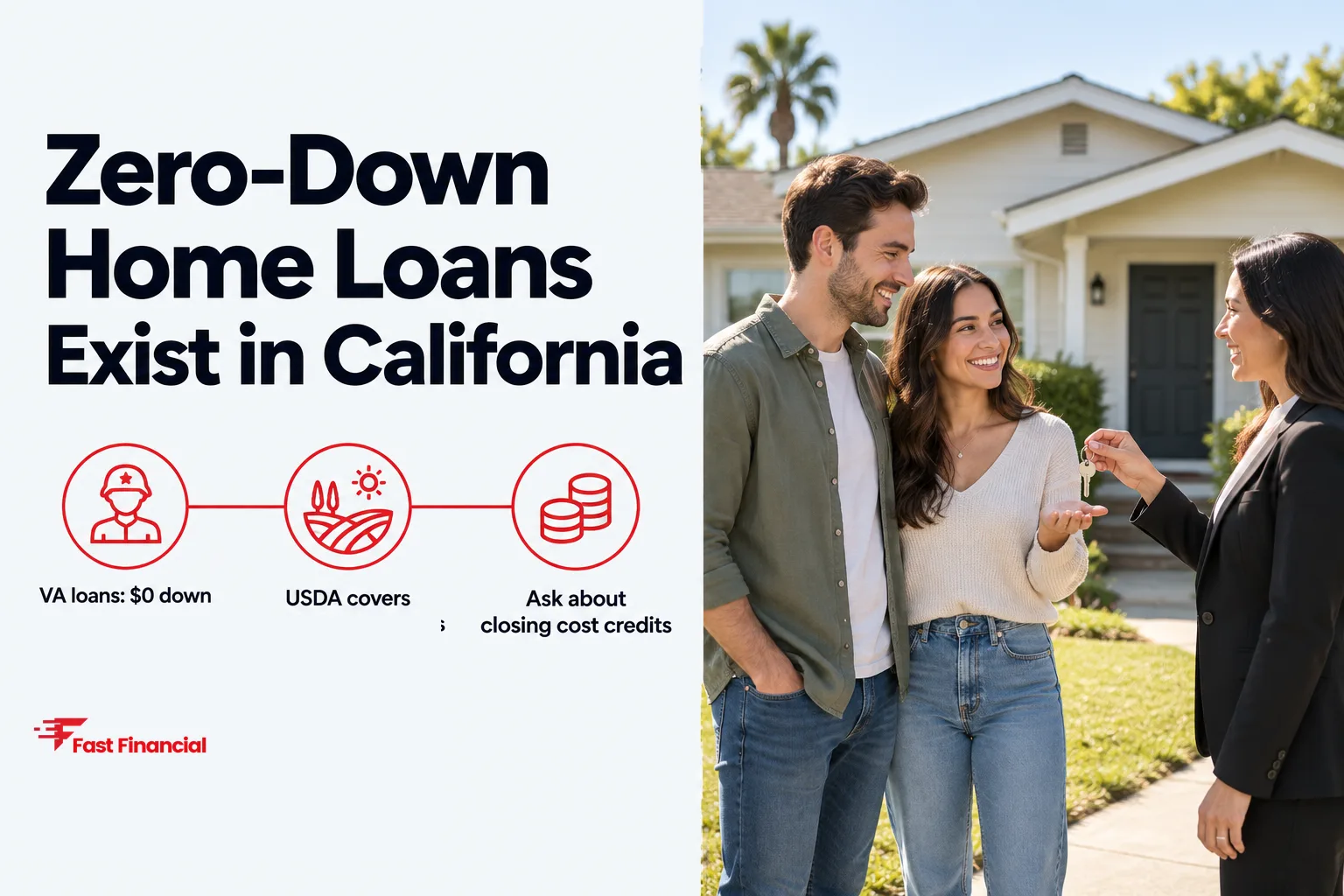
Buying a Home with No Money Down: Is It Possible?
Yes — zero-down home loans are real, and California buyers use them every year. The catch: eligibility is program-specific, and each path has its own rules, trade-offs, and qualifications you need to clear first.
If you're asking whether you can skip the down payment and still buy a home, the honest answer is probably "yes — if you qualify." Here's what the legitimate paths actually look like.
What Programs Actually Let You Buy with No Money Down?
Two federally backed loan programs allow a zero down payment: VA loans and USDA loans. Both are available in California. Neither is for everyone.
Outside of those two, California-specific down payment assistance (DPA) programs — including CalHFA — can reduce your out-of-pocket cash to near zero. Technically you're borrowing the down payment through a second loan rather than eliminating it, but the effect on your wallet at closing can be similar.
VA Loans — The Best Zero-Down Option Available
VA loans are, by any honest measure, the strongest mortgage product available to eligible borrowers. No down payment required. No private mortgage insurance (PMI). Seller concessions allowed for closing costs. The VA loan benefit is open to:
- Qualifying veterans, active-duty service members, and National Guard or Reserve members who meet service requirements
- Eligible surviving spouses
The Antelope Valley has a large veteran and military population connected to Edwards Air Force Base. If that's your background, the VA loan guide for Edwards AFB homebuyers covers the local specifics. And if you want the full picture of what makes this program exceptional, here's why VA loans are hard to beat when you have the eligibility.
One thing to know: most VA borrowers pay a funding fee, which varies based on service history and whether it's a first or subsequent use. That fee can typically be rolled into the loan — so still no cash out of pocket at closing — and veterans with qualifying service-connected disabilities may be exempt entirely.
USDA Loans — Zero Down for Rural and Suburban Properties
USDA Rural Development loans also allow no down payment for qualifying borrowers purchasing in eligible areas. The geographic restriction is the key variable: the property must fall within a USDA-eligible zone, which the USDA defines as rural and some suburban communities. Those maps are updated periodically, so a property's eligibility today isn't guaranteed to hold forever.
Household income limits also apply — USDA is designed for moderate-income buyers, not high earners. If your purchase location qualifies and your income falls within the program ceiling, this is a legitimate zero-down path worth running the numbers on.
What If You Don't Qualify for VA or USDA?
This is where California-specific assistance comes in. CalHFA — the California Housing Finance Agency — runs several programs designed to bridge the gap between what buyers have saved and what lenders require.
The CalHFA MyHome Assistance Program provides a deferred-payment junior loan for the down payment and closing costs, meaning no monthly payment on the assistance amount until you sell, refinance, or pay off the first mortgage. The Dream For All Shared Appreciation Loan provides a larger down payment contribution in exchange for sharing a portion of the home's future appreciation with CalHFA when you eventually sell or refinance.
These aren't grants — you're borrowing the down payment — but for buyers who have steady income and solid credit but limited savings, they're a real bridge. First-time homebuyer programs in the Antelope Valley breaks down what's available for local buyers. CalHFA products typically layer on top of FHA or conventional first mortgages — comparing FHA vs. conventional loans is a useful starting point.
Do I Still Have to Pay Closing Costs with No Down Payment?
Yes — and this is the part many buyers don't think through. Zero down doesn't mean zero at closing. Appraisal, title, escrow, and lender fees still exist regardless of your down payment. In California, closing costs on a mortgage are real and worth factoring in from the start.
Here's how buyers handle closing costs without draining savings:
- Seller concessions — negotiate for the seller to cover some or all closing costs; common in markets where buyers have leverage
- Lender credits — accept a modestly higher rate in exchange for lender-paid closing costs
- VA loans — sellers can pay all closing costs, and the VA caps what lenders can charge the borrower
- CalHFA DPA — some CalHFA products also include assistance toward closing costs, not just the down payment
What Does Your Financial Profile Need to Look Like?
Zero down doesn't mean zero qualifications. Every program has credit, income, and debt-to-income (DTI) requirements.
VA loans: The VA itself doesn't set a hard minimum credit score — lenders apply their own standards within VA guidelines. DTI flexibility is generally stronger than conventional loans, but a lender still has to approve your full picture.
USDA loans: Income limits are the defining constraint. Your household income must fall at or below the area maximum, which varies by location and household size.
CalHFA DPA: Income limits, purchase price caps, and often a first-time homebuyer requirement (or not having owned in the past three years). Before anything else, know what credit score lenders are actually looking for in California.
Self-employed? Document-heavy income adds a layer of complexity to any loan — here's how self-employed borrowers qualify in California. Getting pre-approved before you start searching tells you exactly which programs apply to your profile and at what purchase price. What to expect from the pre-approval process is worth reading before you make any offers.
Is No Money Down Actually the Right Move?
Preserving your cash has real value — California's housing market moves fast, and reserves after closing matter. But a larger loan balance means more interest over the life of the loan, and the VA funding fee adds slightly to that balance.
If you have some savings but want to put as little down as possible, compare the scenarios side by side. Mortgage calculators here let you model different down payment amounts against each other before you commit. Then get your rate reviewed to see where you actually stand.
Frequently asked questions
Can I buy a home in the Antelope Valley with no money down?
Yes, if you qualify. VA-eligible borrowers in the Lancaster and Palmdale area buy with zero down regularly. USDA eligibility depends on the specific property's location and income limits. CalHFA down payment assistance is available statewide, including the Antelope Valley.
Do I need perfect credit to get a zero-down home loan?
No. VA loans in particular are known for credit flexibility — lenders set their own minimums within VA guidelines. USDA and CalHFA programs also work with borrowers who don't have top-tier scores, though every program has a minimum floor and every lender has its own standards.
What's the real catch with no-money-down programs?
Closing costs still apply even when there's no down payment (though seller concessions and lender credits can cover them). VA borrowers typically pay a funding fee. CalHFA DPA involves a second loan with its own repayment terms or shared-appreciation agreement. You're not getting something for nothing — you're financing more, or agreeing to share future equity.
Can first-time homebuyers in California use these programs?
Yes — and most CalHFA DPA programs specifically require first-time homebuyer status or not having owned a primary residence in the past three years. VA and USDA have no first-time requirement. The first-time homebuyer checklist is a good starting point before your first offer.
How does Fast Financial help with zero-down loans?
Fast Financial (NMLS #2226871) is a licensed California mortgage broker with access to VA, USDA, and CalHFA-backed loan products. Start with a rate review to find out which programs fit your profile and what your actual purchase power looks like.