
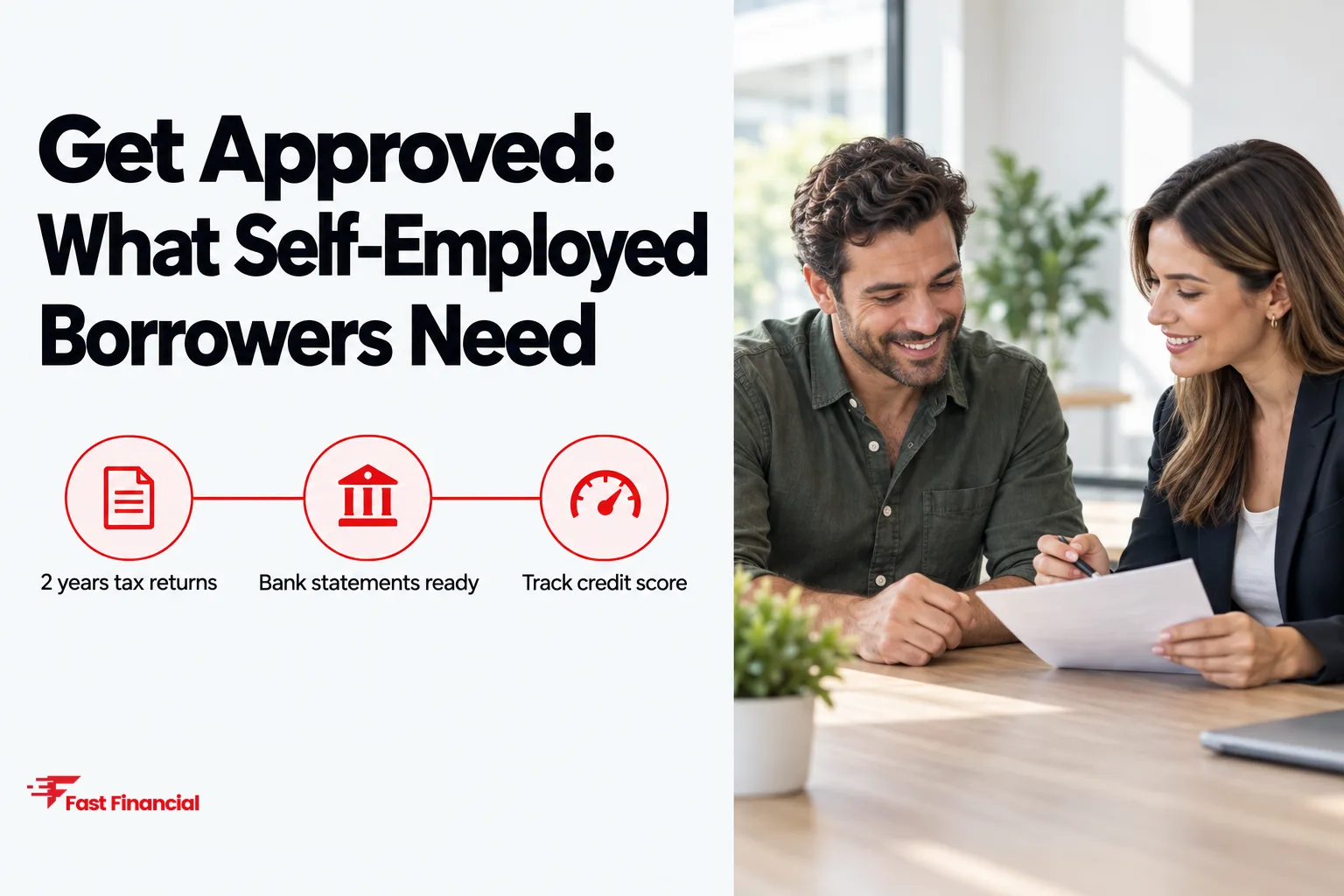
Self-Employed Mortgage Documents Checklist: Full-Doc, Bank Statement, and P&L Loans
Which documents you need for a self-employed mortgage depends on the program you use. A full-doc loan typically asks for two years of personal and business tax returns. A bank statement loan asks for 12 or 24 months of statements. A P&L loan asks for a profit-and-loss statement prepared by a licensed tax professional. Choose the program first, because the checklist follows from it.
Below is each checklist, how far back each item goes, and what underwriters actually look for.
Who counts as self-employed to a lender?
Under conventional agency guidelines, you're generally treated as self-employed if you own 25% or more of a business or are paid on a 1099. That covers sole proprietors, single-member LLCs, partners who get a K-1, S-corp owners who pay themselves a W-2, and independent contractors.
It matters because it changes what the underwriter asks for. An S-corp owner with a W-2 still gets the self-employed file, which means business returns as well as the pay stub.
Which program fits your file?
| Program | Income is proven by | Typical lookback | Best fit |
|---|---|---|---|
| Full-doc (conventional, FHA, VA, jumbo) | Personal and business tax returns | Usually two years | Taxable income supports the loan |
| Bank statement (non-QM) | Deposits on personal or business statements | 12 or 24 months | Write-offs hold net income down |
| P&L-only (non-QM) | Profit-and-loss statement prepared by a CPA, EA, or CTEC-registered preparer | 12 or 24 months | Strong business, clean books, returns that don't show it |
Here's the move: if your returns support the loan you want, full-doc usually gives you the widest set of options. If you write off heavily, a non-QM loan built on deposits or a P&L may be the program that shows your real cash flow.
What documents do you need for a full-doc self-employed loan?
Full-doc covers the traditional programs: conventional, FHA, VA, and most jumbo. The checklist:
- Personal federal tax returns. Usually the two most recent years, all schedules included (Schedule C, E, K-1s). With some automated approvals on established businesses, one year may be accepted. Your lender confirms this once the file runs through underwriting.
- Business tax returns. Form 1065 for partnerships and multi-member LLCs, Form 1120-S for S-corps, Form 1120 for C-corps. Same lookback as your personal returns, for any business you own 25% or more of.
- K-1s. One for each entity and each year.
- Year-to-date profit and loss statement. Often requested when you apply well into the year, so the underwriter can see the business hasn't declined since your last return.
- Signed IRS Form 4506-C. This lets the lender pull tax transcripts from the IRS to confirm that the returns you gave them match what you filed.
- Proof the business exists. A business license, a CPA letter, or a current listing. Lenders verify this again shortly before closing.
- Asset statements. Recent personal bank and investment statements covering down payment and reserves. Business funds used for closing may require a cash-flow analysis or a CPA letter.
In practice, the underwriter averages your qualifying income over the lookback period and adds back non-cash deductions like depreciation. If income has dropped year over year, expect questions. A steep drop can lower the income they're allowed to count.
For a closer look at how this works for California business owners, see our guide to getting a mortgage when you're self-employed in California.
What documents do you need for a bank statement loan?
Bank statement loans skip tax returns completely. Deposits are what qualify you. The checklist:
- Bank statements. 12 or 24 consecutive months, personal or business depending on the program. Provide every page, including the blank ones.
- An expense factor or expense letter. On business statements, the lender either applies a standard expense ratio to deposits or uses an expense ratio supported by a letter from your CPA or tax preparer.
- Proof of self-employment history. Usually around two years, shown through a business license, a CPA letter, or state registration such as a California Secretary of State filing.
- Explanations for large or unusual deposits. Transfers between your own accounts, loan proceeds, and one-time sales usually don't count as income. Be ready to source them.
- Asset and reserve statements. Same as full-doc.
What lenders actually look at here is consistency. Steady deposits, few non-sufficient-funds items, and a clean separation between business and personal money make the file go more smoothly. Our breakdown of bank statement loans for self-employed borrowers in Lancaster goes into how deposits are calculated.
What documents do you need for a P&L-only loan?
P&L programs are the leanest option. The checklist:
- A profit-and-loss statement covering 12 or 24 months, prepared and signed by a CPA, enrolled agent, or (in California) a CTEC-registered tax preparer. Most programs won't accept a P&L you prepared yourself.
- A preparer attestation or license verification confirming the professional prepared the P&L or reviewed it.
- Proof of business existence and history, the same as the other programs.
- Sometimes a short run of bank statements so the lender can check that deposits match the P&L.
- Asset and reserve statements.
This program works for owners whose books are clean but whose returns understate income because of aggressive deductions. If that sounds like you, read mortgage options for small business owners who write off everything.
What does every self-employed borrower need, regardless of program?
Some items are on every checklist:
- Government-issued photo ID
- Authorization to pull credit
- Two months of recent asset statements for down payment, closing costs, and reserves (the exact requirement varies by program)
- Explanation letters for credit inquiries, gaps, or anything unusual
- Documentation for any other income: rental leases, Social Security award letters, pension statements
- The purchase contract or current mortgage statement, depending on whether you're buying or refinancing
How do you get your file approved faster?
The number that matters most is how complete your file is on day one. Every condition the underwriter issues adds time.
- Send complete documents. Every page and every schedule. Missing page 6 of 6 is a condition.
- Keep business and personal money separate. Mixed accounts make income harder to calculate under any program.
- Talk to your tax preparer early. If you're about to file, ask how the new return will affect qualifying income before you file it.
- Don't move money unless you need to. Unexplained transfers mean more paperwork.
- Ask about the right program before you collect documents. Gathering two years of returns for a file that should be a bank statement loan wastes weeks.
Investors financing rentals may not need personal income documentation at all. A DSCR loan qualifies on the property's rent. Borrowers with substantial liquid assets can also look at asset depletion.
Get your file reviewed before you start collecting paperwork
Fast Financial works with self-employed borrowers across the Antelope Valley and Los Angeles County regularly, including contractors, salon owners, consultants, and multi-entity business owners. We match you to the right program first and then give you the checklist that fits it, so you don't collect documents you won't use. Rates, terms, and approval depend on your full file and current market conditions.
Call Fast Financial at (661) 512-4141, get a rate quote online, or visit our local office at 190 Sierra Ct Ste 324, Palmdale, CA 93550. If you're in Palmdale, Lancaster, or Quartz Hill, we're nearby. NMLS #2226871. Equal Housing Opportunity.
Frequently asked questions
How many years of tax returns do self-employed borrowers need?
Most full-doc programs ask for the two most recent years of personal and business returns. Some automated approvals on established businesses accept one year. Bank statement and P&L programs don't use tax returns for income at all.
Can I use business bank statements instead of personal statements?
Yes. Many bank statement programs accept business statements. The lender then applies an expense factor, or uses a ratio supported by your CPA or tax preparer, to estimate qualifying income from deposits.
Can I prepare my own profit and loss statement?
For a P&L-only loan, usually not. Those programs typically require the P&L to be prepared by a CPA, enrolled agent, or CTEC-registered preparer. On a full-doc loan, a year-to-date P&L you sign yourself is often acceptable as a supporting document.
How long do I need to be self-employed to qualify?
Lenders generally look for about two years of self-employment history. Shorter histories can sometimes work when you've moved into the same line of work you did as an employee. Requirements vary by program.
Will my lender check my returns with the IRS?
On full-doc loans, yes. You'll sign IRS Form 4506-C, and the lender pulls your transcripts to confirm they match the returns you submitted.