
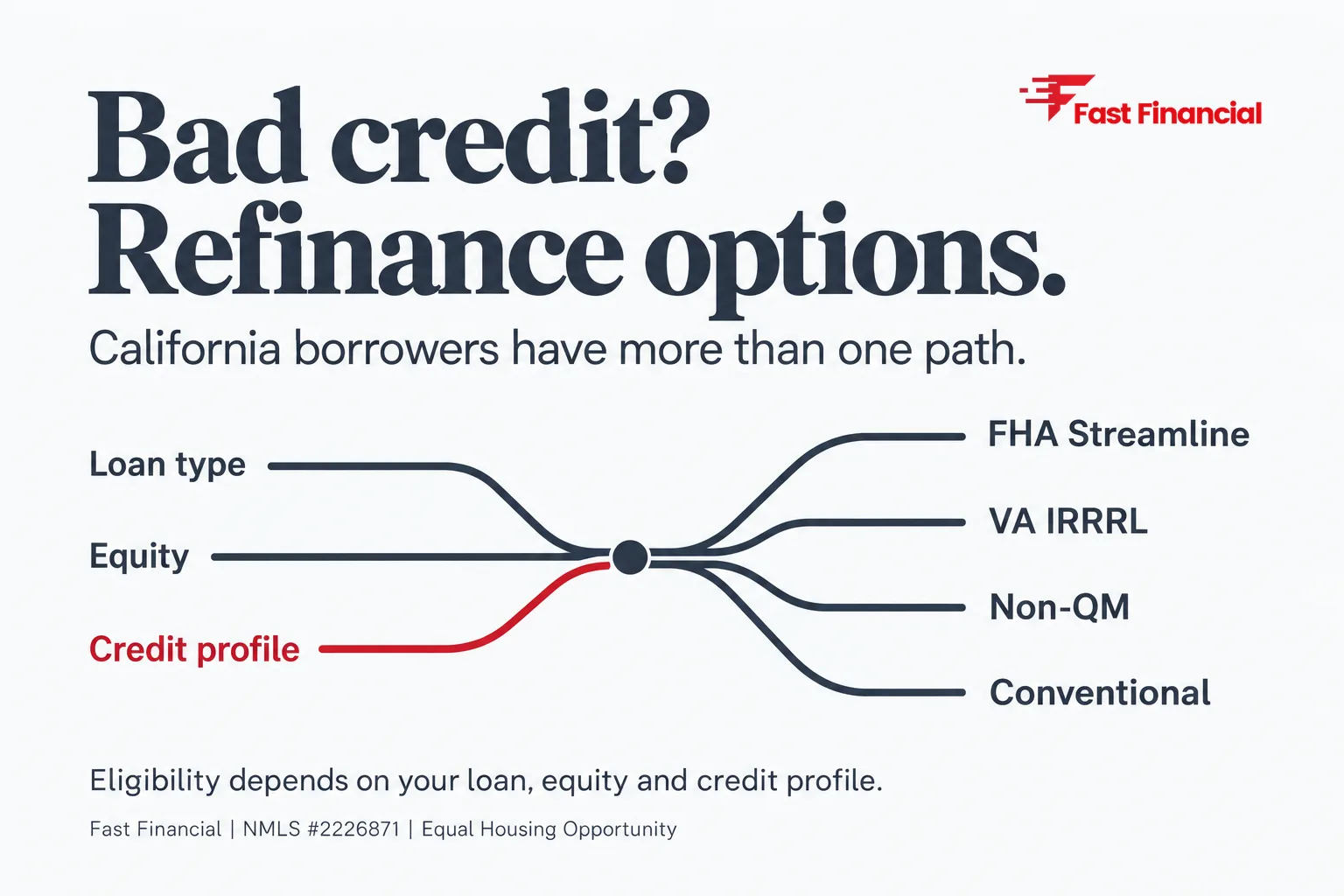
Yes — refinancing with bad credit is possible, and California borrowers have more paths than most people assume. Which door opens depends on your current loan type, your equity position, and the exact shape of your credit file. Here's how to think about it.
What does "bad credit" actually mean to a mortgage lender?
Credit score is one input, not the whole decision. When a lender underwrites a refinance, they're looking at your full credit profile — payment history, utilization, derogatory marks, and how recently any damage occurred.
What qualifies as a disqualifying score varies significantly by program. An FHA loan operates under different credit standards than a conventional one. A non-QM product may use entirely different underwriting criteria. "Bad credit" means different things depending on which program you're being evaluated against.
The detail that matters most: recency. A bankruptcy discharged four years ago reads differently than a 60-day late from three months ago. Lenders price risk based on what happened and when — not just how low the score landed.
What refinance options exist when your credit isn't great?
FHA Streamline — built for existing FHA borrowers
If your current mortgage is an FHA loan, the FHA Streamline refinance is designed for situations like this. It requires minimal income documentation, skips the appraisal in most cases, and operates with more credit flexibility than a standard refinance.
The program's requirement: you must be current on the existing loan and demonstrate a "net tangible benefit" — meaning the new loan has to improve your situation in a clearly defined way. Review how FHA and conventional programs compare if you're not sure which track you're on.
VA IRRRL — the veterans' path
If you have a VA loan and served in the military, the Interest Rate Reduction Refinance Loan (IRRRL) is worth exploring first. It's a streamline product: no appraisal in most cases, reduced documentation requirements, and credit overlays that tend to be lighter than conventional programs.
California veterans — including those near Edwards Air Force Base and throughout the Antelope Valley — often don't realize this option is available even with a beaten-up credit profile. Our VA loan guide for Edwards Air Force Base homebuyers covers the program mechanics in detail.
Non-QM loans — when agency programs don't fit
Non-QM (non-qualified mortgage) lenders underwrite outside Fannie Mae and Freddie Mac's guidelines. Some weigh equity heavily and credit score less. Some use bank statements instead of tax returns. If you have meaningful home equity but a damaged credit file, a non-QM refinance may be a workable path.
Non-QM mortgages carry different terms than conventional loans — that's the trade-off for flexible underwriting. A broker who works with multiple non-QM investors can shop your file without committing you to a single lender's product.
Conventional refinance — possible, with preparation
Conventional refinancing with credit damage is harder, not impossible. Equity position matters here more than anywhere else. A borrower with significant equity in the home has more negotiating leverage than one near the top of their property's value. Loan-to-value (LTV) is often the lever that opens or closes the door when credit is the weak point.
What do lenders actually look at beyond your score?
Your score is the headline. What gets underwritten:
Equity. More equity equals less lender risk. A lower LTV can offset meaningful credit weakness on the right program.
Mortgage payment history specifically. If you've made every house payment on time but stumbled on revolving debt, that reads differently than a file with mortgage lates.
Income stability. A steady, documented income stream reassures underwriters even when the score tells a rough story.
Recency of derogatory items. An old collection that's been resolved and a fresh collection currently in dispute are not the same thing in a credit review — not even close.
Should you repair credit first, or apply now?
That depends on how recent the damage is and what equity you have.
If the derogatory items are older and you're sitting on equity, apply now and see what programs you actually qualify for. There's no objectively perfect moment to refinance — and waiting costs money if your current loan terms are working against you.
If you have recent lates or open collections actively pulling your score, a focused 90–120 day improvement effort might materially shift which programs are accessible. A broker can pull a tri-merge credit report and walk through exactly what's moving the number — that conversation is worth having before you commit to a direction.
If you're not sure where you stand at all, start here: how credit scores affect mortgage qualification.
Does location in California matter for your options?
California doesn't have a state-specific bad-credit refinance product, but geography affects equity — and equity is often what makes a refinance workable when credit alone wouldn't qualify. Markets in Los Angeles County, including the Antelope Valley cities of Lancaster and Palmdale, have appreciated significantly for homeowners who've been in their homes for several years. That appreciation is a real asset on a refinance application.
Program availability is consistent statewide. FHA Streamline, VA IRRRL, and non-QM products are all accessible through a California-licensed broker. Our refinance options page outlines the programs we work with across the state.
The move
Bad credit narrows the field — it doesn't eliminate the options. The question is which program fits your specific situation: your loan type, your equity, your income, and what the credit file actually looks like to an underwriter.
See where you stand — we'll look at your options without pressure.
Fast Financial — NMLS #2226871. Licensed in California. Rates and programs vary by borrower qualification and market conditions.
Frequently asked questions
Can I refinance if my credit score is below 600?
It depends on your current loan type and equity. FHA Streamline and VA IRRRL are streamline products with more flexibility than conventional programs, and non-QM lenders underwrite using different criteria entirely. Your equity position and payment history on the existing mortgage both factor in.
How long after a bankruptcy can I refinance my home?
Waiting periods vary by loan program and bankruptcy type. FHA typically allows a shorter post-discharge window than conventional programs, provided you've re-established credit and can show payment stability since the discharge. Your broker can map the specific timeline based on your situation.
Does shopping for a refinance hurt my credit score?
A hard inquiry appears when a lender pulls your credit, which creates a short-term dip. But if you shop multiple lenders within a condensed window — typically 14 to 45 days depending on the scoring model — those inquiries usually count as a single event. The long-term credit impact of a refinance depends on how it changes your overall debt picture.
Is a VA IRRRL available to California veterans with damaged credit?
Yes. The IRRRL is a streamline refinance specifically designed to reduce underwriting friction for existing VA loan holders. California veterans, including those in the Antelope Valley and near Edwards Air Force Base, often qualify even with credit challenges. Our VA loan guide explains the program in full.
What's the difference between a non-QM refinance and an FHA refinance for bad-credit borrowers?
FHA loans are government-backed and follow HUD guidelines with defined credit and documentation standards. Non-QM loans are privately underwritten, using criteria outside the Fannie/Freddie/FHA framework — which can mean more flexibility on both credit and income documentation, but different terms to reflect that. A broker working both types can show you a side-by-side comparison based on your actual file.