
To qualify for a DSCR loan on an Antelope Valley rental, lenders focus on three things: the property's Debt Service Coverage Ratio (typically 1.0 or above), your credit score, and loan-to-value — your personal income documentation is not part of the equation.
That's the whole model. If you've hit walls with conventional financing because of complex income, multiple properties, or a business that makes your tax returns look thin, DSCR exists for exactly this situation. Here's what lenders are actually looking at when you submit a file.
What Does the DSCR Ratio Actually Mean?
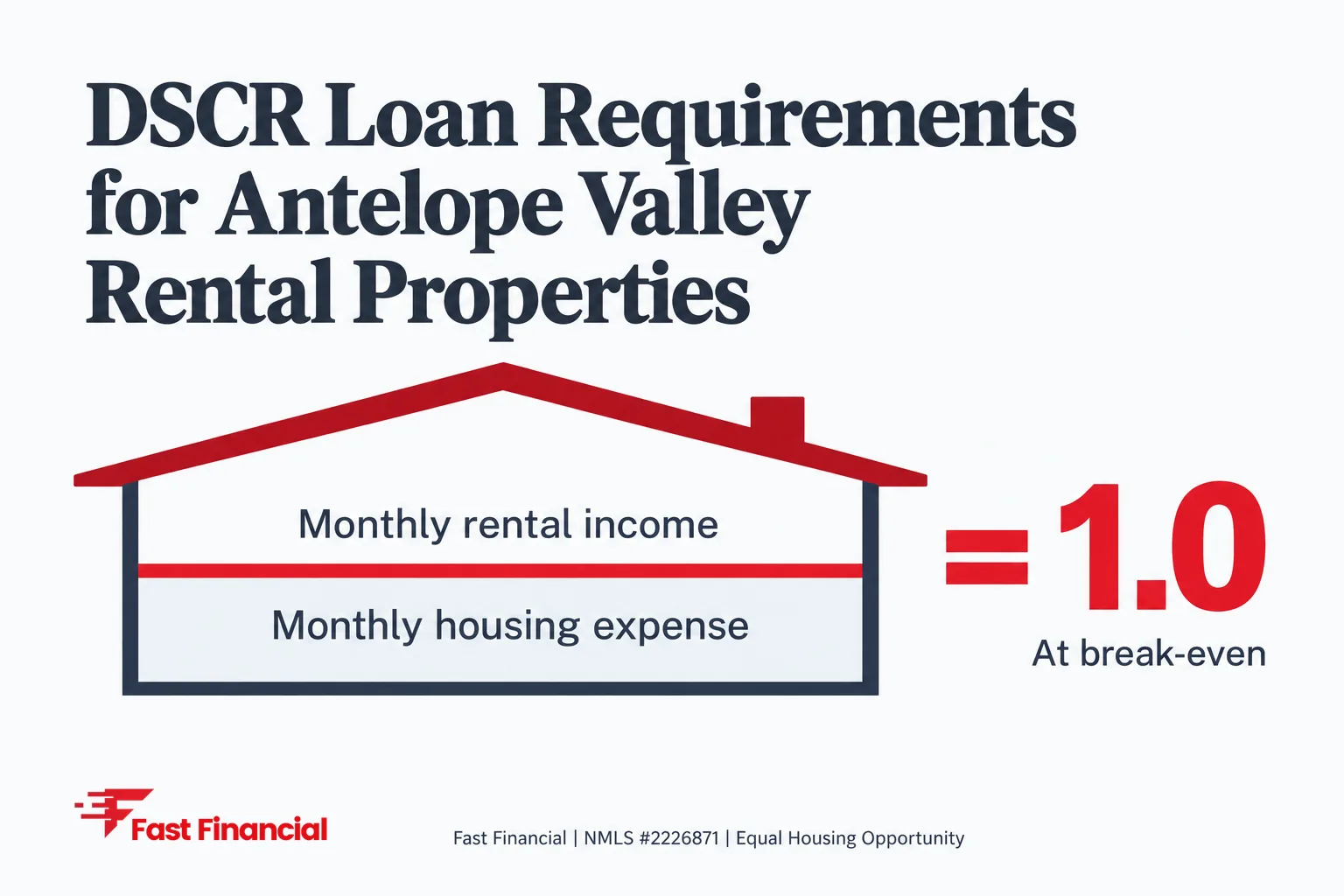
DSCR stands for Debt Service Coverage Ratio. The formula: monthly rental income divided by monthly housing expense (principal, interest, taxes, insurance, and HOA if applicable).
A ratio of 1.0 means the rent covers the payment exactly. Most lenders want to see something above 1.0 — commonly 1.1 or higher — because that cushion signals the property can carry itself through a vacancy month or an unexpected repair bill. Some programs will go below 1.0, but expect stricter requirements on credit score and reserves if you're in that range.
If you're newer to the product, our DSCR loans page for California walks through how these loans are structured, and this breakdown of what a DSCR loan is and who qualifies covers the basics before you start comparing lenders.
How Does the Lender Determine the Rental Income Figure?
Lenders use whichever is lower: the actual signed lease (if the property is already tenant-occupied) or the market rent from an appraiser's rent schedule — typically a Form 1007 for single-family or a Form 1025 for small multifamily.
You cannot self-report what you plan to charge. An appraiser independently determines what the property can realistically earn in the current market, and that number drives the DSCR calculation. In the Antelope Valley, where there's enough rental transaction volume to support reliable comparable rent analysis, this process is generally straightforward for stabilized properties in Lancaster and Palmdale.
What Credit Score Do DSCR Lenders Require?
Most DSCR programs set a minimum somewhere in the 620–680 range. In practice, you'll find more lender options, higher LTV allowances, and better overall terms as your score climbs above 700.
Your score affects how the loan is structured — not just whether it gets approved. Before you apply, it's worth knowing what credit score you need for a mortgage in California and where your profile currently lands.
What Are the LTV and Down Payment Requirements?
DSCR loans are non-QM products, and lenders price risk accordingly. Most programs cap LTV in the 70–80% range for single-family investment properties, which translates to a down payment in the 20–30% range at purchase. Cash-out refinances generally come with a slightly tighter LTV ceiling than purchase transactions.
LTV limits can compress when the DSCR ratio is near 1.0, when the borrower's credit score sits at the floor, or when the property type introduces additional complexity. The stronger your overall file, the more room you typically have.
For context on how investment property financing differs from primary-home programs, this comparison of primary vs. investment mortgages is useful background before you start running numbers.
What Property Types Qualify in the Antelope Valley?
Most DSCR lenders accept:
- Single-family residences — the dominant housing stock in Lancaster and Palmdale
- 2–4 unit properties — each unit's market rent factors into the total income calculation
- Condos — with review for warrantability
- Short-term rental properties — some lenders allow this; underwriting is typically based on long-term market rent unless documented short-term income meets their standard
What they don't finance: primary residences, land, commercial properties, or rural properties outside standard appraisal guidelines.
The Antelope Valley's heavily SFR inventory fits cleanly into DSCR underwriting. If you're looking at distressed or value-add properties as part of your acquisition strategy, distressed asset financing in California follows a different approval path worth understanding separately.
What Documents Do You Actually Need?
This is where DSCR loans earn their reputation for simplicity. You are not submitting:
- Two years of federal tax returns
- W-2s or employer verification letters
- Any personal income documentation
What you are submitting:
- The signed lease agreement (if the property is tenant-occupied)
- The appraisal with rent schedule (ordered through the lender)
- Bank statements showing reserves — most programs want 3–6 months of PITIA in liquid accounts
- Entity documents if you're purchasing in an LLC (most DSCR lenders allow LLC vesting — confirm upfront)
- Insurance binder confirming landlord/dwelling coverage
No employment verification. No debt-to-income calculation based on your W-2s. The property qualifies; you don't have to.
This is why DSCR pairs naturally with self-employed investors whose tax returns don't reflect actual cash flow. If personal income documentation is the friction point, here's how self-employed borrowers navigate the mortgage process in California. If you're based in the Antelope Valley and need an income-doc-light alternative, bank statement loans for Lancaster borrowers are worth comparing against DSCR before you commit to a program.
Why Antelope Valley Investors Are Using DSCR Right Now
The Antelope Valley's purchase prices remain meaningfully lower than coastal Los Angeles markets while rental demand — driven in part by the Edwards Air Force Base community, households priced out of the San Fernando Valley, and long-haul commuters — has kept vacancy tight. That combination often produces DSCR ratios that lenders find comfortable.
Investors scaling a portfolio use DSCR to keep their conventional loan slots available for primary or second-home purchases, since DSCR is underwritten entirely off the property rather than personal DTI. Investors who are also running fix-and-flip projects in the Antelope Valley frequently use DSCR for the hold phase once a rehab is complete and the property is stabilized.
DSCR sits within the broader non-QM lending universe. If you want to map out the full landscape before picking a program, this guide to non-QM mortgages covers every major product type in one place.
Ready to run your property through the numbers? See where you stand.
Frequently asked questions
Can I take out a DSCR loan in an LLC?
Yes — most DSCR lenders allow LLC vesting and many investors prefer it for liability separation. You'll need the entity's formation documents and operating agreement at closing. Confirm with your lender before you open escrow that their program supports non-individual title.
Do I need an existing tenant to qualify?
No. DSCR loans can be underwritten on a vacant property using the appraiser's market rent determination. You don't need an active lease or a rental history to qualify — the appraiser's comparable analysis substitutes for actual income.
Can I use a DSCR loan for a short-term rental property in Lancaster or Palmdale?
Some lenders allow it. Underwriting is typically based on long-term market rent (the conservative approach) unless you can document short-term income that meets the lender's standard. Not every DSCR program accepts short-term rentals, so confirm this specifically before you apply.
What if my DSCR ratio comes in below 1.0?
A sub-1.0 ratio means the rent doesn't fully cover the payment. Some lenders offer "no-ratio" DSCR programs or will accept a lower ratio with strong compensating factors — higher credit score, more reserves, larger down payment. Options exist, but the file gets closer scrutiny. Run your scenario by a broker before assuming you don't qualify.
Is a DSCR loan the right move for every Antelope Valley investor?
Not automatically. It depends on your credit profile, how the property cash-flows, and whether the non-QM rate structure makes sense relative to conventional alternatives. A broker who knows both conventional and non-QM can help you compare real options — not just the easiest one to place.
Fast Financial | NMLS #2226871 | Licensed in California | Rates, terms, and program availability vary by borrower qualification and market conditions. This article is for informational purposes only and does not constitute a loan offer or commitment. Equal Housing Opportunity.