
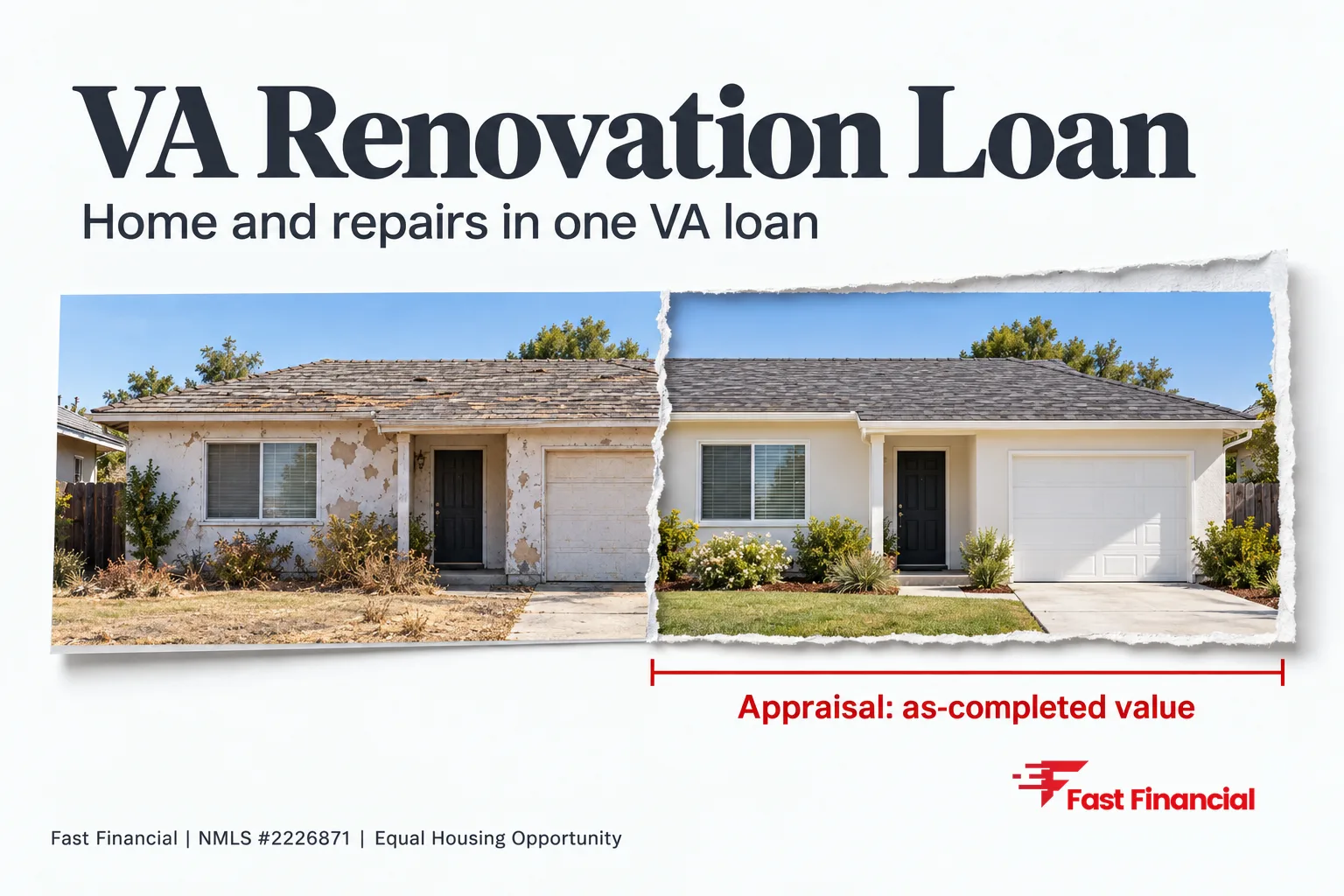
A VA renovation loan lets an eligible veteran, service member or surviving spouse finance a home and the repairs it needs in one VA-guaranteed mortgage. The appraisal is based on the home's value after the work is done, so you aren't limited to what the property is worth today.
That opens up homes a standard VA loan can't touch. It's also a niche product with its own rules, and only some lenders offer it. Here's how it works and how to tell whether it fits your plans.
What is a VA renovation loan?
It's a VA-guaranteed mortgage that rolls renovation costs into the loan amount. You can use it to buy a home that needs work or to refinance a home you already own and fix it up. You still get the core VA benefits: no monthly mortgage insurance, flexible credit standards and the VA guaranty behind the loan.
The key difference is the appraisal. A regular VA loan is appraised on the home's current condition. A VA renovation loan is appraised "as-completed," meaning the value the home will have once the planned repairs are finished.
Why would a veteran need a renovation loan instead of a regular VA loan?
Every VA loan has to meet the VA's Minimum Property Requirements (MPRs). The home has to be safe, structurally sound and sanitary. A bad roof, broken heating, peeling paint on an older home or faulty electrical can stop a standard VA purchase.
In practice, that means many fixer-uppers, estate sales and bank-owned homes are off the table with a regular VA loan. A renovation loan solves this by building the repairs into the financing, so the MPR problems get fixed as part of the deal. If you're looking at foreclosures or neglected properties, our guide to distressed asset financing in California covers how those deals usually look.
What repairs can you finance with a VA renovation loan?
The VA renovation loan is meant for repairs that make a home livable and keep its value. It's not meant for a luxury remodel. Here's how lenders usually sort the work:
| Usually allowed | Usually not allowed |
|---|---|
| Roof repair or replacement | Swimming pools and spas |
| HVAC, plumbing and electrical updates | Outdoor kitchens and fire pits |
| Kitchen and bathroom remodels | Luxury add-ons with no effect on livability |
| Flooring, windows and doors | Work the borrower does themselves (DIY) |
| Energy-efficiency upgrades | Major structural additions (varies by lender) |
| Accessibility changes | Tear-downs and new construction |
| Fixing MPR issues (paint, safety, water damage) | Anything a VA-registered contractor won't sign off on |
Each lender sets its own rules on top of the VA's. Some won't allow any structural work, like moving load-bearing walls or adding rooms, and others will. Get the lender's eligible-repair list before you fall in love with a scope of work.
How does the VA renovation loan process work?
These loans take more steps than a standard VA purchase. Here's the order:
- Confirm eligibility. Get your Certificate of Eligibility (COE) and a full pre-approval. Our walkthrough on VA loan pre-approval covers what to gather.
- Find the property. Tell your agent you're using renovation financing, because the offer and timeline need to account for it.
- Hire a qualified contractor. The contractor must be licensed and insured. Most lenders also require them to be registered with the VA or approved by the lender. In California, that means a valid CSLB license.
- Submit a detailed bid. The lender needs an itemized scope of work with costs, materials and a timeline.
- Appraisal and review. A VA-assigned appraiser estimates the as-completed value. Many lenders also send a consultant or inspector to review the bid.
- Underwriting and closing. The mortgage underwriter reviews you, the property and the renovation plan together. At closing, the renovation money goes into an escrow account instead of to you.
- Draws and inspections. The contractor is paid in stages as the work is checked and completed. A final inspection confirms the job is done.
The lender sets a deadline for finishing the work. Plan for it, and pick a contractor who can actually meet it.
Who can qualify for a VA renovation loan?
The borrower requirements mostly match a standard VA loan. You need VA eligibility, enough steady income to cover the new payment, an acceptable debt-to-income ratio (DTI) and credit that meets the lender's minimum. Lender credit minimums vary. Our breakdown of the minimum credit score for a VA loan explains how lenders set those floors.
What lenders actually look at more closely here is the renovation itself. The bid has to be realistic and the contractor has to be qualified. The as-completed value also has to support the full loan amount. If the appraisal comes in low, you may need to cut the scope or pay the difference.
The home also has to be your primary residence. VA renovation loans can't be used for investment properties. If you're renovating a rental, you'd look at options like DSCR loans in California instead.
Why is it hard to find VA renovation loan lenders?
Lenders have to manage contractors, draw schedules, inspections and the risk that a project stalls. Many decide it's not worth the extra work and simply don't offer the product. Others offer it with tight overlays that rule out a lot of projects.
That's where a broker helps. Fast Financial can compare lenders that actually close VA renovation loans and match your project to the one whose rules fit your scope. One lender may say no to a project another approves. Shopping lenders is part of the job.
What are the alternatives to a VA renovation loan?
A VA renovation loan isn't always the right tool. Compare it with these options:
| Option | Best for |
|---|---|
| VA renovation loan | Buying or refinancing a primary home that needs real repairs |
| VA cash-out refinance | Owners with equity who want flexibility in how they use funds |
| VA Energy Efficient Mortgage (EEM) | Adding efficiency upgrades like solar, insulation or windows |
| VA Specially Adapted Housing (SAH) grant | Eligible veterans with qualifying service-connected disabilities making accessibility changes |
| Fannie Mae HomeStyle renovation | Borrowers who want more freedom in what they renovate |
| FHA 203(k) | Borrowers without VA eligibility |
If you already have equity, a cash-out refinance can be simpler. There's no contractor registration and no draw schedule, but approval depends on your equity and your full financial picture. If you're weighing VA against FHA altogether, read FHA vs VA loan first.
Does the VA funding fee apply to a renovation loan?
Yes. The VA funding fee applies as it does on any VA loan, and the amount depends on your loan type, prior VA use and down payment. Veterans who receive VA compensation for a service-connected disability are generally exempt. Your Loan Estimate will show whether the fee applies to you and how it's being paid.
Is a VA renovation loan worth it in California?
In much of California, move-in-ready homes sell fast and at a premium. Older homes that need work often draw fewer offers. A renovation loan lets a veteran compete for those homes, fix them up and build value without paying for repairs out of savings.
That matters in the Antelope Valley, where many buyers are military families tied to Edwards AFB. If that's you, our VA loan guide for Edwards Air Force Base homebuyers covers the local side. The tradeoff is time and paperwork. If you need to close fast or don't want to manage a contractor, a move-in-ready home with a standard VA loan may be the better choice.
Frequently asked questions
Can I do the renovation work myself with a VA renovation loan?
Generally, no. VA renovation loans require a licensed, insured contractor, and most lenders also require that contractor to be VA-registered or lender-approved. DIY labor isn't financed.
Can I use a VA renovation loan to refinance my current home?
Yes, some lenders offer VA renovation financing on a refinance as well as a purchase. The home must be your primary residence, and the as-completed value has to support the new loan amount.
What happens if the renovation costs more than the bid?
Many lenders build a contingency reserve into the loan for unexpected costs. Costs beyond that reserve are typically your responsibility, which is why a detailed, realistic bid matters up front.
Do all VA lenders offer renovation loans?
No. Many VA lenders don't offer renovation financing at all, and those that do set their own overlays. Working with a broker who can compare several VA renovation loan lenders improves your chances of finding one that fits your project.
Can I buy a fixer-upper with a VA loan without a renovation loan?
Only if the home already meets VA Minimum Property Requirements, or the seller makes the required repairs before closing. If the home fails MPRs and the seller won't fix them, renovation financing is usually the route.
See where you stand. Every VA renovation deal depends on the property, the contractor and your full financial picture, and rates and terms vary by borrower and market. Fast Financial (NMLS #2226871) will review your eligibility, your project scope and which lenders fit it. Get your rate reviewed, call us at (661) 512-4141, or visit our office at 190 Sierra Ct Ste 324, Palmdale, CA 93550. Equal Housing Opportunity.