
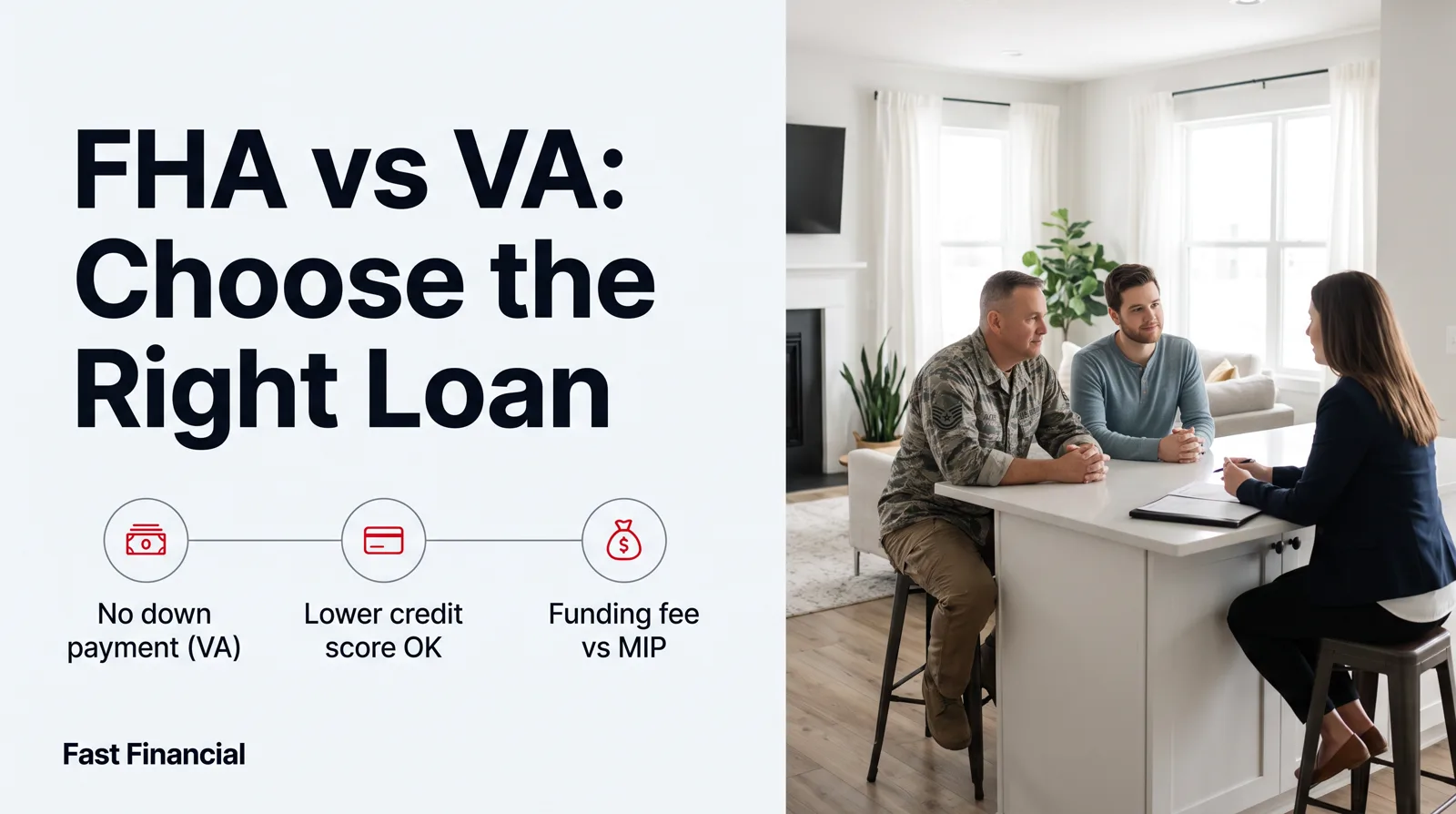
If you're VA-eligible, the VA loan wins almost every time — no down payment, no ongoing mortgage insurance, and terms that are hard to beat. FHA exists for everyone else who needs a lower barrier to entry than conventional financing allows.
That's the short answer. Here's what actually drives the decision.
Who qualifies for each loan?
VA loans are available to veterans, active-duty service members, National Guard and Reserve members who meet service requirements, and eligible surviving spouses. Eligibility is confirmed through a Certificate of Eligibility (COE) issued by the Department of Veterans Affairs — without it, the loan doesn't move forward.
FHA loans have no military service requirement. Any borrower who meets the credit and income guidelines can apply — first-time buyers, repeat buyers, or anyone who can't qualify for conventional financing. That open eligibility is FHA's biggest structural advantage over VA.
If you're stationed at or transitioning out near Edwards Air Force Base, the VA loan guide for Edwards AFB homebuyers covers the details specific to that situation before you default to FHA.
Do I need a down payment?
This is where the two programs diverge most sharply.
VA loans allow eligible borrowers with full entitlement to purchase with no down payment at all. In California, where home prices make accumulating a down payment one of the biggest obstacles to buying, that's a serious structural edge.
FHA loans require a minimum down payment, with the floor set by HUD based on the borrower's credit score — lower scores require a higher down payment percentage. The mortgage calculators can help you model what different down payment scenarios look like for a target purchase price.
For buyers who are not VA-eligible and haven't built up significant savings, first-time homebuyer programs in the Antelope Valley may offer down payment assistance that stacks with FHA financing and closes that gap.
Mortgage insurance vs the VA funding fee
This cost difference is the one borrowers most consistently underestimate.
FHA borrowers pay mortgage insurance premium (MIP) — an upfront premium at closing plus an annual premium rolled into the monthly payment. Unlike conventional PMI, MIP on most FHA loans does not drop off automatically as you build equity. For borrowers who hold their loan long-term, that ongoing cost adds up meaningfully. This guide on mortgage insurance explains how MIP is structured and when it ends.
VA borrowers pay a funding fee — a one-time charge at closing that can be financed into the loan balance. The amount varies based on down payment and whether it's the borrower's first or subsequent use of the VA benefit. Some veterans with service-connected disability ratings are exempt from the fee entirely.
The math is simple: MIP compounds every month for years; the VA funding fee is a single fixed cost. Most borrowers who hold the loan more than a few years come out ahead with VA on a total-cost basis.
What credit score do I need?
Both programs are more accessible than conventional loans on the credit side, but they're not identical.
FHA is explicitly built for borrowers with credit challenges. HUD's published minimums are lower than what most conventional programs allow, though individual lenders often add their own overlays on top of HUD's baseline. If you're not sure where your credit profile lands, here's what lenders actually look at in California.
VA doesn't publish a hard minimum credit score — the VA guarantees the loan but lets participating lenders set their own thresholds. In practice, most VA lenders want to see a meaningful FICO score, but the government guaranty behind the loan reduces lender risk, which typically means more flexibility on the qualifying side overall.
FHA and VA appraisals: What's different?
Both loan types require an appraisal that goes beyond market value — and both are stricter than what a conventional appraisal requires. But the standards differ.
FHA appraisals evaluate the property against HUD's Minimum Property Standards (MPS). Appraisers check for health and safety issues: working utilities, structural soundness, adequate heating, and no peeling paint in homes built before 1978. Any condition deficiencies flagged in the appraisal must be resolved before closing. How FHA appraisals work in practice is worth reading before you make an offer on anything that isn't move-in ready.
VA appraisals use VA Minimum Property Requirements (MPRs), which overlap significantly with FHA standards. VA appraisers are assigned directly through the VA rather than selected by the lender. They also assess "remaining economic life" — the property needs a serviceable life consistent with the loan term. VA tends to be especially cautious on deferred maintenance and properties with functional issues.
The practical takeaway: both programs have limits on what properties qualify. If you're eyeing a distressed property or a fixer, FHA and VA both have constraints you should understand upfront.
Which loan should I choose?
Here's the decision tree:
- VA-eligible, buying a primary residence? Start with VA. The no-down-payment structure and absence of ongoing MIP make it the structurally superior product in most scenarios.
- Not VA-eligible? FHA is the likely path if conventional financing requires more down payment or credit than you currently have.
- VA-eligible but comparing all three options? VA vs FHA vs conventional is a different analysis — the right answer depends on your credit, how much you're putting down, your loan size, and how long you plan to hold the loan.
- Already have an FHA loan? If you're now VA-eligible or want to eliminate MIP, a refinance into a VA loan may make sense. Explore refinance options here.
Whatever the program, the numbers only get real when you run them against your actual scenario. Get your rate reviewed to see where you stand.
Frequently asked questions
Can a veteran use FHA instead of VA?
Yes — VA eligibility doesn't obligate you to use a VA loan. Some veterans choose FHA or conventional, particularly if their VA entitlement has been used and not yet restored, or if a specific property doesn't meet VA MPRs. That said, most VA-eligible borrowers benefit from starting with the VA program.
Is VA always cheaper than FHA?
In most scenarios, yes — over the life of the loan. The VA funding fee is a real upfront cost, but it's finite. FHA MIP continues monthly for most borrowers unless they refinance out of the program. The longer you hold the loan, the wider that gap becomes.
Do both loans require owner-occupancy?
Yes. Neither FHA nor VA financing is available for investment properties or second homes — both programs require the borrower to occupy the property as a primary residence. If you're financing a rental or investment property, DSCR loans in California are the right tool.
What's the VA funding fee exemption?
Veterans with a service-connected disability rating from the VA are typically exempt from paying the funding fee. Surviving spouses of veterans who died in service or from a service-connected disability may also qualify for the exemption. The exemption is confirmed through the COE process — it's not self-certified.
Can I refinance from FHA into a VA loan?
Yes, if you have VA eligibility. This is sometimes a deliberate strategy: use FHA when you need the flexibility at purchase, then refinance into VA later to eliminate MIP. Whether it makes financial sense depends on your current loan balance, the funding fee, and how long you plan to stay in the home — a broker can model the break-even for your situation.
Fast Financial — NMLS #2226871 — Licensed in California. Loan programs, eligibility requirements, and terms vary by borrower and are subject to change. Nothing in this article constitutes a commitment to lend or a guarantee of approval.