
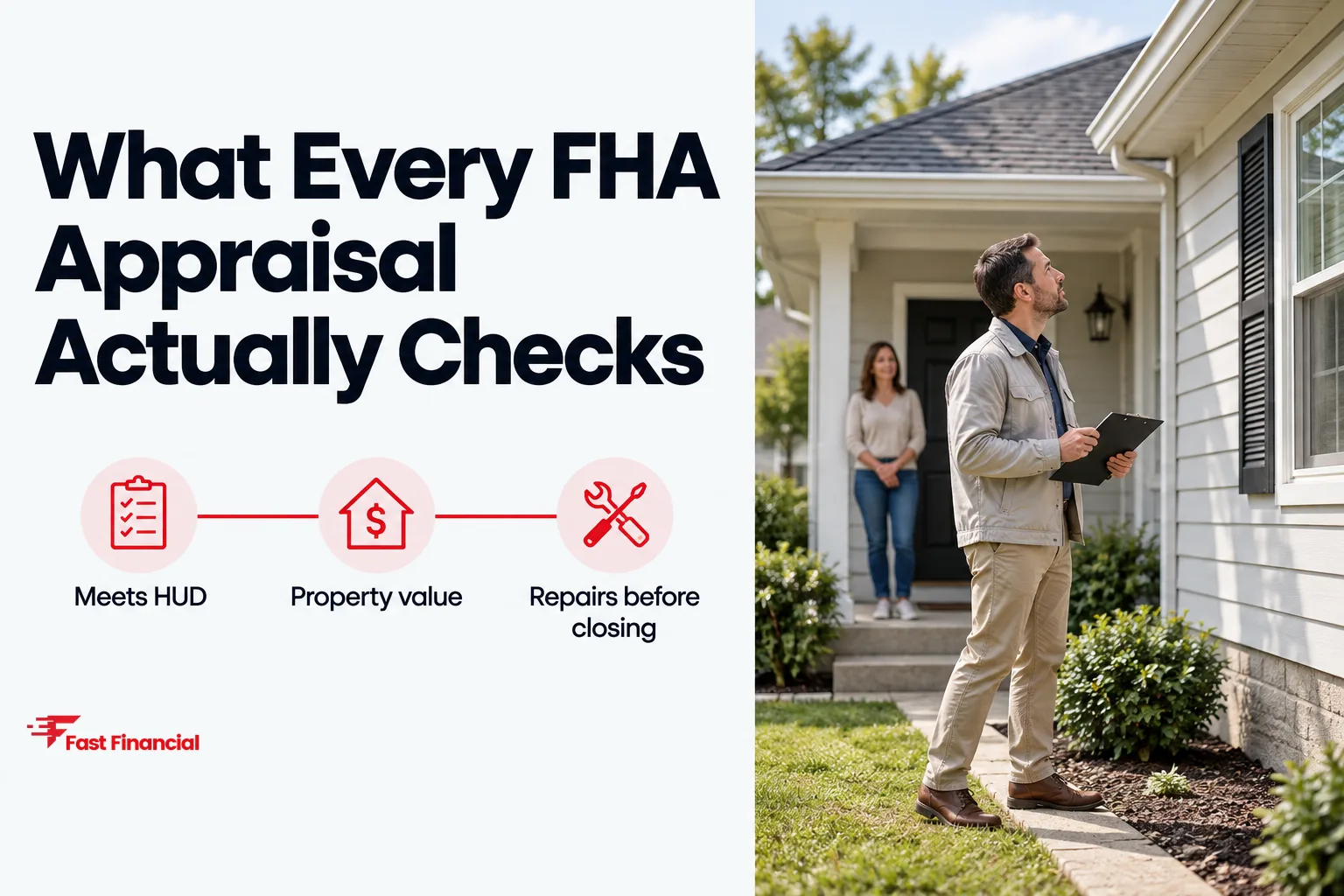
An FHA appraisal does two jobs. It sets the home's market value, and it confirms the property meets HUD's minimum standards for safety, security and soundness. A conventional appraisal mostly cares about value. An FHA appraisal also looks at the condition of the house, and that second job is where most FHA deals hit trouble.
This guide covers what the appraiser actually checks, which repairs come up most often, and what to do if the number comes in low.
Who orders the FHA appraisal, and who does it?
Your lender orders it. You don't pick the appraiser and neither does the seller. The appraiser has to be state-certified and on HUD's FHA Appraiser Roster, and they're assigned through a process meant to keep them independent of the loan officer and the agents.
You usually pay the fee upfront or at closing. The appraisal is tied to the FHA case number, not to you, so it stays with the property for as long as it's valid. That has two effects. If you change FHA lenders partway through, the appraisal generally goes with the case. If the deal falls apart, the next FHA buyer on that house will probably see the same report and the same repair conditions.
What does an FHA appraiser look at?
Value is the first piece. The appraiser compares the home with recent nearby sales of similar properties and adjusts for size, condition, lot and features, the same way any appraisal works.
The second piece is HUD's Minimum Property Requirements and Minimum Property Standards, laid out in HUD Handbook 4000.1. The question isn't whether the home is pretty. It's whether the home is safe, sound and secure for someone to live in. In practice, the appraiser walks the property looking at:
- Roof: it has to keep moisture out and have reasonable remaining life. Active leaks or badly worn roofing get flagged.
- Foundation and structure: no significant settlement, structural cracks or water intrusion that threatens the building.
- Utilities and systems: heat, water and electricity must be on and working. The appraiser checks for adequate heating, safe electrical (no exposed or hanging wiring), and a working water heater.
- Paint on older homes: in homes built before 1978, any chipped or peeling paint is treated as a possible lead-based paint hazard and has to be fixed.
- Access: the appraiser needs to see into the attic and crawl space, and each living unit needs its own access without going through another unit.
- Health and safety hazards: broken windows, trip hazards, missing doors, standing water, excessive debris, or anything else a reasonable person would call unsafe.
- Pests: a separate wood-destroying insect inspection is no longer automatic. If the appraiser sees signs of active infestation, or local practice calls for one, it becomes a condition.
The appraiser also confirms the site is usable: legal access to the property, and wells or septic systems where they apply. California also has its own requirements at sale, like water heater strapping and smoke and carbon monoxide detectors. Those generally have to be met anyway, so plan for them.
What are the most common FHA repair flags?
Most required repairs are small. In Antelope Valley and Los Angeles County resale homes, these come up again and again:
| Common flag | Why it gets called out | Typical fix |
|---|---|---|
| Peeling exterior or interior paint (pre-1978 home) | Possible lead hazard | Scrape and repaint using lead-safe practices |
| Roof leaks or heavy wear | Moisture and remaining life | Repair, or replace if needed |
| Exposed or ungrounded wiring | Safety | Licensed electrical correction |
| Inoperable heat or water heater | Basic habitability | Repair or replace the unit |
| Broken windows or missing doors | Security and weather | Replace the glass or the door |
| Blocked attic or crawl space access | Appraiser couldn't inspect | Clear the access and re-inspect |
| Debris, junk vehicles or hazards on the lot | Safety | Clean up |
Here's how it usually goes. The appraiser notes the issue and makes the appraisal "subject to" the repair. Someone, usually the seller, fixes it before closing. Then the appraiser or another inspector comes back to confirm the work was done, which is often a quick re-inspection. Who pays for repairs is negotiable between buyer and seller, so settle that early.
Some homes need more than a punch list: failing systems, major deferred maintenance. A standard FHA loan isn't built for that. An FHA 203(k) loan can roll the renovation cost into one mortgage, and it's often the better tool for a fixer.
Is an FHA appraisal the same as a home inspection?
No, and this is the mistake buyers make most often. The appraiser is protecting the lender and HUD. They aren't testing every outlet, running the dishwasher or scoping the sewer line. HUD even gives FHA buyers a disclosure titled For Your Protection: Get a Home Inspection to make that point.
Get a separate home inspection, and set your inspection contingency up so you have time to act on what it finds. Our guide to how contingencies work when buying a home explains how the appraisal and inspection contingencies fit together in a California purchase contract.
What happens if the FHA appraisal comes in low?
FHA loan amounts are based on the lower of the purchase price or the appraised value. If the appraisal comes in below your contract price, the lender won't cover the gap. You have four realistic options:
- Renegotiate the price. Ask the seller to come down to the appraised value or meet you partway. A low FHA appraisal is real leverage, because the next FHA buyer will probably see the same number.
- Cover the difference in cash. You can pay the gap out of pocket. This is a judgment call, so make sure you're comfortable with the price you're paying against what the home appraised for.
- Request a Reconsideration of Value (ROV). If the appraiser missed relevant comparable sales or got a fact wrong, like square footage, bedroom count or an upgrade, your lender can submit an ROV. HUD's current rules give borrowers a formal path to request one, with supporting comps and a clear explanation. An ROV isn't an appeal of opinion. It's a correction backed by evidence.
- Walk away. Most FHA purchase contracts include the FHA amendatory clause (HUD exempts some sales, such as certain REO and agency sales). It says you're not obligated to complete the purchase, or forfeit your earnest money, if the appraised value is below the sales price. You can still choose to go ahead if you want.
The best route depends on how far apart the numbers are, how competitive the market is, and how much cash you have. That's worth talking through with your loan officer before you answer the seller.
Does the appraisal affect FHA underwriting?
Yes. The underwriter reviews the appraisal along with your income, credit and assets. They confirm the value supports the loan, repair conditions are cleared and the report meets HUD standards, and can ask the appraiser to revise anything unclear.
That's also why an appraisal problem can push your closing date. Repairs, re-inspections and ROVs all take time, so build some cushion into your contract timeline.
How can I prepare for an FHA appraisal?
Here's how to give the house its best shot:
- Ask for the seller's disclosures early and look for anything that might be an FHA issue: roof age, older paint, unpermitted additions.
- Make sure the utilities are on for the appraisal visit. A home with the water or gas shut off can't be fully evaluated.
- Clear attic and crawl space access so the appraiser can actually get in.
- Gather recent upgrades and permits so your agent can give the appraiser comps and documentation.
- Talk about repairs before you write the offer. If the house clearly needs work, decide up front whether FHA is the right fit or whether a conventional loan would be a better match.
Check whether you qualify with our FHA mortgage requirements guide. Antelope Valley first-time buyers can also pair FHA with local homebuyer programs.
Get your FHA deal reviewed before the appraiser shows up
Fast Financial helps California borrowers structure FHA purchases so the appraisal is a checkpoint and not a surprise. We'll look at the property, flag likely repair issues, and walk you through your options if the value comes in short. Terms and approval depend on your full financial picture and the property.
Get a rate quote, call (661) 512-4141, or stop by our Antelope Valley office at 190 Sierra Ct Ste 324, Palmdale, CA 93550. Fast Financial is a California-licensed mortgage broker, NMLS #2226871. Equal Housing Opportunity.
Frequently asked questions
How long is an FHA appraisal valid?
An FHA appraisal has a set validity period tied to its effective date. HUD allows an update in some cases if closing runs past that window. Your lender will confirm the exact expiration on your file.
Who pays for FHA-required repairs?
It's negotiable. Sellers often handle them because the work has to be done before closing, but buyers and sellers can agree to split the cost or adjust the price.
Can I use a different appraiser if I don't like the FHA appraisal?
Usually not. The appraisal stays with the FHA case number, so switching lenders generally doesn't get you a fresh appraisal. The proper route for factual errors or missed comps is a Reconsideration of Value through your lender.
Does an FHA appraisal require a termite inspection?
Not automatically. One is required when the appraiser sees evidence of wood-destroying insects or when local practice calls for it.
Can I back out if the FHA appraisal is low?
In most cases, yes. The FHA amendatory clause lets you cancel without losing your earnest money if the appraised value is below the purchase price. You can also choose to go ahead.