
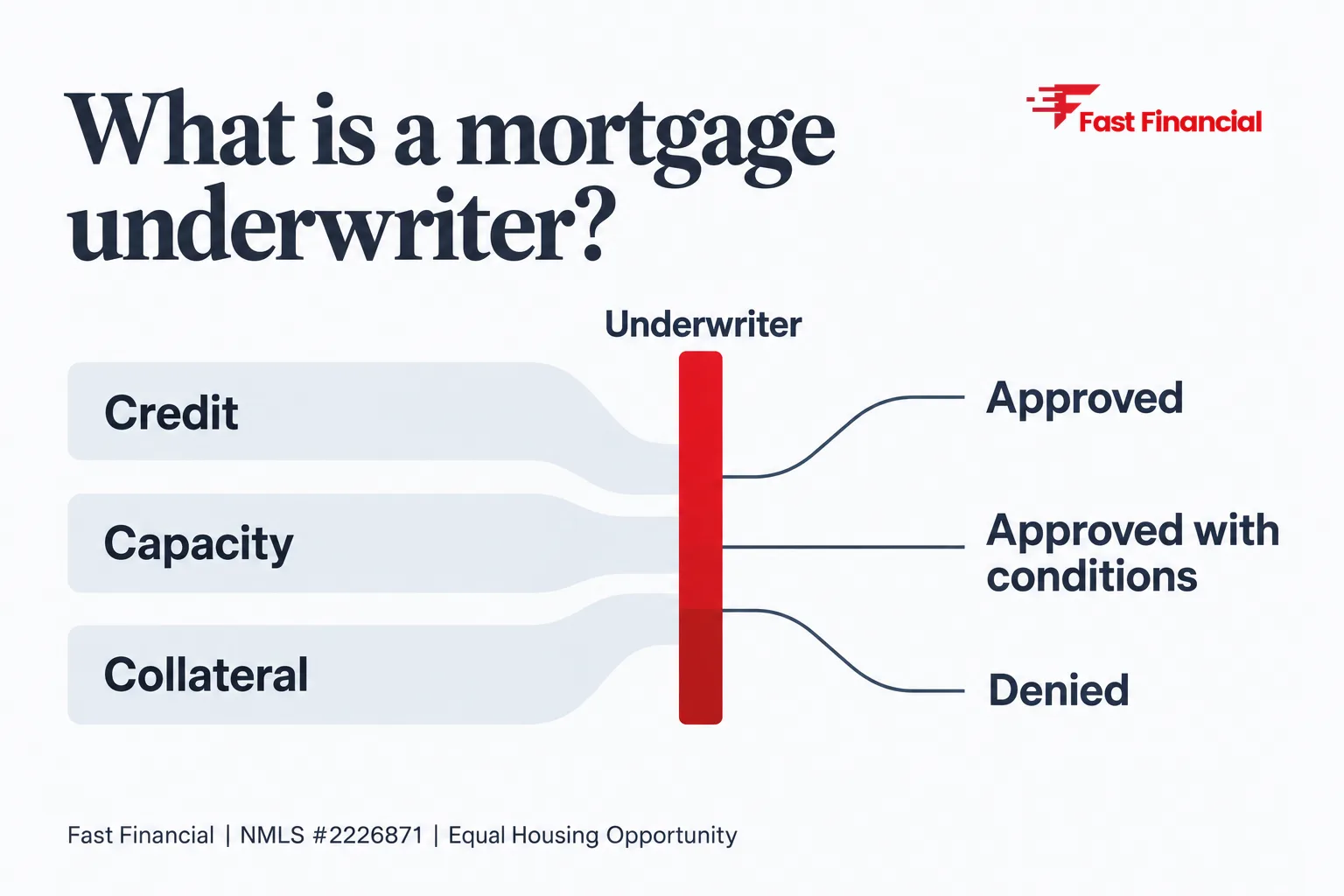
An underwriter is the lender's risk analyst — the person who reviews your entire loan file and makes the final call: approved, denied, or approved with conditions. Understanding what they do puts you in a stronger position before you ever submit an application.
What Does a Mortgage Underwriter Actually Do?
The underwriter's job is to answer one question: Is this loan a safe bet for the lender?
They do that by verifying everything in your file against the loan program's guidelines — income, assets, credit history, employment, and the property itself. They're not trying to disqualify you. They're confirming the numbers support the loan.
In practice, underwriting runs through what the industry calls the "Three Cs":
- Credit — your history of paying debts, your score, any derogatory marks
- Capacity — your ability to repay (income, employment, debt-to-income ratio)
- Collateral — the property value and condition, confirmed by the appraisal
Every loan program — conventional, FHA, VA, DSCR, non-QM — has its own set of guidelines. The underwriter's job is to confirm your file meets them, line by line.
Who Does the Underwriting — a Person or a Computer?
Both, usually — and in that order.
Most lenders run your application through an Automated Underwriting System (AUS) first. Fannie Mae's system is called Desktop Underwriter (DU). Freddie Mac's is Loan Product Advisor (LPA). These systems pull your credit, assess income and asset data, and issue a preliminary finding.
An "Approve/Eligible" finding speeds things up considerably. But a human underwriter still reviews the full file — they're working with a green light from the system, not skipping the review.
If the AUS returns a "Refer" — or you're in a loan program that doesn't use AUS at all, such as some jumbo or non-QM products — the file goes to manual underwriting. A human reviews everything from scratch. That takes longer and requires more documentation, but it's not a dead end, especially for borrowers with strong compensating factors.
What Does an Underwriter Look at in Detail?
Income and employment
For W-2 borrowers, underwriters want a consistent two-year employment history. Pay stubs, W-2s, and tax returns are standard. Gaps in employment or a recent job change attract more scrutiny.
For self-employed borrowers, the review gets more nuanced. Underwriters typically average two years of net income from tax returns. If your income fluctuated or write-offs are heavy, that can compress your qualifying income significantly. This is one reason bank statement loans exist — they allow the underwriter to use deposit history rather than tax returns to assess income.
Credit
The underwriter reviews your full credit report, not just the score. Late payments, collections, charge-offs, bankruptcies — these get documented and explained. How your credit profile translates to mortgage qualification is worth understanding before you apply, because the underwriter is reading more than a number.
Assets
Where is your down payment coming from? The underwriter verifies that funds are seasoned — typically sitting in your account for at least 60 days — and sourced from acceptable origins. Gift funds follow their own documentation rules.
The property
The appraisal is the underwriter's primary tool for evaluating collateral. They confirm the appraised value supports the loan amount and that the property meets the loan program's condition requirements. FHA and VA carry stricter property standards than conventional — the underwriter checks all of them.
What Is a Conditional Approval?
"Conditionally approved" is not a rejection. It's the most common outcome of underwriting, and it means the underwriter is ready to approve the loan — once you provide a few outstanding items.
Those items are called "conditions." They might be a letter of explanation for an employment gap, proof that a collection account was paid, an updated pay stub, or a clarifying page from the appraisal. You clear the conditions, the file moves to final approval — also called "clear to close."
A strong mortgage pre-approval process surfaces many of these issues before you're in contract, so you're not scrambling during escrow. The more organized your documentation going in, the fewer conditions come back.
How Long Does Underwriting Take?
It depends on the lender, loan type, and how complete your file is when it arrives.
A well-prepared file with clean documentation can move through underwriting in a few business days. Complex files — self-employed income, properties with condition issues, jumbo loan requirements — can take longer. High lender volume adds time on top of that.
The fastest underwriting happens when the file arrives complete. Missing documents, unsigned forms, and unexplained items create back-and-forth that eats days. If closing speed matters, fast-close lending starts with preparation on the borrower's side.
What Causes a Denial in Underwriting?
The most common reasons a loan gets denied at underwriting:
- DTI too high — monthly obligations exceed what the program allows relative to income
- Credit score below program minimum — knowing where your score lands before you apply is the move
- Appraisal shortfall — the property didn't support the loan amount
- Property condition — failed to meet the loan program's standards
- Income documentation gaps — can't fully support the income stated on the application
- Undisclosed new liabilities — a credit account opened after pre-approval that changed the debt picture
Most of these are fixable — sometimes immediately, sometimes after a few months of cleanup. A denial is data, not a permanent verdict.
Does the Underwriter Talk to the Borrower Directly?
No. The underwriter works behind the scenes and communicates with your loan officer or processor — who then relays conditions and questions to you.
If you're working with a California mortgage broker, your broker serves as your advocate at this stage, helping you respond to conditions accurately and quickly. The goal is fewer round-trips, faster close.
Frequently asked questions
What's the difference between a loan officer and an underwriter?
The loan officer takes your application, structures the loan, and is your main point of contact throughout the process. The underwriter works independently on the back end to verify the file and make the final approval decision. They serve different roles — your loan officer works with you; the underwriter works on your file.
Can an underwriter reverse an approval?
Yes. If new information surfaces after the initial approval — a new debt, a job change, a revised appraisal — the underwriter can revise or rescind the approval. This is why lenders advise against opening new credit accounts or making large financial moves between pre-approval and closing.
What does it mean when my loan is "in underwriting"?
It means the underwriter is actively reviewing your file. This is a normal, expected stage — not a red flag. The typical next step is either a conditional approval (with a list of items to clear) or a clear to close.
Do underwriters look at investment property loans differently?
Yes. For DSCR loans in California, the underwriter evaluates the property's rental income relative to the loan payment — not your personal W-2 income. It's a framework built for real estate investors where the property's cash flow does the qualifying work. The Three Cs still apply, but "capacity" is measured by the deal, not the borrower's salary.
What can I do to make underwriting go faster?
Get your documents organized before you apply: two years of tax returns and W-2s, two months of bank statements, a current pay stub, and a government-issued ID. Respond to any conditions your loan officer sends within 24 hours. Avoid opening new credit or changing jobs mid-process. Clean files move fast; incomplete files stall.
Fast Financial | NMLS #2226871 | Licensed in California | Equal Housing Opportunity
Loan terms and approval decisions vary based on creditworthiness, loan type, property, and market conditions. Nothing in this article constitutes a commitment to lend.