
In Los Angeles County, the conforming loan limit only gets you so far — and given what homes cost here, that ceiling comes up fast. Any loan above the FHFA's annual limit for the area steps into jumbo territory, and the underwriting rules change. Here's what you need to qualify in 2026.
What makes a loan "jumbo" in Los Angeles County?
Los Angeles County is a federally designated high-cost area, which means it gets a conforming loan limit well above the national baseline. The FHFA resets that ceiling each November based on home price data. For 2026, the LA County limit sits in the seven-figure range — but one dollar over it puts you in jumbo territory.
The key difference: a jumbo loan has no government backing. Fannie Mae and Freddie Mac won't buy it, so the lender holds it in portfolio or sells it to private investors. That shift in risk is exactly why jumbo guidelines run stricter than conforming ones.
What credit score do you need for a jumbo loan?
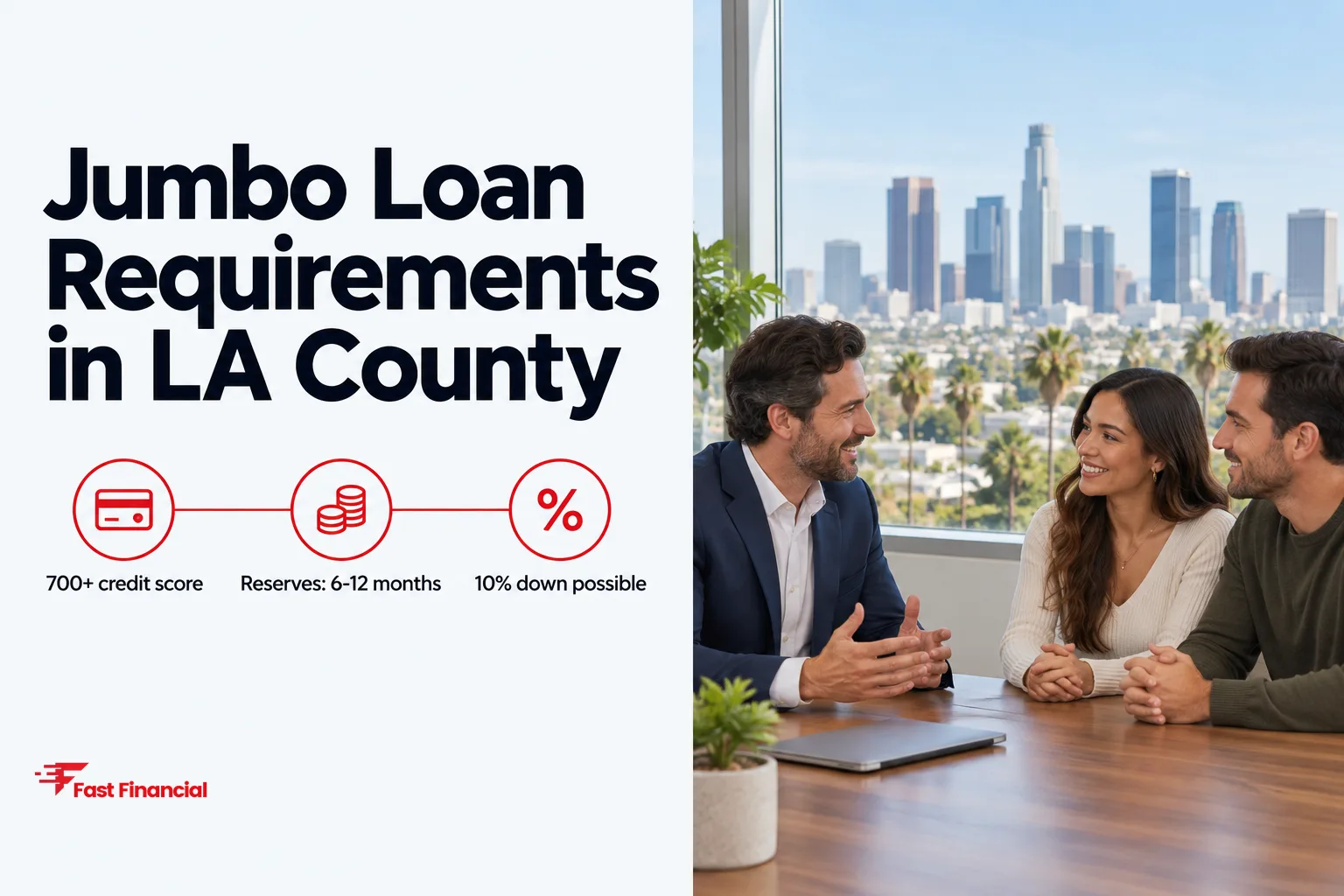
Most jumbo lenders require a 700 minimum, and a 720 or higher unlocks better pricing tiers. Some portfolio lenders will go to 680 with strong compensating factors — more reserves, larger down payment — but that's the exception.
The number that matters is your middle score across all three bureaus. One thin tradeline or recent late payment can sink an otherwise strong file. Pull your full report before you start. If you're sitting at 695, a few targeted paydowns might be the move that puts you over the threshold.
How much down payment does a jumbo loan require?
The floor on most jumbo products is 10%, but lenders price their best terms at 20% down. In LA County where purchase prices regularly push past $1.5M, that gap is significant — we're talking $150K versus $300K out of pocket on the same property.
Some lenders offer 5% down jumbo programs, but those come with tighter credit floors and often mortgage insurance layered in. The cleanest execution in 2026 is still 20% down with documented reserves and a 720+ score. If you're not there yet, it's worth mapping out which lever moves first.
What does your DTI need to be?
Debt-to-income ratio for jumbo loans typically caps at 43–45%. A handful of portfolio lenders will stretch to 49% on ultra-high-credit files, but that's a niche call — not the norm.
The math: add your proposed housing payment (PITI — principal, interest, taxes, insurance) to all monthly debt obligations (car, cards, student loans), then divide by gross monthly income. If that number is above 45%, the file needs restructuring before it goes anywhere. Income, down payment, or paying off a debt are the levers.
How many months of reserves do jumbo lenders require?
This is where jumbo loans show their teeth. A conforming loan might ask for 2 months of PITI in reserves. Jumbo lenders typically want 6–12 months, and some go higher on loan amounts above $2M.
Reserves have to be verified and documented — bank statements, brokerage accounts, vested 401(k) funds. Gift funds generally don't count. If your net worth is mostly tied up in equity or a business rather than liquid accounts, that's a conversation to have early so we can structure around it.
How does the jumbo approval process differ from conforming?
A few ways that matter to your timeline and prep:
Documentation is heavier. Two years of W-2s and tax returns is baseline. Self-employed borrowers typically need a CPA-prepared P&L plus 24 months of business and personal returns.
Two appraisals are common on larger loan amounts. Lenders protecting a $2M+ position want a second opinion on value. Budget for it and build it into your contract timeline.
Underwriting is mostly manual. There's no automated system rubber-stamping a jumbo file. Clean, organized packages move faster. Unexplained deposits, income gaps, or inconsistent returns slow everything down.
Overlays vary by lender. Unlike conforming loans governed by Fannie/Freddie rules, every jumbo lender sets its own guidelines. One shop caps DTI at 43%; another allows 45%. Shopping your scenario is how you find the right fit — not just the best rate.
Can self-employed borrowers qualify for a jumbo loan in LA?
Yes, and LA County has no shortage of self-employed buyers — business owners, entertainers, contractors, freelancers. The path is documenting income the way the lender wants to see it, which usually means two years of consistent income across personal and business returns.
If aggressive write-offs push your adjusted gross income well below your actual cash flow, bank statement programs are worth a look. These are non-QM products that underwrite on 12–24 months of deposits rather than tax returns. They're commonly paired with jumbo loan amounts for high-income self-employed buyers where traditional documentation doesn't tell the full story.
If you're buying in Los Angeles County and your loan amount is pushing into jumbo territory, get your scenario reviewed before you're under contract. Fast Financial (NMLS #2226871) works with jumbo borrowers across California — see where your file stands before the clock is running.
Frequently asked questions
Can I get a jumbo loan with 10% down?
Yes, some lenders offer jumbo products at 10% down, but expect stricter credit requirements and potentially mortgage insurance. The cleanest path — best pricing, fewest overlays — is still 20% down with documented reserves and strong credit.
Are jumbo loan rates higher than conforming rates?
Not necessarily. The spread between jumbo and conforming rates has narrowed considerably in recent years, and depending on loan amount and borrower profile, jumbo rates can be competitive with — or even below — conforming. The only way to know where you stand is to get your scenario quoted.
Do all jumbo lenders require two appraisals?
Not all, but it's common above $2M. Below that threshold, many lenders are comfortable with a single appraisal. Confirm with your lender early so it doesn't catch your timeline off guard.
What if my loan amount is just barely above the conforming limit?
It's worth running the math both ways. Increasing your down payment to stay under the conforming limit can sometimes make more sense than going jumbo by a small margin — more lender competition, easier underwriting, often less friction. Ask your broker to model both scenarios before you commit.
Can I use rental income to qualify for a jumbo loan?
Potentially, but standard jumbo loans underwrite on personal income. If you want to qualify primarily on rental cash flow, that's DSCR loan territory — a separate non-QM product with its own underwriting criteria. Both exist; the right one depends on your income structure and the property type.