
Jumbo financing in Los Angeles works differently for high-net-worth borrowers — and in most cases, that's an advantage. If your financial picture goes beyond a standard W-2, the right lender builds the file around how you actually hold wealth, not how a conforming underwriting engine expects to see it.
Here's what actually matters in the LA jumbo market in 2026.
What Makes a Loan "Jumbo" in Los Angeles?
A mortgage becomes jumbo once it exceeds the conforming loan limit set annually by the Federal Housing Finance Agency (FHFA). Los Angeles County qualifies as a high-cost area, which pushes that ceiling higher than in most counties — but the city's luxury market clears it routinely. The full breakdown of where the 2026 threshold lands and what it means for purchase and refinance transactions is covered in our Jumbo Loan Requirements in Los Angeles County 2026 guide.
The short version: if you're buying in Bel Air, Brentwood, Pacific Palisades, or anywhere else where eight-figure price tags are unremarkable, you're almost certainly in jumbo territory.
Why Standard Income Docs Don't Work for Most HNW Borrowers
The conforming playbook — two years of W-2s, a pay stub, a 1040 — was designed for salaried employees. It's a poor fit for:
- Business owners whose income flows through an S-corp or partnership
- Physicians with equity stakes, deferred compensation, or early-career income gaps
- Entertainment-industry professionals with lumpy, project-based earnings
- Real estate investors whose taxable income is reduced by depreciation
- Attorneys or consultants with variable fee revenue
In each case, the adjusted gross income on a tax return understates the borrower's actual financial position. The solution isn't to force-fit the file — it's to use a product category built for it. How to get a mortgage when you're self-employed in California covers the income documentation landscape in detail.
Non-QM Products That Actually Fit High-Net-Worth Borrowers
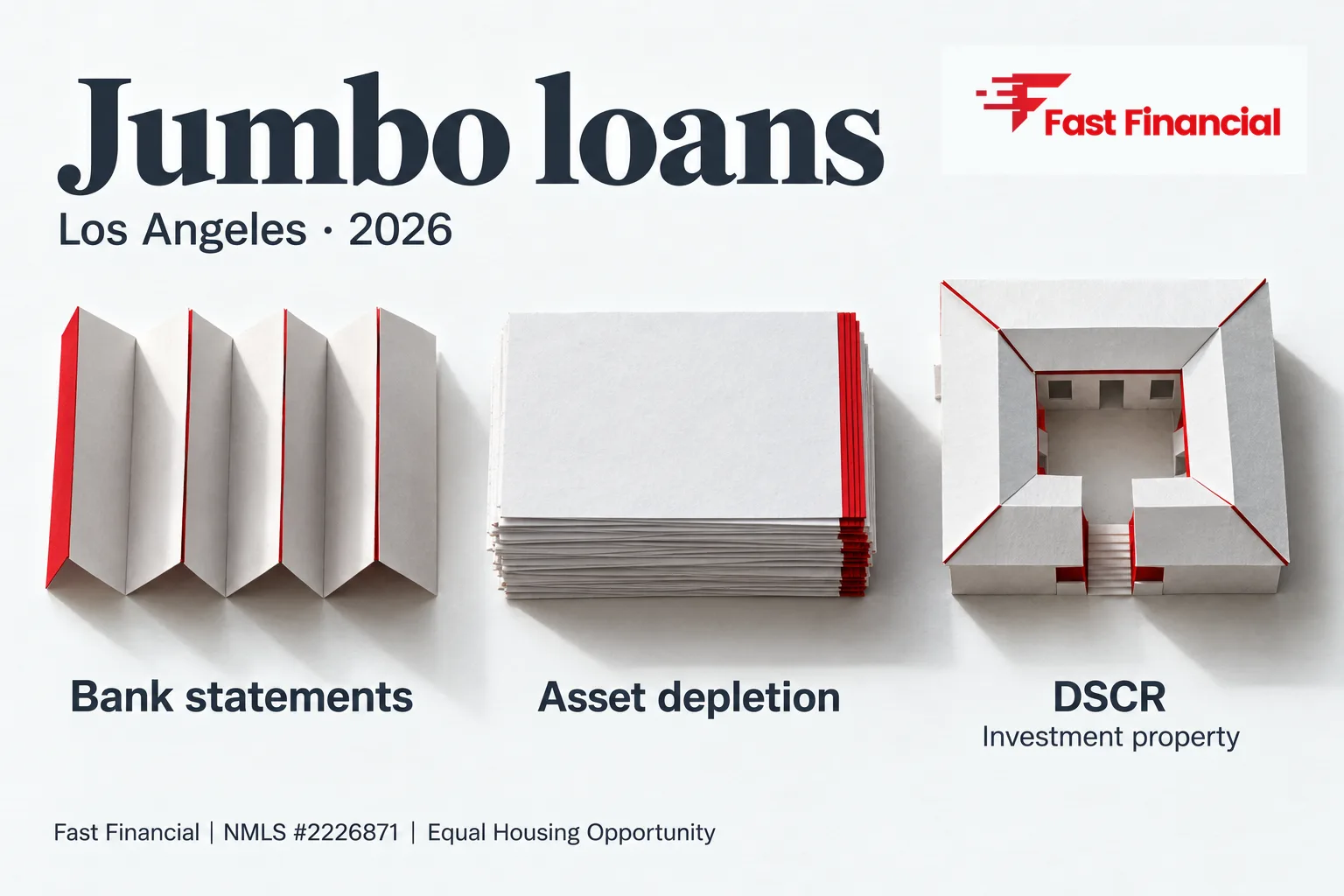
Non-QM loans exist precisely because a significant portion of well-qualified borrowers don't fit the Fannie/Freddie template. Three non-QM tracks dominate the LA jumbo market:
Bank Statement Loans — for business owners
Instead of tax returns, lenders analyze 12 to 24 months of personal or business bank statements to calculate a usable income figure. Deductions that reduce taxable income don't affect the qualifier. This is the workhorse product for self-employed borrowers in LA's luxury segment. Before you apply, pull together what the checklist for self-employed borrowers outlines — it saves time.
Asset-Depletion Income — for high-liquid-net-worth borrowers
Some borrowers hold substantial investable assets — brokerage accounts, retirement accounts, trusts — but draw little or no traditional income. Asset-depletion underwriting converts those assets into a monthly income figure using a formula set by the lender. The borrower qualifies on that figure, not a W-2. This is a well-established, legitimate path for retirees and wealth-preservation borrowers who don't need to liquidate assets to service the debt.
DSCR Loans — for real estate investors
If the property being financed is an investment property, the income from the asset itself can drive qualification — not the borrower's personal income at all. Debt-service coverage ratio loans underwrite on rent income versus the mortgage payment. No personal income docs required. DSCR loans in California are particularly relevant in the LA market, where rental demand is strong and values support the math. What Is a DSCR Loan and Who Qualifies? covers the mechanics.
Trust and LLC Vesting — Getting Title Right Before You Open Escrow
High-net-worth buyers frequently want to vest title in an entity: a living trust, a family trust, an LLC, or a corporate structure. The mechanics matter, and a mismatch discovered mid-transaction can delay closing or force a program switch.
Trust vesting is generally lender-friendly for owner-occupied properties. The borrower signs personally; the trust holds title. Lenders will require a certification of trust or the full trust document to confirm the trustee's borrowing authority.
LLC vesting is common for investment properties, particularly in California where asset-protection structures are standard. DSCR lenders are typically more comfortable with LLC vesting than conventional jumbo lenders, who often require the individual borrower to hold title. Confirm the vesting structure with your broker before you're in contract.
What Lenders Actually Look at in a Jumbo File
Beyond income documentation, here's where underwriters spend their attention:
Reserves. Conforming loans require minimal post-close reserves. Jumbo programs — especially at higher loan balances — often require substantial documented liquid reserves. The larger the loan, the more months of total mortgage payment a lender typically wants to see in verifiable accounts post-close.
Credit profile. Jumbo lenders want a clean history, not just a score. Recent derogatory marks, collections, or a pattern of lates will attract scrutiny even when the score clears the threshold. How credit scores affect your mortgage covers what lenders actually examine.
Loan-to-value. Luxury properties are harder to appraise. Lenders price that risk into LTV requirements. Expect more conservative caps than on a conforming purchase, particularly at the higher end of the price range.
Closing costs at scale. Jumbo loans carry the same closing cost categories as any California mortgage, but the numbers scale with the loan amount. California mortgage closing costs breaks down what to budget.
Appraisal complexity. Comparable sales in ultra-luxury neighborhoods are scarce. A lender may order a second appraisal or apply a larger LTV cushion as a hedge against appraisal volatility. Plan for this in your contract terms.
Discretion Is Available
Fast Financial works with entertainment-industry professionals, real estate investors, physicians, and attorneys who require discretion throughout the lending process. NDAs are available on request. One point of contact from application through funding. Nothing routes through a call center.
Get your rate reviewed or reach our Los Angeles mortgage broker team directly at (661) 512-4141. Fast Financial — NMLS #2226871 — is licensed to arrange jumbo and non-QM financing throughout California.
Frequently asked questions
What is the jumbo loan limit in Los Angeles County in 2026?
Los Angeles County is designated a high-cost area under FHFA guidelines, so the conforming loan limit here is higher than in most of the country. Any loan above that limit is jumbo. See Jumbo Loan Requirements in Los Angeles County 2026 for the current figure and what it means for your transaction.
Can I qualify for a jumbo loan without tax returns?
Yes, depending on how your income is structured. Bank statement loans, asset-depletion programs, and DSCR loans are all designed for borrowers who are well-qualified but whose tax returns don't reflect their actual financial position.
Do jumbo lenders allow LLC or trust vesting in California?
Many do. Trust vesting is common for owner-occupied properties; LLC vesting is frequently used for investment properties, especially with DSCR programs. The specifics depend on the lender and the loan type — confirm the structure with your broker before going into contract.
How much in reserves do jumbo lenders typically require?
Reserve requirements vary by lender and loan size, but jumbo programs consistently require more post-close liquidity than conforming loans. The threshold scales with the loan amount and is measured in months of total housing payment held in documented, verifiable accounts.
Is a cash-out refinance available on a jumbo property in California?
Yes. Jumbo cash-out refinances are available, though LTV limits tend to be more conservative than on conforming loans. How a cash-out refinance works explains the mechanics and what to weigh before pulling equity from a high-value property.