
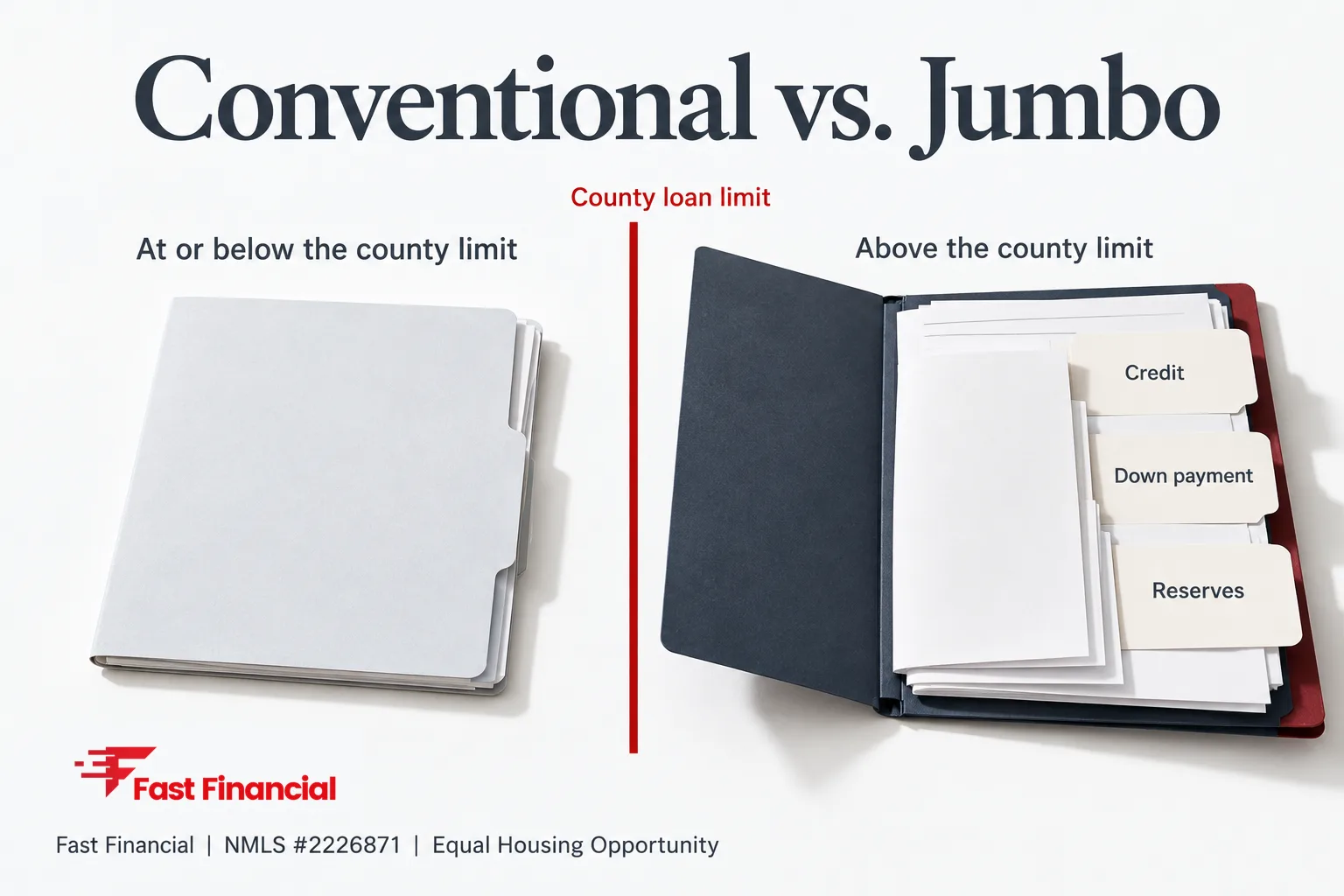
The difference comes down to loan size. A conventional (conforming) loan stays at or under the limit set by the Federal Housing Finance Agency (FHFA). A jumbo loan is any mortgage above that limit, and lenders underwrite it more strictly because Fannie Mae and Freddie Mac won't buy it.
Here's how to tell which one you're looking at and what changes when you cross the line.
What is a conventional loan?
A conventional loan is a mortgage that isn't insured or guaranteed by the government. That rules out FHA, VA and USDA loans. Most conventional loans are also "conforming," meaning they meet Fannie Mae and Freddie Mac guidelines on loan size, credit, documentation and debt.
Because those two agencies buy the loans, lenders can price them competitively and approve them under a standard rulebook. That's why conventional is the default for most buyers who aren't using a government program. If you're weighing it against government-backed options, see our breakdown of conventional vs. FHA loans.
What is a jumbo loan?
A jumbo loan is a mortgage larger than the conforming loan limit for the county where the home sits. Technically it's still a conventional loan, since it has no government backing. But it's non-conforming, so it can't be sold to Fannie or Freddie.
The lender or investor holds that risk, so they set their own guidelines. That's where the stricter requirements come from. In practice, jumbo is about what the lender is willing to carry, not about a different kind of house.
How is the conforming loan limit set?
FHFA sets the limit every year, and it varies by county. There's a baseline limit for most of the country and a higher ceiling for designated high-cost areas.
Los Angeles County is a high-cost area, so the limit here is well above the baseline. Kern County, which sits just north of the Antelope Valley, uses a different limit. Check the current published figure for your county rather than relying on a number from an older article, because it's adjusted annually. We cover the local picture in our guide to jumbo loan requirements in Los Angeles County.
Conventional vs. jumbo: how do they compare?
| Factor | Conventional (conforming) | Jumbo |
|---|---|---|
| Loan size | At or below the county limit | Above the county limit |
| Who backs it | Sold to Fannie Mae / Freddie Mac | Held by the lender or private investors |
| Credit expectations | Flexible; many borrower profiles fit | Typically stricter |
| Down payment | Lower options available | Usually larger |
| Cash reserves | Often modest | Often several months of payments, sometimes more |
| Appraisal | Standard | May require a second appraisal on bigger loans |
| Mortgage insurance | Required on low-down-payment loans | Handled differently, depending on the lender |
| Rates | Set by market and borrower profile | Set by market and borrower profile |
Treat that table as a pattern, not a rule. Jumbo guidelines differ lender to lender, and that's the main reason shopping the market matters.
Are jumbo rates higher than conventional rates?
Not automatically. People assume jumbo costs more, but jumbo pricing can land close to conforming pricing, and sometimes it competes well. It depends on the market, the lender's appetite and your profile.
What moves the number is the same set of factors either way: credit, loan-to-value (LTV), occupancy, reserves and loan structure. Any specific rate comparison you read online is a snapshot of one day and one borrower. For how pricing works in general, read understanding mortgage rates, then request a quote based on your own file.
What do jumbo lenders look at that conventional lenders don't?
Jumbo underwriting puts more weight on your ability to absorb a larger obligation. Here's what lenders actually look at:
- Credit profile. Expect a higher bar than many conforming programs.
- Down payment and LTV. A bigger equity stake lowers the lender's risk, so jumbo files typically need more skin in the game.
- Reserves. Liquid assets left over after closing matter. Lenders want proof you can keep paying if income wobbles.
- Debt-to-income. Your monthly debts against income still decide the approval. Here's how DTI is calculated and what lenders allow.
- Documentation. Larger loans often get a closer look at income sources, asset seasoning and the property.
Can you avoid jumbo by splitting the loan?
Sometimes. If your purchase is only modestly above the limit, a larger down payment can bring the loan amount back under it. That's the move worth testing first.
Another approach is a conforming first loan plus a second mortgage, but that adds a second payment and its own terms. Whether it beats a single jumbo depends on the second lien's structure and your cash position. Run both scenarios side by side before deciding, and use our mortgage calculators to see how the amounts shift.
What if you don't fit either box?
Some borrowers have the assets and the credit but not the paycheck pattern a standard jumbo wants: business owners, investors, entertainment and sports professionals, and people with irregular income. That's where non-QM options come in. Read what a non-QM loan is and when it makes sense, or see how asset depletion lets you qualify on what you've saved instead of what you earn.
Buying at the high end of the market? Our guide to financing a luxury home in Beverly Hills, Bel Air or Calabasas covers jumbo and super-jumbo.
Which one should you choose?
You usually don't get to choose. The purchase price and your down payment set the loan amount, and the loan amount sets the category. If it's under the county limit, conventional is typically the cleaner path. If it's over, you're in jumbo territory, and the job is finding the lender whose guidelines fit your file.
The move is to get your numbers reviewed before you make offers. A Los Angeles mortgage broker can compare conforming and jumbo paths across multiple lenders and tell you where you stand. That's the advantage of working with a broker like Fast Financial rather than a single bank's product shelf.
Get your options reviewed
Not sure which side of the limit you're on? Get your rate reviewed and we'll walk through conforming and jumbo scenarios for your purchase or refinance. Rates and terms vary by borrower and market, and nothing here is a commitment to lend.
Call Fast Financial at (661) 512-4141, or stop by the office at 190 Sierra Ct Ste 324, Palmdale, CA 93550. We're a California-licensed mortgage broker, NMLS #2226871.
Frequently asked questions
Is a jumbo loan the same as a non-conforming loan?
Yes, in most cases. "Jumbo" and "non-conforming" both describe a loan above the conforming limit that can't be sold to Fannie Mae or Freddie Mac. Some other non-conforming loans, like non-QM, are non-conforming for different reasons.
Do jumbo loans require private mortgage insurance?
It depends on the lender. Conventional loans with a small down payment generally require mortgage insurance, and jumbo lenders handle the issue in their own way, often by requiring a larger down payment. See what mortgage insurance is and when you can stop paying it.
Is the conforming loan limit the same everywhere in California?
No. FHFA sets it by county, and high-cost counties like Los Angeles have a higher limit than lower-cost areas. Always check the current figure for the county where the property is located.
Can I use a jumbo loan to refinance?
Yes. If your balance is above the conforming limit, a jumbo refinance is the usual route. Explore our refinance options to see how a rate-and-term or cash-out refinance fits your situation.