
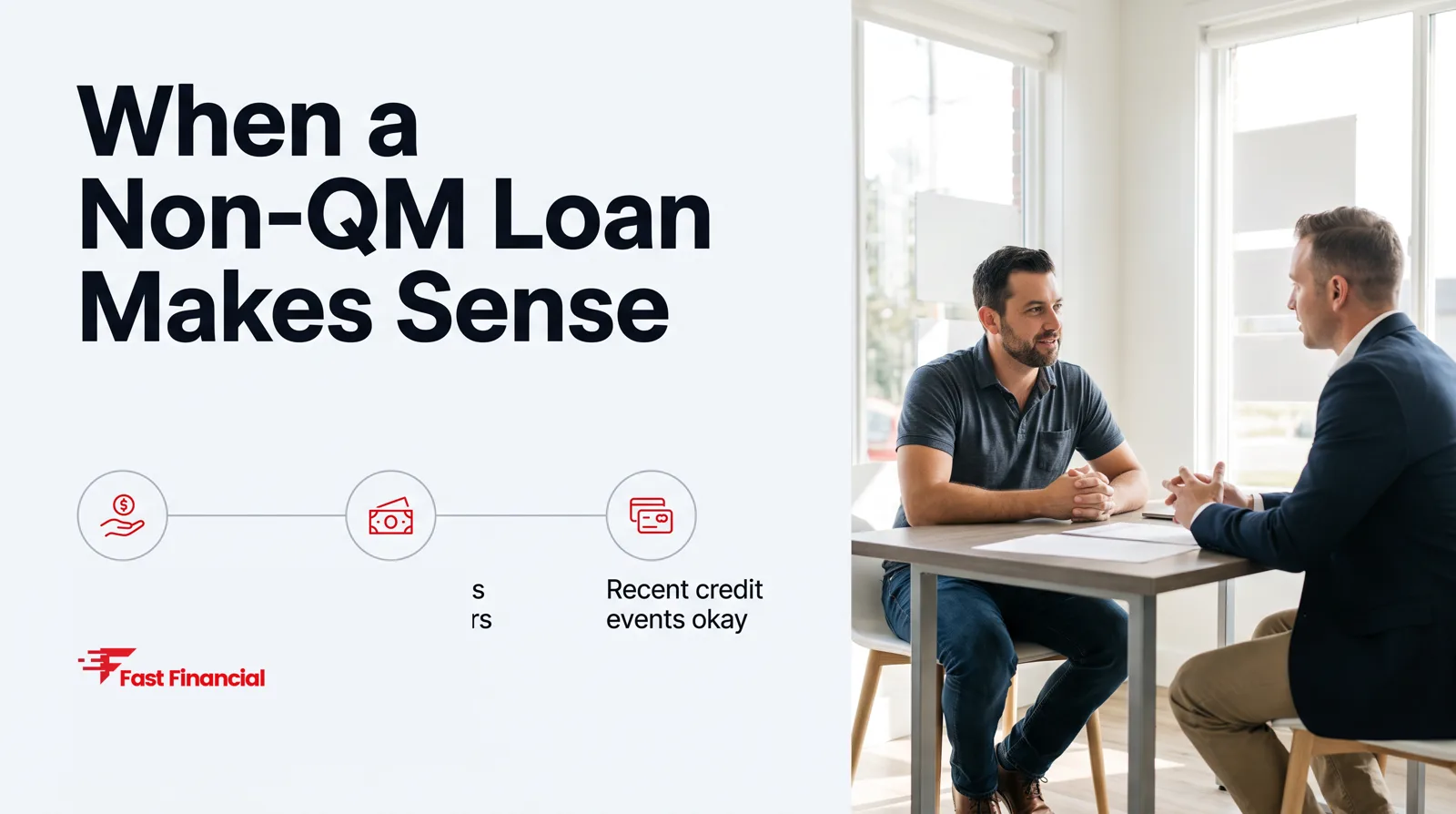
A non-QM loan is a mortgage that doesn't meet the federal "Qualified Mortgage" guidelines set by Fannie Mae and Freddie Mac — which means lenders can use different income documentation, different debt ratios, and different underwriting logic to approve borrowers the conventional system would turn away.
That's not a loophole. It's a legitimate loan category designed for borrowers whose financial picture is real but doesn't fit neatly into a W-2 box.
What Does "Non-QM" Actually Mean?
QM stands for Qualified Mortgage — a set of standards established after the 2008 housing crisis. Lenders who originate QM loans get certain legal protections; they also have to follow strict rules: debt-to-income (DTI) caps, no interest-only periods past a point, no excessive points and fees, and — critically — income verified through W-2s, tax returns, or standard employment documentation.
Non-QM loans operate outside those rules. They're not subprime. They're not the "liar loans" of 2005. They're portfolio products — lenders hold them (or sell them to private investors) rather than selling them to Fannie/Freddie. Because the lender takes on the risk, they set their own standards.
The result: more flexibility. Different documentation. Different ways to prove ability to repay.
Who Are Non-QM Loans Actually For?
Self-employed borrowers whose tax returns don't tell the whole story
If you own a business and write off $80k in expenses a year, your taxable income looks small on paper. A conventional underwriter sees that number and stops. A non-QM lender can look at your bank statements instead — 12 or 24 months of deposits — and use that to calculate qualifying income.
This is called a bank statement loan. It's one of the most common non-QM products and it's specifically built for business owners, freelancers, and 1099 earners in California where that profile is extremely common.
Real estate investors using DSCR loans
DSCR stands for Debt Service Coverage Ratio. A DSCR loan qualifies you based on the property's rental income — not your personal income at all. If the rent covers the mortgage (typically a 1.0x ratio or better), many lenders will approve the loan.
This is the go-to for investors who own multiple properties and whose personal DTI is loaded but whose rentals are cash-flowing.
Borrowers with recent credit events
Conventional (Fannie/Freddie) guidelines have hard seasoning rules: four years after Chapter 7 bankruptcy (two with documented extenuating circumstances) and seven years after foreclosure (three with documented extenuating circumstances) for most programs. Non-QM lenders can work with shorter timelines — sometimes as little as one day out of bankruptcy for certain products, depending on the loan-to-value.
High-net-worth borrowers with asset-heavy balance sheets
Asset depletion or asset-utilization loans let lenders count liquid assets as income. If you have $3M in an investment account, a lender may be able to calculate a monthly income figure from that pool, even if you're not drawing a paycheck.
Foreign nationals
If you don't have a U.S. Social Security number or credit history, conventional lending is essentially closed. Non-QM foreign national programs exist specifically for this profile.
What Are the Trade-offs?
Non-QM flexibility comes with a cost. Here's the honest version:
| Factor | Conventional/QM | Non-QM |
|---|---|---|
| Documentation | W-2, tax returns, paystubs | Bank statements, P&L, DSCR, assets |
| DTI limits | Typically 43–50% | Varies by lender and program |
| Rates | Generally lower | Generally higher than QM |
| Down payment | As low as 3% (conventional) | Often 10–20%+ |
| Loan amounts | Conforming limits apply | Can go higher (jumbo non-QM) |
| Approval speed | Standard | Can vary widely |
The rate differential between QM and non-QM is real. For the right borrower — someone who legitimately can't qualify conventionally — that spread is a cost worth paying to get into a home or an investment property. For someone who can qualify conventionally, non-QM is usually the wrong move.
That's the key question: can you qualify the conventional way first?
When Does a Non-QM Loan Actually Make Sense?
Here's how to think about it.
Non-QM makes sense when:
- You're self-employed and your tax returns understate your real income
- You're an investor and the property cash-flows but your personal DTI is maxed
- You had a credit event (bankruptcy, short sale, foreclosure) and you're in the recovery window
- Your income is real but the documentation is non-standard — seasonal work, foreign income, asset-based income
- You're buying a property type that doesn't fit agency guidelines (certain condos, mixed-use, rural)
Non-QM doesn't make sense when:
- You could qualify conventionally with some light prep — building credit, paying down a balance, waiting 60 days
- You're stretching into a payment you can't sustain just because the product is available
- You're being pushed toward it to close faster when a conventional loan is the right product
Are Non-QM Loans Legal and Safe?
Yes — when originated correctly. Non-QM loans are regulated under the Ability to Repay (ATR) rule. Lenders are still required to make a good-faith determination that you can repay the loan. They just have more flexibility in how they document and assess that ability.
What's not acceptable: stated income with no supporting documentation, inflated appraisals, or loans structured to fail. A reputable non-QM lender is still stress-testing your ability to repay — they're just doing it differently.
In California, you're also dealing with state licensing on top of federal requirements. Any broker or lender offering non-QM products must be properly licensed — verify the NMLS number before you sign anything.
What to Watch Out For
Non-QM is an area where product knowledge matters a lot, because programs vary significantly across lenders. A few things to ask:
- Is this a bank statement loan, DSCR loan, asset depletion, or something else? Know what you're getting.
- What's the prepayment penalty structure? Some non-QM loans have prepayment penalties — understand the terms.
- What's the rate environment for this product today, and does it make sense given your timeline?
- Is there a path to refinancing into a conventional loan later, once your situation normalizes?
That last question is the right long-term play for many non-QM borrowers: use the non-QM to get in, then refinance when you have two years of tax returns, more equity, or a cleaner credit picture.
The Bottom Line
Non-QM loans exist because real borrowers — business owners, investors, people with complicated income — don't fit the W-2 mold. If that's your situation, non-QM isn't a consolation prize. It's the right tool.
The number that matters: can you actually repay the loan? A good lender asks that question regardless of which product is on the table.
If you want to see where you stand — whether conventional, non-QM, or something in between is the right fit — get your situation reviewed. NMLS #2226871. Rates and terms vary by borrower, loan type, and market conditions.
Frequently asked questions
What makes a mortgage non-QM?
It falls outside standard qualified-mortgage guidelines and permits different documentation and underwriting methods.
Who commonly uses a bank-statement loan?
Self-employed borrowers may use deposits to document income when tax returns do not reflect their full financial picture.
Are non-QM lenders still required to assess repayment ability?
Yes. The Ability to Repay rule still requires a good-faith determination that the borrower can repay the loan.