
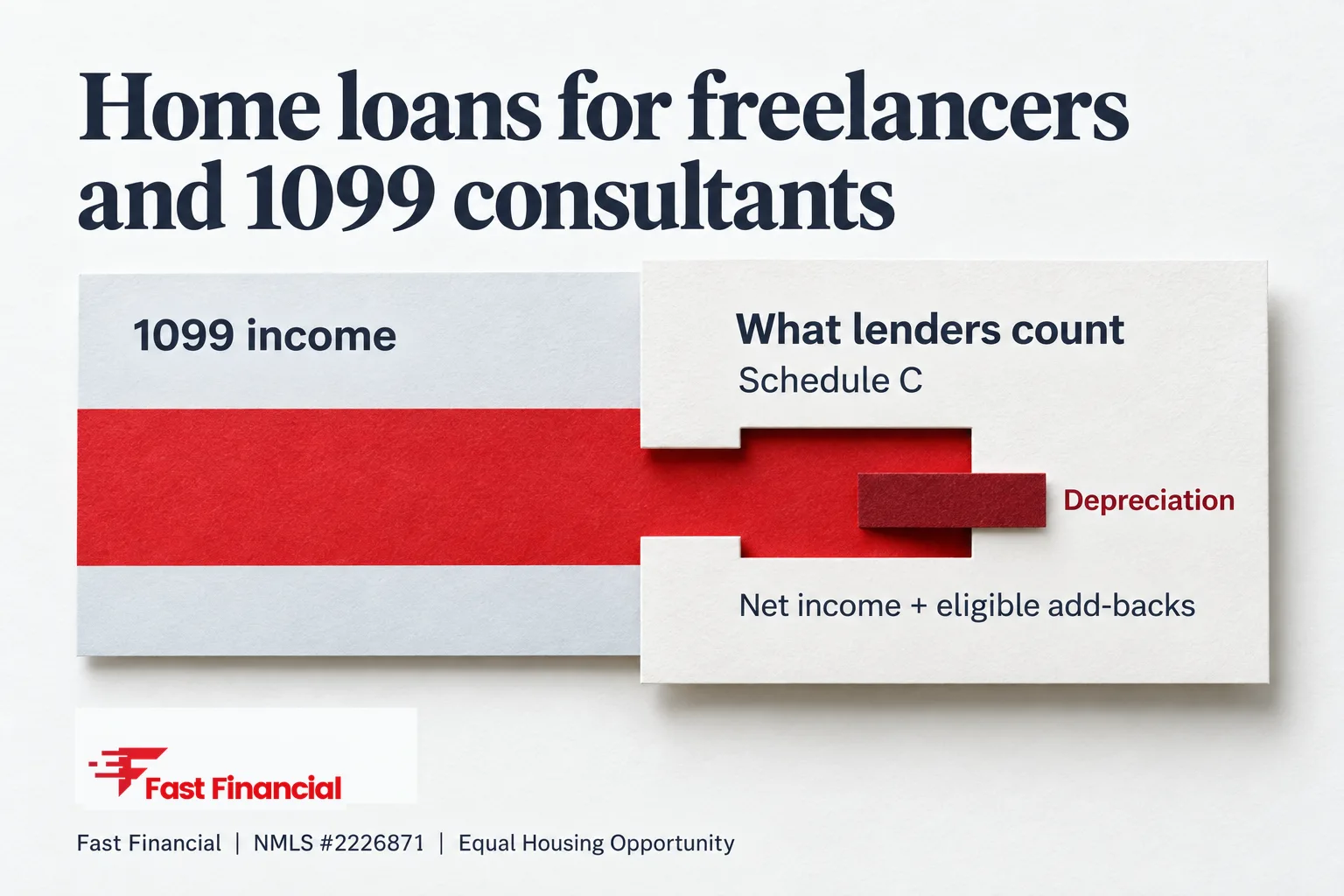
Freelancers and 1099 consultants can absolutely qualify for a home loan — the process just looks different than it does for a salaried borrower.
W-2 employees have it easy: two pay stubs and you're done. If you're billing clients on a 1099 basis, the income picture is more complicated. Lenders need to verify that your earnings are real, consistent, and likely to continue. Here's exactly what they're looking at.
Why Does 1099 Income Make Lenders Look Twice?
It's not that lenders distrust freelancers — it's that income volatility is a real underwriting risk. A salaried employee has a predictable monthly figure. A 1099 consultant might bill heavily one quarter and go quiet the next. Lenders need to see a pattern that justifies the loan.
The other wrinkle: most self-employed borrowers do what any good accountant would tell them — maximize deductions. That reduces taxable income, which is great for your tax bill and challenging for your loan application. Qualifying income on a conventional loan typically flows from your tax return, and heavy deductions can compress that number significantly.
What Counts as Qualifying Income on a Conventional Loan?
On a conventional or FHA loan, lenders use a two-year average of your net self-employment income — the number from your tax returns after business deductions. That figure is often lower than what actually hit your bank account.
Here's what they want to see:
- Two years of federal tax returns (personal, plus Schedule C or Schedule SE for sole proprietors)
- 1099 forms from the same period
- Year-to-date profit-and-loss statement prepared by a CPA or licensed tax preparer
- Business bank statements to support the P&L
- Business entity docs — if you're structured as an LLC or S-corp, the lender will pull those business returns too
The two-year history is a hard requirement on most conventional programs. If you've been freelancing for less than two years, you'll likely need to look at alternative paths. If your income is rising year over year, that works in your favor — lenders can sometimes use the most recent year's number when the upward trend is clear.
For the full document list, see the self-employed borrower document checklist.
The Deduction Problem — and How to Think About It
Here's the practical tension: a great tax return minimizes taxable income. A strong mortgage application maximizes qualifying income. Those two goals pull in opposite directions.
Some deductions get added back. Depreciation is the most common — it's a paper expense, not a real cash outflow, so lenders typically restore it to your qualifying income. Your loan officer will go line by line through your Schedule C to identify what's addable.
But there are limits. If your net income after deductions still doesn't support the debt-to-income ratio (DTI) the program requires, you're either looking at a smaller loan or a different product entirely.
That's where non-QM lending comes in.
What If the Tax Returns Don't Tell the Full Story?
Non-QM (non-qualified mortgage) products exist specifically for borrowers whose income is real but difficult to document the conventional way. The two most relevant for 1099 earners:
Bank statement loans — Instead of tax returns, the lender averages 12 or 24 months of personal or business bank deposits. If your actual cash flow is substantially higher than what your Schedule C shows, this often produces a much stronger qualifying number. It's common for high-earning freelancers, consultants, and creative professionals.
1099-only loans — Some lenders will qualify you using just your 1099 forms from the past one to two years, without running the full tax return analysis. This is particularly useful when you carry significant pass-through deductions that reduce your net income on paper.
Both are non-QM programs, which means different underwriting standards than conventional financing. Read how non-QM loans work and when they make sense before assuming it is or isn't the right fit. If you're in Los Angeles County, this breakdown of bank statement lending for self-employed borrowers is worth reading for a concrete look at how the income calc actually works.
Does Your Credit Score Still Matter?
Absolutely. Credit requirements don't soften just because you're a 1099 earner — in fact, strong credit matters more when your income documentation is more complex. It's one less thing for underwriting to push back on.
What credit score you need for a California mortgage depends on the loan type. Conventional programs have stricter floors than FHA; non-QM lenders vary by program. Know your score before you apply, and fix anything addressable before the file hits underwriting.
How Much Income Do You Actually Need?
The lender's question isn't "how much do you make" — it's "how much of what you make can we count, and does that number support the payment?"
DTI is the metric. Lenders compare your total monthly debt obligations — proposed housing payment plus all recurring debt — against your qualifying monthly income. Conventional programs have DTI ceilings; non-QM programs are more flexible but still have floors.
For a sense of what the income math looks like in today's California market, this guide on how much income it takes to buy a house in California walks through the logic.
What Moves the Needle Before You Apply?
A few concrete steps that actually help:
- Run two full years of clean returns. File on time, document everything, and give a lender two consecutive tax years to work with.
- Keep business and personal accounts separate. Bank statement underwriting becomes significantly cleaner and faster.
- Have a CPA-prepared P&L ready. If you're going the bank statement route, a signed P&L is usually required — and it strengthens the file.
- Get pre-approved before you shop. Pre-approval surfaces income shortfalls and documentation gaps while you still have time to address them. Here's what goes into mortgage pre-approval and what to expect from the process.
- Work with a broker, not just one lender. A broker has access to conventional, FHA, bank statement, and non-QM products and can match your income profile to the program most likely to approve you. Fast Financial works with self-employed borrowers all across California — from the Antelope Valley to greater Los Angeles — and has direct experience with the full range of self-employed mortgage options.
If you own investment properties with rental income, there's also the DSCR loan path — which qualifies based on the property's cash flow rather than your personal income.
Frequently asked questions
Can I get a home loan with only one year of 1099 income?
Conventional and FHA loans typically require a two-year self-employment history. Some non-QM lenders will accept one year under specific circumstances. Talk to a broker before assuming you need to wait — the answer depends on your income trend, credit profile, and down payment.
Do lenders use my gross or net income as a 1099 borrower?
On conventional loans, lenders use your net income from the tax return — after deductions — averaged over two years. Bank statement loans typically apply a percentage to gross deposits. Which method produces a better qualifying number depends entirely on how you run your business finances.
What if my income has grown significantly from year one to year two?
When year two is noticeably higher than year one and trending upward, some lenders will use only the most recent year's figure. This isn't universal — ask your loan officer how they'll calculate your income before assuming an average applies.
Will I need a larger down payment because I'm a freelancer?
Not necessarily on conventional or FHA loans — down payment requirements are tied to the loan program, not your employment type. Non-QM programs often do require more down. Your qualifying income and credit score have more impact on your options than the 1099 status itself.
Is it harder to get approved as a freelancer in California?
The qualification standards are the same — California doesn't add requirements on top of federal guidelines. The challenge is specific to income documentation. Two clean years of returns, strong credit, and the right loan product close that gap faster than most borrowers expect.
Ready to see where you actually stand? Get a rate review from Fast Financial — NMLS #2226871. Call us at (661) 512-4141 or visit our office at 190 Sierra Ct Ste 324, Palmdale, CA 93550.