
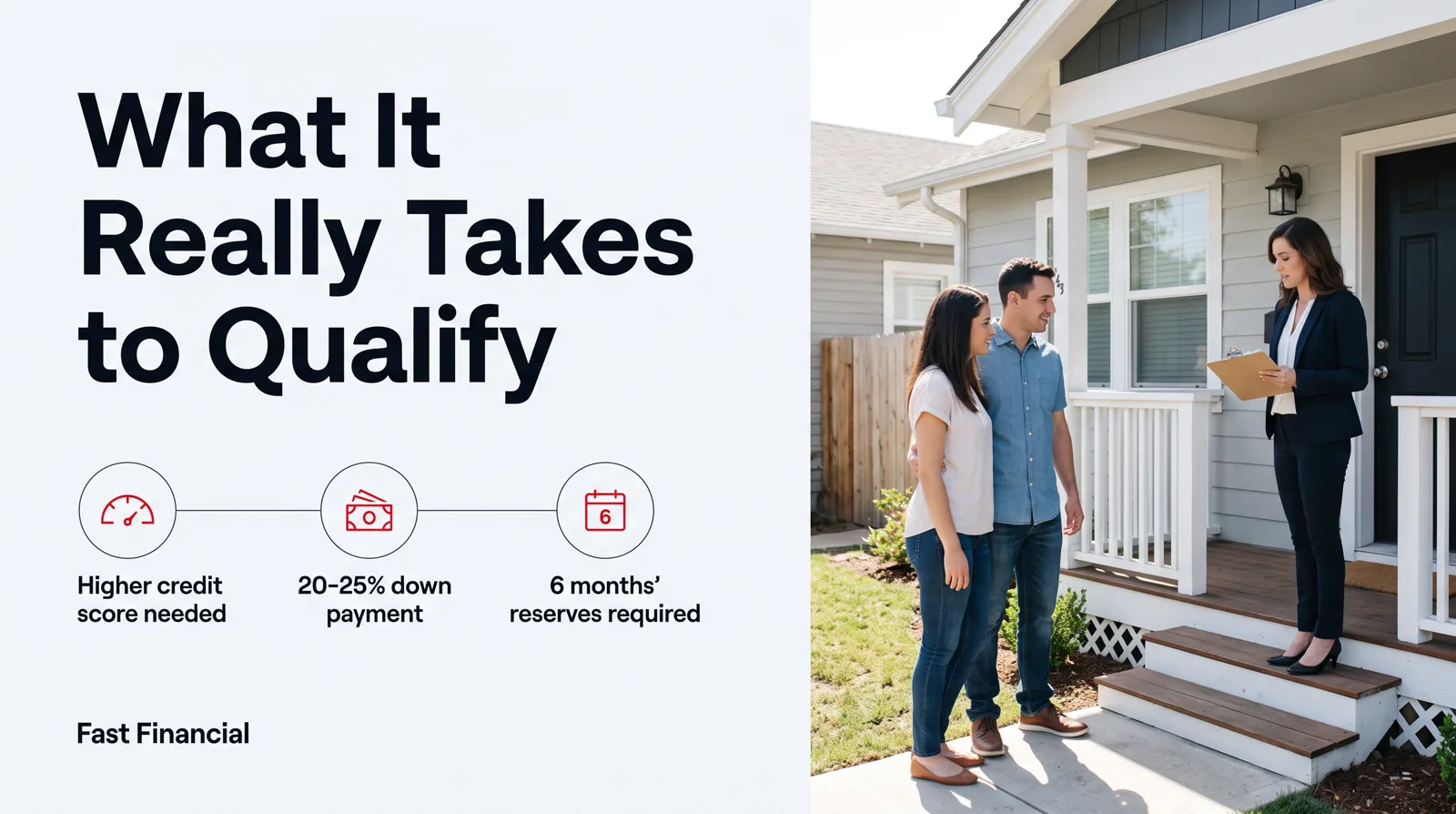
Quick answer: Yes, you can buy a rental with a conventional loan. Expect a larger down payment than on a home you live in, typically at least 15% on a one-unit property and 25% on two to four units, plus a solid credit score and several months of reserves. Documented rental income can help you qualify.
Yes, you can buy an investment property with a conventional loan — but the qualification bar is higher than it is for a home you're moving into, and investors who find that out mid-contract usually wish they'd known sooner.
Can you use a conventional loan for a rental property?
Fannie Mae and Freddie Mac both allow conventional financing on one-to-four-unit non-owner-occupied properties. That covers single-family rentals, duplexes, triplexes, and fourplexes — the most common investment property types for California buyers.
What changes is the risk profile lenders are underwriting. When you're not living in the property, lenders price in the possibility that rental income interruptions could strain your ability to carry the loan. That concern shows up in stricter credit requirements, higher reserve standards, and a larger required down payment than you'd need for a primary purchase.
What do lenders actually look at for investment properties?
Is my credit score high enough?
Investment property loans require a stronger credit profile than a primary residence purchase under Fannie Mae guidelines. Mid-tier credit scores that would clear a primary home deal can disqualify you — or push you into a significantly different pricing tier — on a rental. Understanding what credit score lenders actually need for a California mortgage is worth doing before you're in contract.
How much do I need to put down?
Plan to put down significantly more than you would on a primary home. Fannie Mae sets a higher minimum for non-owner-occupied properties, and it scales with unit count — a fourplex requires more than a single-family. The Conventional 97 and other low-down-payment programs are for primary residences only; they're not available on investment deals.
This is one of the most common planning gaps I see. A borrower models a deal assuming primary-home down payment math, then gets a different number from their lender. Model the real threshold before you make an offer.
How much in reserves do I need?
Reserves are a bigger deal on investment properties than most borrowers expect. Fannie Mae guidelines require documented liquid reserves covering several months of payments on both the subject property and your primary residence — and the more properties you own, the more reserves lenders want to see across the portfolio.
If you're building toward multiple properties in the Antelope Valley or across Los Angeles County, reserve requirements compound fast. This is something to model on a spreadsheet before you start writing offers, not after you're already in underwriting.
What's the loan limit on a conventional investment property?
Conventional loans are subject to FHFA conforming loan limits, which reset annually. High-cost counties in California — including Los Angeles County — carry higher limits than the national baseline, which matters in a market where even modest rental properties push into the mid-range. If your purchase price clears the conforming ceiling, you're in jumbo loan territory, which has its own underwriting standards.
What's the seller concession cap on investment properties?
Seller concessions — where the seller covers a portion of your closing costs — are allowed on conventional investment property loans. The cap, however, is lower than on a primary purchase.
Per Fannie Mae guidelines, seller contributions on investment properties are capped at 2% of the purchase price regardless of LTV. On a primary residence, that ceiling can be higher depending on your loan scenario. If you're factoring seller credits into your net cash-to-close, keep that 2% ceiling in mind when structuring your offer.
DSCR loan vs. conventional loan — which one makes sense for investment property?
This question matters more than most investors realize. The answer depends on your income picture.
A conventional loan qualifies you on your personal financial profile — W-2s, tax returns, DTI. If your personal income is clean and the addition of a new rental doesn't blow out your debt ratios, conventional underwriting can work in your favor.
A DSCR loan in California qualifies on the property's rental income — specifically whether the monthly rent covers the debt service. No tax returns required. No personal income calculation. For self-employed borrowers or investors scaling a portfolio, this is often the cleaner route even if it means a different rate tier. Our article on how non-QM mortgages work walks through the full landscape if you're comparing options.
The honest version: if your W-2 income is straightforward and your DTI handles the new property comfortably, conventional is worth running first. If you're self-employed, have complex returns, or are buying cash-flowing properties where rental income is the real story — DSCR is worth a serious look.
When is a conventional loan the wrong call for an investment property?
Conventional financing works best when the property and your income profile are both clean. If you're buying a distressed property, it may not appraise as-is — and conventional appraisal standards don't bend for condition. See distressed asset financing in California and fix-and-flip loans for Antelope Valley investors for those scenarios.
If you're simultaneously looking at a primary residence purchase alongside an investment deal, the sequencing matters. Understanding how primary vs. investment mortgages differ helps you structure both moves without one undercutting the other.
When you're ready to see what your specific scenario qualifies for, get your rate reviewed.
Frequently asked questions
Can you buy an investment property with a conventional loan?
Yes. Fannie Mae and Freddie Mac both allow conventional financing on one-to-four-unit non-owner-occupied properties. The credit, reserve, and down payment requirements are higher than for a primary residence.
What is the minimum down payment for a conventional investment property loan?
Fannie Mae sets the minimum higher for investment properties than for primary residences, and it increases with unit count. Expect to put down significantly more than you would on a home you're moving into — get the exact threshold from a broker before making an offer.
What is the seller concession limit on a conventional investment property?
Per Fannie Mae guidelines, seller contributions are capped at 2% of the purchase price on investment properties, regardless of LTV. Factor this into your offer strategy if you're counting on the seller to cover closing costs.
Is a DSCR loan better than a conventional loan for investment property?
It depends on your income documentation. Conventional works well for W-2 borrowers with clean DTI. DSCR works better when the property's rental income is the story — no personal income docs required. Talk through both options before committing to a path.
Does the Conventional 97 loan work for investment properties?
No. The Conventional 97 and other low-down-payment agency programs are restricted to primary residences. Investment properties require a higher down payment minimum under Fannie Mae guidelines.