
Construction loan requirements come down to five things: strong credit, documented income and a manageable debt load, cash for the down payment and reserves, a qualified builder, and plans and a budget the lender can appraise. A construction loan is harder to get than a standard purchase mortgage because the lender funds a house that doesn't exist yet. Here's what lenders actually look at, and how it changes by program.
What are the basic requirements for a construction loan?
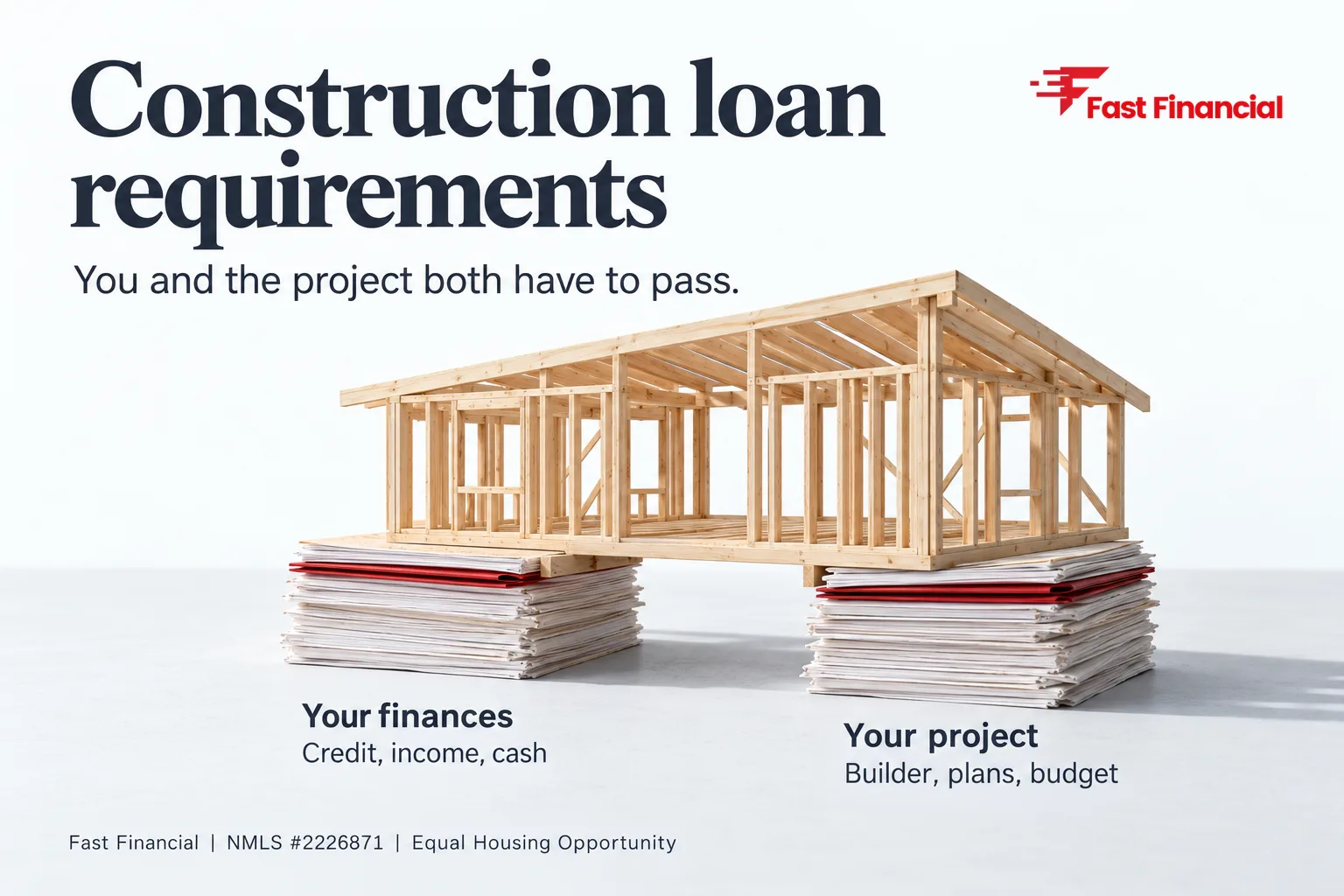
Lenders underwrite two things at once: you and the project. Both have to pass.
On the borrower side:
- Credit. Lenders set stricter credit expectations on construction than on a typical purchase. Your score and payment history drive both approval and pricing. If you're unsure where you stand, start with our guide to the credit score needed for a mortgage in California.
- Income and DTI. The number that matters is your debt-to-income ratio. Lenders qualify you on the future payment, and often on your current housing payment too if you still own your home. Here's how DTI is calculated and what lenders allow.
- Down payment and reserves. Expect to put real cash into the deal. Many lenders also want to see reserves left over after closing, because cost overruns are common on new builds.
- Land. If you already own the lot, its equity can often count toward your down payment. If you're buying the lot too, it gets financed as part of the same transaction or separately.
On the project side: a signed contract with a licensed builder, full plans and specifications, a line-item budget, permits, and an appraisal based on the finished home. We'll go through each below.
What does the lender want to see on the builder and the plans?
The builder is underwritten almost as hard as you are. Lenders want to know the contractor is licensed, insured, financially stable, and has finished comparable homes. A builder with a thin track record is one of the most common reasons a file stalls.
Here's the project package lenders typically require:
- A fixed-price or detailed cost-plus construction contract
- Complete architectural plans and written specifications
- A line-item budget, including a contingency for overruns
- Building permits and proof the lot is buildable (utilities, access, zoning)
- A builder's license and proof of insurance
The appraiser values the home as completed, using your plans and comparable sales. If that value comes in below the cost to build, you cover the gap. Appraisal and loan contingencies matter even more on a build than on a resale.
How does a construction loan get paid out?
Funds don't arrive in one lump. They're released in stages, called draws, as work is completed and inspected. In practice that looks like this:
| Stage | What happens |
|---|---|
| Closing | Land is paid off or financed; the draw schedule is set |
| Construction | The builder requests a draw; an inspector verifies the work; funds are released |
| Completion | Final inspection and certificate of occupancy |
| Permanent financing | The loan converts to a standard mortgage, or you refinance out |
Which structure you choose matters. A construction-to-permanent loan closes once and converts automatically. A stand-alone construction loan closes separately from the final mortgage, which means a second approval and a second closing later. If your income or credit could shift mid-build, that second approval is a real risk.
What are FHA construction loan requirements?
FHA allows a one-time-close construction-to-permanent loan, so you qualify once and the loan converts when the home is done. You'll still need a builder who meets FHA's requirements, and the plans and property must satisfy FHA's minimum property standards. FHA generally does not let you act as your own builder unless you hold the right license.
FHA also tends to be more flexible on credit than conventional options, though lenders can set their own overlays. We break down the full process in how FHA construction loans work in California. If you're buying an existing home and renovating rather than building, an FHA 203(k) loan is a different tool.
What are VA construction loan requirements?
The VA does not make construction loans itself. It guarantees the permanent financing, and only some lenders offer a construction-to-permanent product that uses the VA benefit. If you find one, expect these conditions:
- You need a valid Certificate of Eligibility.
- The home must meet VA's minimum property requirements, with a VA-assigned appraiser.
- The builder typically must be able to work within VA's process and provide the required warranty and inspections.
Because lender availability is thin, many veterans use a different construction financing structure and then move into a VA loan once the home is finished. If your goal is fixing up an existing home, see the VA renovation loan guide.
What are USDA construction loan requirements?
Like the VA, USDA doesn't fund the construction phase directly. USDA guarantees the end loan on eligible new homes, so the build is usually financed through a builder or a separate construction lender, then taken out by the USDA loan at completion. The requirements that stay constant are:
- The property must be in a USDA-eligible rural area.
- Household income must fall within USDA limits for the county and household size.
- The home must be your primary residence and meet USDA property standards.
Eligibility maps change, so verify the specific address before you buy land.
What if I'm self-employed or don't fit a standard box?
Construction lending still runs on documented income, but "documented" can look different. Self-employed borrowers can often qualify with tax returns, or with alternative documentation through other loan programs. Our guide to getting a mortgage when you're self-employed in California covers what lenders count. Investors building to sell or rent should look at fix and flip loans or hard money options, which weigh the project more heavily than personal income.
How do you get ready to apply?
Here's the move: get the builder, the plans, and the budget lined up before you ask for a rate. Lenders can't fully evaluate a file without them. Then gather two years of tax returns, recent pay or bank statements, asset statements, and your land documents. A mortgage broker can compare construction lenders for you, since programs and overlays vary a lot from one to the next. Learn more about working with a Los Angeles mortgage broker, or get your rate reviewed to see where you stand. Rates and terms vary by borrower and market, and approval depends on full underwriting.
Frequently asked questions
What credit score do I need for a construction loan?
There's no single number. It depends on the loan program and the lender's own overlays. Construction loans generally carry stricter credit standards than a standard purchase loan, so ask your lender for its specific requirement before you apply.
Can I be my own builder?
Rarely. Most lenders require a licensed general contractor, and FHA generally doesn't allow owner-builders without the proper license. A few lenders consider owner-builders with strong construction experience, but expect heavier documentation.
Do I need to own the land first?
No. You can finance the lot and the build together in some programs. If you already own the land, its equity may count toward your down payment.
What happens if the build costs more than the budget?
You're generally responsible for the difference. That's why lenders ask for a contingency in the budget and often want cash reserves on top of your down payment.
Is a construction-to-permanent loan better than a stand-alone construction loan?
For many borrowers, yes, because you qualify and close once. The stand-alone route can make sense in some situations, but it means a second approval before the final mortgage.
Ready to talk through your build? Call Fast Financial at (661) 512-4141 or visit our Palmdale office at 190 Sierra Ct Ste 324, Palmdale, CA 93550. We're a California mortgage broker (NMLS #2226871), and we'll walk through your options. Equal Housing Opportunity.