
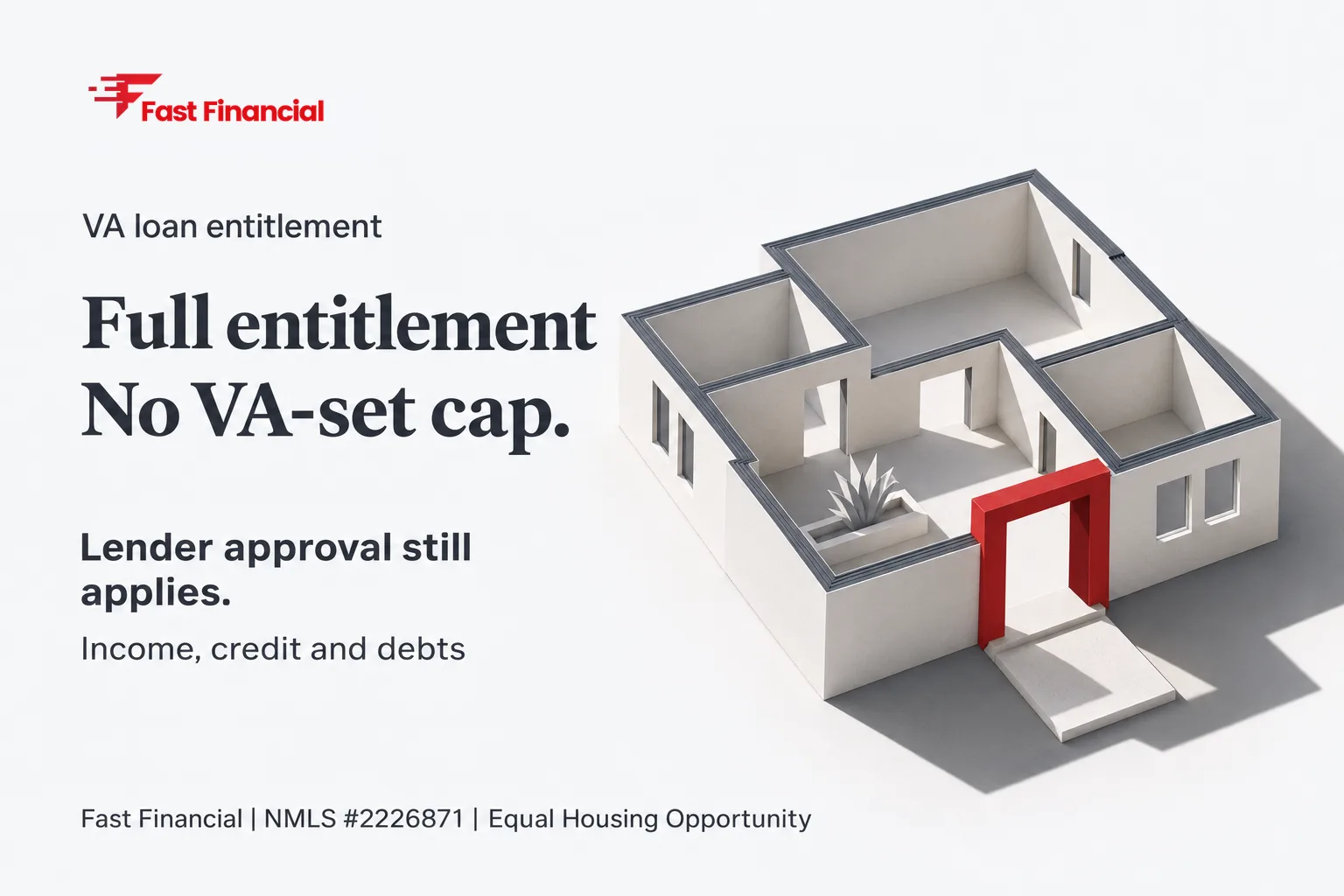
For a veteran with full entitlement, there is no VA-set maximum loan amount. Your entitlement is the VA's guaranty to the lender, not a spending cap. What limits your purchase is what a lender will approve based on your income, credit and debts. If you have used some of your benefit before, the rules change, and that's where most of the confusion starts.
Here's how to tell which situation you're in and what to do about it.
What is VA loan entitlement?
Entitlement is the amount the VA promises to back if you default on a VA-guaranteed loan. It's what lets lenders offer terms most buyers can't get, including no down payment in most cases. The VA doesn't lend you money. It guarantees part of the loan, and the lender takes on less risk.
Two terms matter:
- Basic entitlement: the fixed dollar amount the VA guarantees on any eligible veteran's loan, regardless of county.
- Bonus entitlement: additional guaranty that applies to larger loans, tied to the county loan limit where the home sits.
Together, these make up your total entitlement. The VA publishes the current figures, and they can change, so confirm them on VA.gov or with your lender before you plan around a number.
What is the maximum VA loan entitlement if you have full entitlement?
If you've never used your VA benefit, or you used it and the loan was paid off and the property sold, you have full entitlement. Since the 2020 change in federal law, the VA no longer sets a maximum loan amount for full-entitlement borrowers. The county loan limits no longer cap the loan.
In practice, here's the move: the lender decides how much you can borrow. Underwriters look at your income, your debt-to-income ratio, your credit profile, your residual income (a VA-specific measure of what's left each month after major expenses), and the appraised value. For a deeper look at that last piece, see our breakdown of how VA and FHA appraisals differ.
Note the practical limit: very large loans can run into investor appetite. Some lenders add overlays on high-balance VA loans, so a larger amount may mean fewer lenders to choose from. Where the line between conventional and jumbo sits in California is covered in our guide to the jumbo loan limit.
What if you only have remaining entitlement?
Remaining entitlement applies when you already have an active VA loan, or you paid one off but still own the home. Here the VA's county loan limit does matter.
The VA takes your total entitlement, subtracts what's tied up in your current loan, and what's left is your remaining entitlement. A lender then looks at whether the guaranty on the new loan, plus any down payment you bring, is enough to protect the lender at the loan size you want.
| Situation | Entitlement status | Does the county limit cap the loan? |
|---|---|---|
| First-time VA use | Full | No VA-set cap |
| Prior VA loan paid off and property sold | Full (restored) | No VA-set cap |
| Prior VA loan paid off, still own the home | Remaining (one-time restoration may be available) | Yes |
| Active VA loan on another home | Remaining | Yes |
| Previous VA loan ended in foreclosure or a short sale with a loss | Reduced until the loss is repaid | Yes |
If your remaining entitlement falls short, you can often cover the gap with a down payment. The exact amount depends on the loan size and your remaining entitlement, so this is a case where a worksheet beats a rule of thumb.
Can you use VA entitlement more than once?
Yes. Entitlement isn't used up after one loan. You can reuse it in several ways:
- Sell and pay off the loan. Your full entitlement is restored.
- One-time restoration. If you paid the loan off but kept the property, you can request a one-time restoration, which can bring your full entitlement back.
- Use remaining entitlement. Buy a second home with what's left, subject to the county limit.
- Let a qualified buyer assume the loan. A substitution of entitlement can free yours. For how that process works, read how to assume a VA loan.
Many veterans keep their first home as a rental when they get new orders, then buy the next one with remaining entitlement. If you're thinking about that, plan the numbers before listing the first house.
How does entitlement affect refinancing?
A VA refinance also touches your entitlement. An Interest Rate Reduction Refinance Loan (IRRRL) generally doesn't require you to have unused entitlement because it replaces an existing VA loan. A cash-out refinance is different, because the new loan has to work against your entitlement and the lender's equity requirements. Our VA streamline refinance guide walks through the streamline option, and the refinance options page covers the broader picture.
Does entitlement change if you build or renovate?
It can't buy you extra room, but it does govern what the guaranty will cover. VA construction and renovation loans use the same entitlement, with added documentation on the builder and the work. See VA one-time close construction loans and VA renovation refinance if you're looking at either path. Land alone has tighter limits, covered in VA loan for land purchase.
How do you find your entitlement?
Your Certificate of Eligibility (COE) shows your entitlement status, including how much you've used and how much remains. A lender can usually pull it for you through the VA's system. You can also request it yourself through the VA's eBenefits or VA.gov portal.
The COE is the document to check before you shop. It tells you whether you're a full-entitlement borrower or a remaining-entitlement borrower, which changes the entire conversation.
What should you do before you make an offer?
- Pull your COE and confirm your entitlement status.
- Get pre-approved, not just prequalified. VA loan pre-approval shows what a lender will actually approve.
- Run your own numbers. The mortgage calculators can help you see how different prices fit your budget.
- Ask about the funding fee. It depends on your service history, down payment and whether it's your first VA use. Disabled veterans are generally exempt.
Fast Financial is a licensed California mortgage broker (NMLS #2226871). We look at your entitlement, your debt and your goals together, so you're not guessing at what you can buy. You can also read what to look for in a California VA lender.
Frequently asked questions
Is there a maximum VA loan amount?
For borrowers with full entitlement, the VA doesn't set a maximum loan amount. The lender decides how much you can borrow based on your income, credit, debts and the property's appraised value.
What is the VA county loan limit used for now?
The county limit mainly matters if you have remaining entitlement, meaning you already have a VA loan or still own a home bought with one. It helps determine how much the VA guaranty can cover on a new loan.
Can I use my VA loan benefit twice at the same time?
Yes, if you have remaining entitlement. The VA subtracts what's tied up in your current loan, and what's left can support a second VA purchase, subject to the county limit and lender approval.
How do I restore my VA entitlement?
Selling the home and paying off the VA loan restores it. If you paid off the loan but kept the home, you may qualify for a one-time restoration. A lender can help you confirm which applies to you.
Does entitlement guarantee I'll be approved?
No. Entitlement is the VA's guaranty to the lender, not an approval. You still have to qualify on credit, income, debts and the property.
Ready to see where you stand?
Call Fast Financial at (661) 512-4141, or get your rate reviewed. If you're in the Antelope Valley, our office is local to you at 190 Sierra Ct Ste 324, Palmdale, CA 93550. Rates, terms and approval depend on your individual situation. Learn more about Fast Financial.
Equal Housing Opportunity. NMLS #2226871.