
Yes, you can get an FHA loan after bankruptcy, but only once you've cleared HUD's waiting period and shown that your credit and finances are back on track. FHA is one of the more forgiving programs for borrowers with a bankruptcy on their record. The rules differ by chapter, and a second filing makes the review stricter.
Here's the move: know which clock applies to you, then fix what an underwriter will look at before you apply.
How does an FHA loan treat a bankruptcy?
FHA doesn't ban borrowers with a bankruptcy. HUD's underwriting guidance (Handbook 4000.1) sets waiting periods and conditions, and lenders apply them to every file. A bankruptcy isn't an automatic denial, and it isn't ignored either.
What the underwriter actually wants to see is a clean break from the old problem. That means the bankruptcy is discharged or properly managed, new credit is being paid on time, and you can document stable income. Our guide to FHA mortgage requirements covers the baseline every FHA borrower has to meet.
How long do you have to wait after Chapter 7?
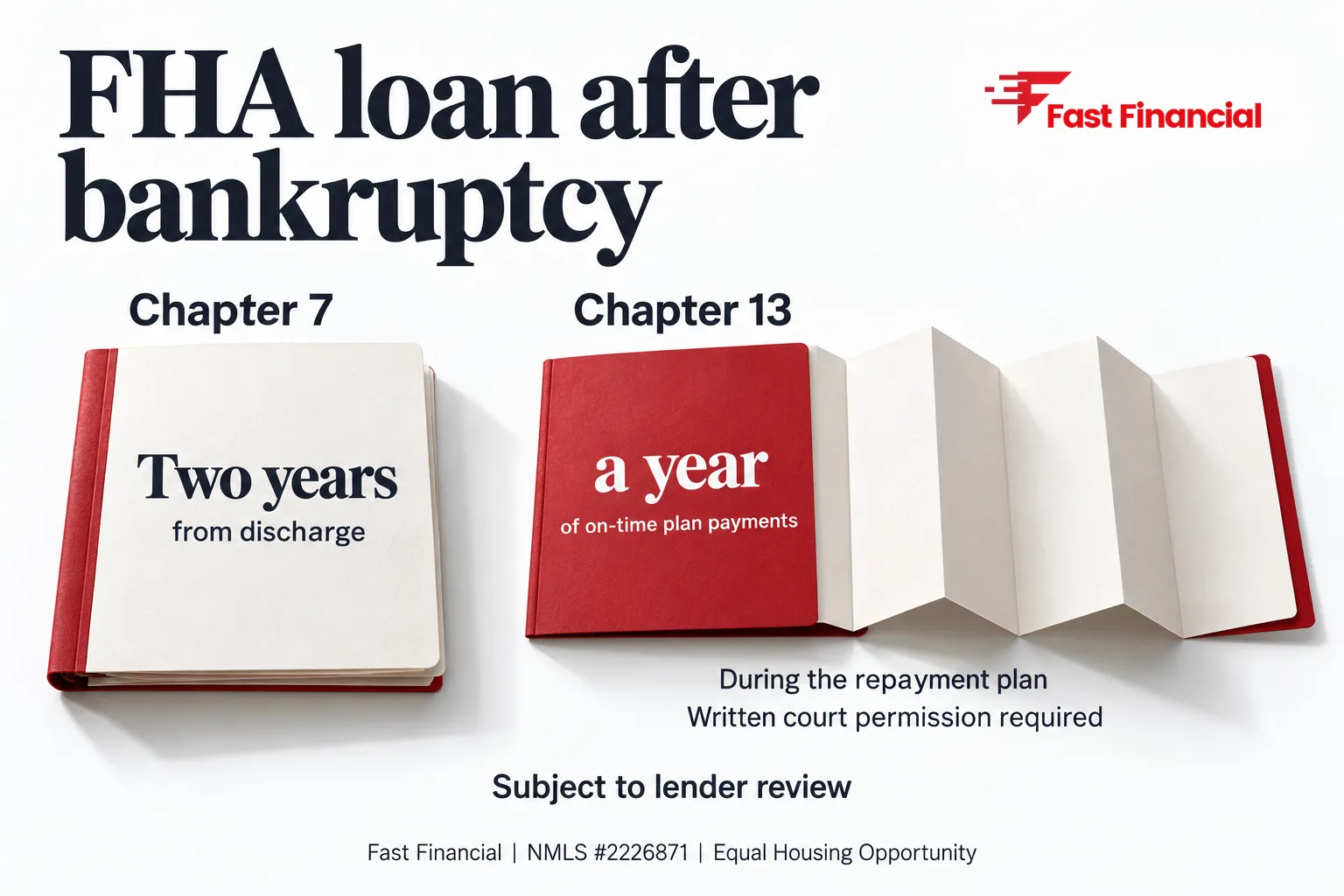
For a Chapter 7 liquidation, HUD's standard waiting period is two years from the discharge date. The clock starts at discharge, not the day you filed.
HUD allows a shorter wait only with documented extenuating circumstances. That means a event outside your control, such as a serious illness or job loss, that caused the bankruptcy. Even then, you must show you've handled your finances responsibly since. Lenders can be strict about this exception, so don't count on it.
Can you buy during a Chapter 13 repayment plan?
Often, yes. Chapter 13 is a court-supervised repayment plan, and FHA treats it differently from Chapter 7. You may be eligible while still in the plan if you've completed at least a year of the plan with on-time payments and received written permission from the bankruptcy court or trustee.
Here's what that looks like in practice:
- Your plan payments are current and documented.
- The trustee or court approves the new mortgage in writing.
- The new housing payment fits into your budget alongside the plan payment.
- The lender verifies all of it before approval.
If your plan is discharged, the Chapter 13 discharge is generally less of a barrier than a Chapter 7 discharge. Once you've finished, the lender is mostly looking at your credit since then.
Chapter 7 vs. Chapter 13: side-by-side
| Factor | Chapter 7 | Chapter 13 |
|---|---|---|
| What it is | Liquidation and discharge of eligible debts | Court-supervised repayment plan |
| HUD standard wait | Two years from discharge | Can apply during the plan after a year of on-time plan payments, with court approval |
| Extra paperwork | Discharge papers | Plan history, trustee payment record, court permission letter |
| Shorter-wait option | Extenuating circumstances, documented | Handled case by case through the court approval process |
| Biggest underwriting focus | Credit since discharge | On-time plan payments and affordability |
What about FHA loans with multiple bankruptcies?
Multiple bankruptcies don't automatically disqualify you, but they raise the bar. HUD does not publish a hard cutoff on how many filings a borrower can have. Instead, the lender looks at the pattern.
Underwriters ask why each bankruptcy happened and whether the cause was a one-time event or a repeating habit. Two filings years apart, each tied to a documented hardship, read very differently from filings close together. Expect more documentation, a clean recent history, and a manual look at your file. Some lenders also add their own stricter overlays on top of FHA rules. It is worth asking each lender, because they don't all apply the same standard.
A broker can help here. Fast Financial works with multiple lenders, so we can place a file where the underwriting fits your history instead of getting turned down by one overlay.
What else do lenders check besides the waiting period?
The waiting period is only the first gate. Underwriters then review:
- Re-established credit. They want to see new accounts paid on time since the bankruptcy. Collections and late payments after discharge hurt more than the bankruptcy itself.
- Credit score. FHA has its own score tiers, and lenders can add stricter ones. See our breakdown of FHA loan credit score requirements for how that works.
- Debt-to-income ratio. The number that matters is your total monthly obligations versus income. Learn how to calculate it in our debt-to-income ratio guide.
- Income and employment stability. Steady, documentable income matters more after a bankruptcy than before one.
- Source of funds. Your cash to close needs a paper trail. If a relative is helping, review the gift letter requirements early.
Every file goes through a mortgage underwriter, who makes the final call. Clean documentation makes that call easier.
How can you strengthen your file before you apply?
Start with the things you control:
- Pull your credit reports and confirm the bankruptcy shows as discharged, and that included debts report a zero balance.
- Open one or two new accounts, if you have none, and pay them on time every month.
- Keep balances low and avoid new collections or late payments.
- Save a documented cash cushion for closing costs and reserves.
- Read up on how to raise your credit score in the right order.
Then get a pre-approval review before you start house hunting. It tells you whether you're ready now or what to fix first.
What if FHA isn't the right fit?
Sometimes the timing or the numbers don't line up. If you haven't reached the FHA waiting period or your file needs a different structure, a non-QM loan may be worth a look. Those programs set their own credit-event rules, but terms vary by lender and borrower. If you already own a home, our guide to refinancing with bad credit lays out your California options.
See where you stand
Rates and terms vary by borrower and market, and approval depends on full underwriting. The best way to know where you stand is to have your file reviewed. Get your rate reviewed online, call Fast Financial at (661) 512-4141, or visit our office at 190 Sierra Ct Ste 324, Palmdale, CA 93550. We're a California mortgage broker, NMLS #2226871, and we're glad to walk through your timeline.
Frequently asked questions
Can you get an FHA loan with a bankruptcy on your record?
Yes. FHA allows borrowers with a bankruptcy once HUD's waiting period is met and the lender is satisfied with your re-established credit and income. Approval is never guaranteed and depends on full underwriting.
How long after a Chapter 7 discharge can you qualify for FHA?
HUD's standard wait is two years from the discharge date. A shorter period may be possible only with documented extenuating circumstances, and individual lenders may be stricter.
Can you get an FHA loan while in Chapter 13?
Often, yes. You generally need to complete at least a year of on-time plan payments and get written approval from the bankruptcy court or trustee before the lender can move forward.
Can you get an FHA loan with multiple bankruptcies?
It's possible, but expect closer scrutiny. Lenders look at why each filing happened, how far apart they were, and how your credit has behaved since.
Does a bankruptcy disqualify you from an FHA loan forever?
No. A bankruptcy is a time-based hurdle, not a permanent bar. Once the waiting period passes and your credit is rebuilt, FHA financing can be on the table again.