
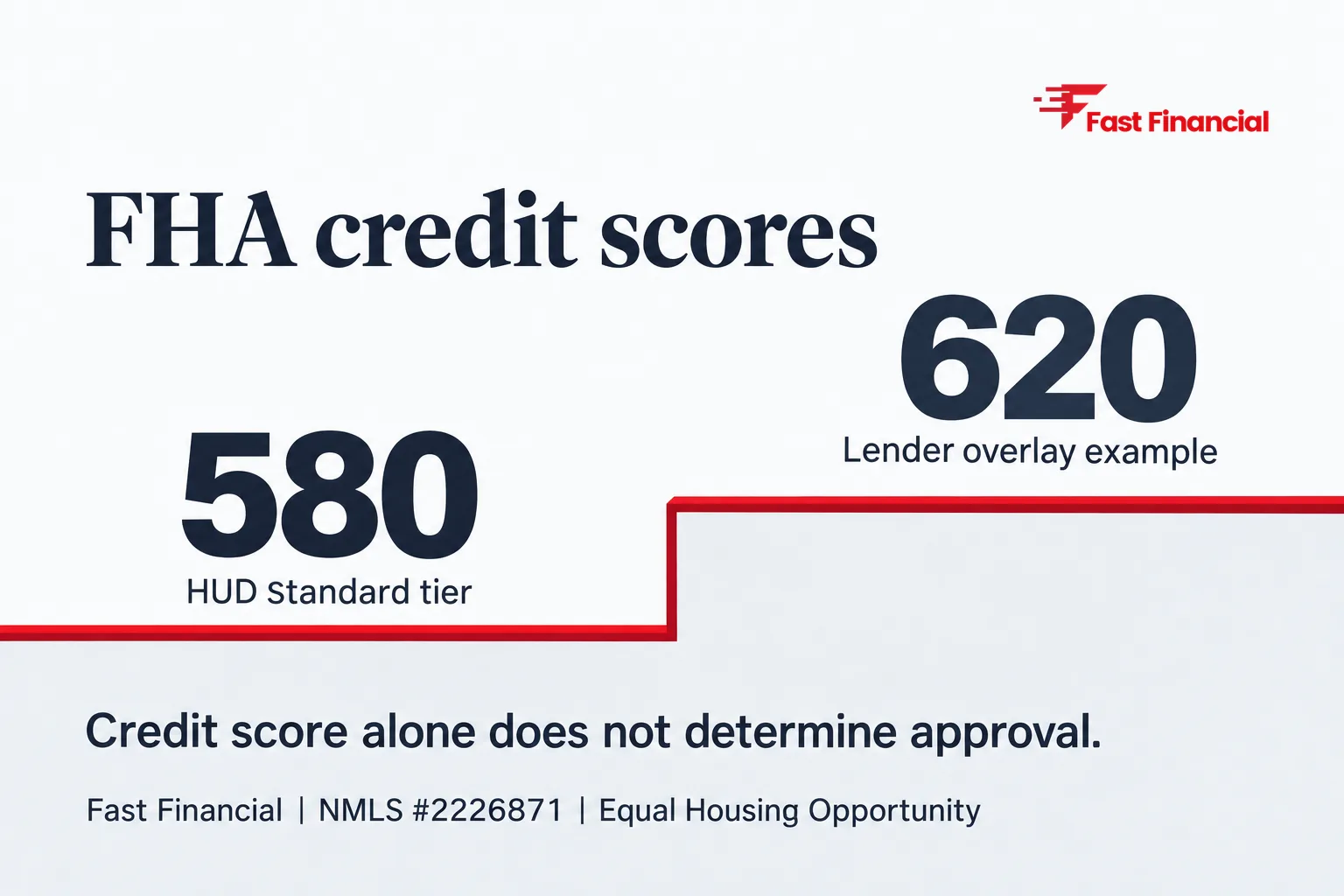
FHA loans set their credit score floor through HUD guidelines — and that floor is lower than most borrowers expect. Here's exactly how the tiers work and what stands between your score and an approval.
What Is the Minimum Credit Score for an FHA Loan?
HUD, the federal agency that backs FHA loans, establishes two distinct credit score tiers in its Single Family Housing Policy Handbook (4000.1):
- 580 and above: Qualifies for the standard FHA down payment program
- 500 to 579: Still eligible for FHA financing under HUD rules, but requires a 10% down payment rather than the standard tier
- Below 500: Not eligible for FHA-insured financing under any circumstances
These aren't lender preferences — they're HUD-established program floors every FHA lender must follow. The real question is whether your lender stops there or adds stricter requirements on top.
How credit scores affect mortgages generally is worth understanding if you want the full picture on how your score shapes every part of the loan — pricing, program access, and documentation requirements.
Why Does My Lender's Minimum Look Higher Than HUD's?
This is the most common frustration for borrowers with low credit scores — and it's worth understanding clearly before you apply.
HUD sets the program floor. Lenders set their own "overlays" — internal credit standards that can be stricter than HUD's guidelines. A lender might require a 620 minimum even though FHA technically allows 580. They're not breaking any rules; they're managing their own credit risk.
This is why lender selection matters on a low-credit FHA application. One lender's overlay might disqualify you; another might not. If you're figuring out what credit score you need to buy a house in Lancaster, CA, the right lender relationship changes what's actually possible.
The practical takeaway: HUD's floor tells you what the program allows. Your lender's overlay tells you what that specific lender will do.
What's the Real Difference Between a 580 and a 620 Score?
Both score ranges can qualify for FHA — but the path looks different.
At 580 and above, you have access to the full FHA program at HUD's standard down payment tier. Most FHA-approved lenders will work here, though some require 600 or 620 due to their overlays.
At 500–579, you're eligible on paper but limited in practice. Few lenders go below 580 regardless of HUD's floor, and the 10% down requirement under HUD guidelines changes the financial math significantly.
At 620 and above, you move into a cleaner approval zone for most FHA lenders — and you also start to qualify for conventional options. At that threshold, comparing FHA to conventional becomes a real decision, especially in a high-cost market like Los Angeles County where loan amounts put the program to work.
What Else Do FHA Lenders Look At Beyond Credit Score?
Your credit score gets you in the door. These factors determine whether you close:
Debt-to-income ratio (DTI). FHA generally allows higher DTI than conventional loans, but lenders have limits. Your monthly obligations relative to your gross income matter — keep it tight.
Employment and income history. Two years of consistent employment is the standard. Gaps, recent job changes, or self-employment don't automatically disqualify you, but they require more documentation.
Down payment source. FHA allows gift funds from a family member as long as it's documented properly — a gift letter and bank statements showing the transfer. Lenders will verify the paper trail.
Property condition. FHA appraisals are stricter than conventional ones. The home has to meet HUD's minimum property standards — not just appraised value. How FHA appraisals work is a part of the process borrowers underestimate until a deal gets held up by it.
Mortgage insurance premium (MIP). FHA loans require an upfront MIP and an annual MIP that's paid monthly. These are program costs that don't vary by credit score — they vary by loan term and LTV. Budget for both.
Can an FHA Loan Compete in the California Market?
Yes — and in much of California, it's a primary tool for buyers who aren't bringing large down payments.
In the Antelope Valley — Lancaster, Palmdale, Quartz Hill — FHA loan limits follow Los Angeles County guidelines, which HUD sets higher than most counties nationally. That's a real advantage in a market where even entry-level homes carry significant price tags.
First-time homebuyer programs in the Antelope Valley can layer onto FHA financing in some cases. CalHFA programs, for example, may assist with down payment when you're FHA-eligible — though they carry their own credit requirements, typically at or above FHA minimums.
If your score puts you in FHA territory and you're not sure whether it's the right fit, the move is to compare options side by side. See where you stand — Fast Financial (NMLS #2226871) works across California and can run multiple scenarios for your situation.
How to Move Your Credit Score Before You Apply
If you're at 550 and need to get to 580 or 620, the levers are concrete:
- Pay down revolving balances. Credit utilization — how much of your available revolving credit you're using — is one of the fastest-moving factors in your score. Getting utilization below 30% across your accounts can move your score noticeably within a billing cycle or two.
- Don't open new accounts. New inquiries and new accounts temporarily dip your score. Hold off during the months before you plan to apply.
- Dispute errors. Pull your reports from all three bureaus. A wrong derogatory mark can be dragging your score for no reason — dispute it in writing with documentation.
- Keep existing accounts open. Closing old accounts shortens your average credit age and can hurt more than it helps.
- Ask about rapid rescore. If you've paid off a balance but the bureaus haven't reflected it yet, ask your lender whether rapid rescore is available. It can fast-track an update through the bureaus in days rather than weeks.
A few focused months can move a 560 to a 590, and a 590 to a 620. That gap is often the difference between a narrow approval path and a clean one. Pair your credit work with a mortgage pre-approval once you're in range — it gives you a real number to work with instead of guessing.
Frequently Asked Questions
What is the lowest credit score for an FHA loan?
HUD's official floor is 500. At 500–579, you're eligible under HUD guidelines but face a 10% down payment requirement. Below 500, FHA financing isn't available. In practice, most lenders set their own floor at 580 or higher — some require 620 due to internal overlays.
Can I get an FHA loan with a 580 credit score in California?
Yes — 580 meets HUD's minimum for the standard FHA down payment tier. Whether a specific California lender approves you at exactly 580 depends on their overlays. Working with a broker who has access to multiple lenders gives you more options than going directly to one institution. See how credit score requirements vary across mortgage types in California.
How is FHA different from conventional for low-credit borrowers?
FHA is generally more accessible at lower scores. Conventional loans have their own minimums, and their pricing structure — unlike FHA's fixed MIP — adjusts aggressively based on credit score. For borrowers in the 580–639 range, FHA vs. conventional is a comparison worth running with a broker who can show you both.
Does my credit score affect my FHA mortgage insurance premium?
No — FHA's mortgage insurance premiums are set by HUD and don't vary by credit score. They vary by loan term and loan-to-value ratio. This is one area where FHA differs from conventional loans, where mortgage insurance pricing is directly credit-score-sensitive.
Can I refinance an FHA loan with a low credit score?
The same HUD credit score standards that apply to FHA purchases generally apply to FHA refinances. FHA Streamline refinances have specific eligibility rules around existing FHA loans, but credit requirements still apply. Refinancing options depend on your current loan type, credit picture, and goals — worth reviewing with a broker before assuming you don't qualify.
Related reading
Related reading
Related reading
- FHA Assumable Mortgage Requirements: What Buyers Need to Know
- FHA Mortgage Requirements: What You Need to Qualify