
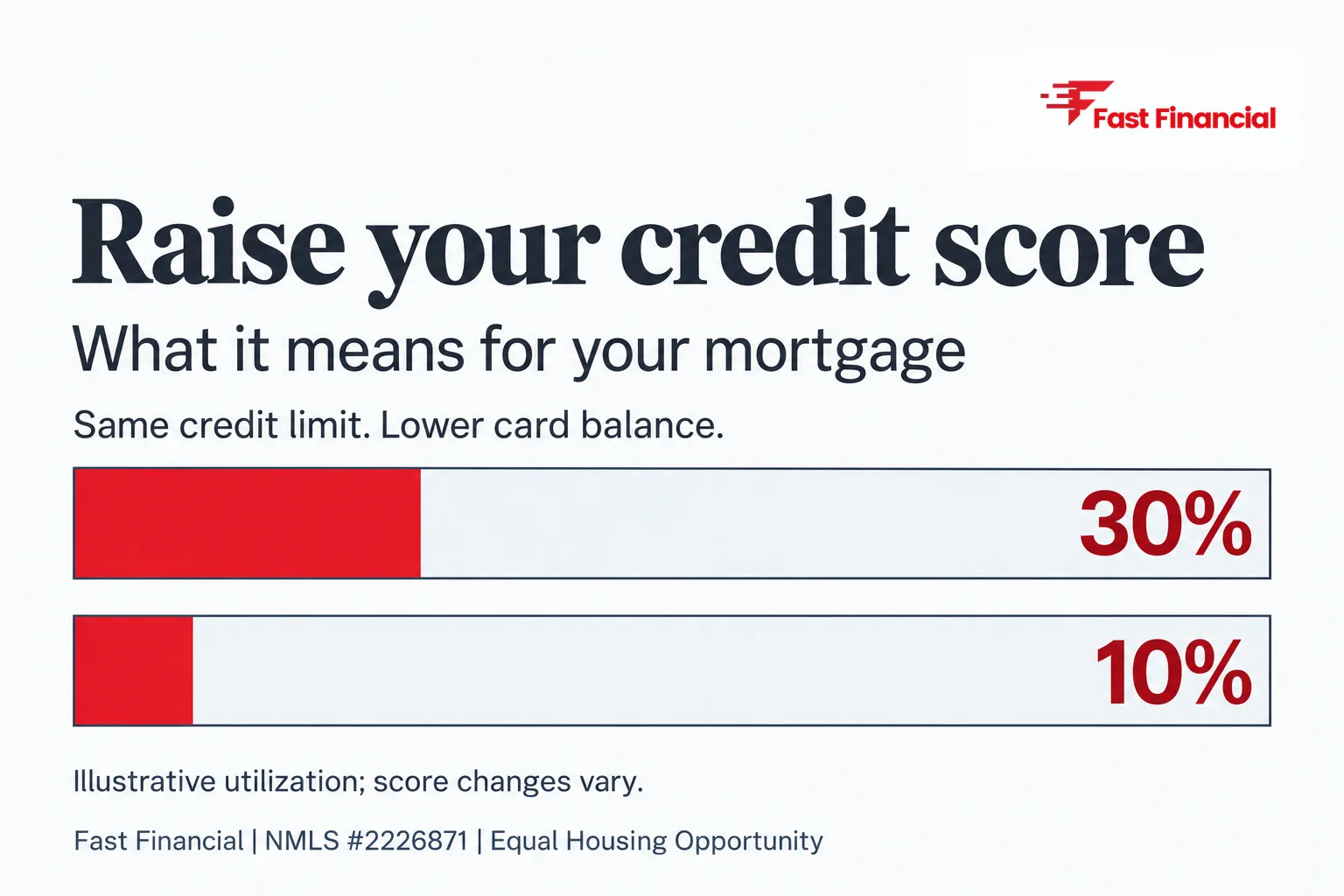
Raising your credit score comes down to two levers that control nearly two-thirds of your score: pay everything on time, and reduce what you owe on revolving credit. Everything else matters — but those two moves are where the points live.
If you're planning to buy or refinance in California, your credit score doesn't just affect whether you qualify. It shapes which loan programs are available to you, what lenders will offer, and how much flexibility you have on the deal. Here's exactly how to move it.
Why Your Credit Score Is the Mortgage Wildcard
Mortgage lenders underwrite to score bands. Cross a threshold and you unlock programs you couldn't access before — or qualify on terms that weren't on the table.
Understanding how credit scores affect mortgages starts with recognizing the relationship isn't linear. A focused 20–40 point improvement can be the difference between a conventional loan and a non-QM product, or between qualifying independently and needing a co-borrower. If you're not sure what credit score you need for a mortgage in California, start there before you decide what number you're chasing.
The move: know your target before you build toward it. Going from 640 to 660 may matter more than going from 720 to 740.
What Actually Drives Your Score?
FICO — the scoring model most mortgage lenders pull — weights five factors. Two of them account for nearly two-thirds of your score:
| Factor | Weight |
|---|---|
| Payment history | 35% |
| Amounts owed (utilization) | 30% |
| Length of credit history | 15% |
| Credit mix | 10% |
| New credit inquiries | 10% |
Payment history is binary: pay on time, every time. One 30-day late payment can damage a strong score significantly and stays on your report for seven years.
Utilization — your revolving balances relative to your credit limits — is the fastest lever you can pull. It recalculates every month when your balances report. Pay down a card and your score moves next cycle.
How Do I Raise My Credit Score Quickly?
These moves are ranked by how fast and how significantly they typically shift the needle:
Can paying down credit card balances move my score in 30 days?
Yes — and it's often the fastest single action available. Lenders see your utilization as your statement balance, not your payment date. Aim to keep total revolving utilization under 30%. Under 10% is better for top-tier scores.
If balances are spread across multiple cards, prioritize any card over 50% utilization first. High per-card utilization can hurt disproportionately, even when your overall utilization looks reasonable.
Does requesting a credit limit increase actually help?
It can — and immediately. A higher credit limit on an existing card lowers your utilization percentage without you paying a dollar. Call the card issuer and ask. Most will run a soft inquiry that doesn't affect your score. Some do a hard pull, so confirm before they run it.
How does becoming an authorized user raise a credit score?
Getting added as an authorized user on a family member's or spouse's account puts that account's history on your report. If the account is old, carries a low balance, and has a clean payment record, it can meaningfully strengthen a thin or young credit profile. The primary cardholder doesn't need to give you access to the card.
This is one of the few moves that can add years of positive history to your report without waiting years.
Should I check my credit reports for errors first?
Before you do anything else. Pull your reports from all three bureaus and look for accounts you don't recognize, balances that look off, or late payments that weren't actually late. Dispute directly with the bureau in writing.
Legitimate errors are more common than people expect. A corrected tradeline produces a score update as soon as the bureau applies the change — not months later.
What Should I Avoid While Raising My Score?
Two moves that consistently backfire:
Don't open new accounts. Each application generates a hard inquiry and a new account that shortens your average credit age. A pattern of new accounts before a mortgage application signals elevated risk to underwriters.
Don't close old accounts. Closing an account removes that available credit from your utilization math and can shrink your average credit history length. An old card you don't use is still working for you. Leave it open.
Is There a Faster Path Through the Mortgage Process — Like Rapid Rescore?
Yes. If you're already working with a lender and your score is close to a qualifying threshold, ask about rapid rescore. It's a lender-side tool that lets a licensed mortgage professional submit documented payoffs or corrections directly to the bureaus — and receive an updated score in a few business days instead of waiting for the next regular reporting cycle.
You can't access it directly as a consumer. But if you're serious about buying and within striking distance of a meaningful threshold, this is worth discussing early. Getting a rate review started opens that conversation.
How Long Does It Actually Take to Raise a Credit Score?
Honest answer: it depends on what's holding your score down.
- High utilization, paid down: one billing cycle (30 days or less) after the balance reports
- Authorized user added: one to two billing cycles
- Disputed error, corrected: typically 30–45 days for the bureau investigation to close
- Late payment on record: the account is current again immediately, but the derogatory history fades slowly over time
- Thin file (not enough history): months to build, because you're waiting on time itself
If you're planning to buy a home in the Antelope Valley or anywhere in California and you're six to twelve months out, that's real runway. Start now. Knowing how much income you need to qualify and what first-time homebuyer programs are available in your area will help you set the full picture.
If you're closer to buying, start a mortgage pre-approval conversation now — a good broker identifies the exact threshold that changes your options and works backward from there. That's how you avoid six months of generic credit advice that moves you in the wrong direction.
Frequently asked questions
What credit score do I need to qualify for a mortgage in California?
It depends on the program. FHA loans have a minimum of 580 under standard guidelines; conventional loans typically require at least 620; some non-QM products can qualify below that. The floor is a starting point — a stronger score opens more programs and better terms. See the full breakdown in what credit score you need to buy a house in Lancaster, CA.
Will checking my own credit hurt my score?
No. Pulling your own report is a soft inquiry with zero scoring impact. Only a hard pull — initiated by a lender when you formally apply — affects your score, and even those carry minimal weight individually.
How much can I realistically raise my score in 30 days?
It depends on your starting profile. Borrowers who tackle high utilization aggressively often see meaningful movement in a single billing cycle. There's no universal number. A mortgage broker can review your actual report and tell you where the points are and how to get them. See where you stand.
Does paying off a collection account raise my credit score?
Under older scoring models (FICO 8 and earlier, still widely used), paid collections can still weigh on your score. Newer models like FICO 9 and VantageScore give less weight to paid collections. Whether paying one helps — and by how much — depends on which score your lender is pulling. Worth a direct conversation with your loan officer.
When is the right time to talk to a mortgage broker about my credit score?
Earlier than you think. The ideal time is before you believe you're ready — that's when you actually have room to move the number. Reach out to Fast Financial and we'll review where you stand and what it takes to qualify for the programs that make sense for your situation.
--- Fast Financial is a California mortgage broker, NMLS #2226871. Loan terms and qualification requirements vary by borrower, lender, and market conditions. This content is educational and does not constitute a loan commitment or guarantee of credit.