
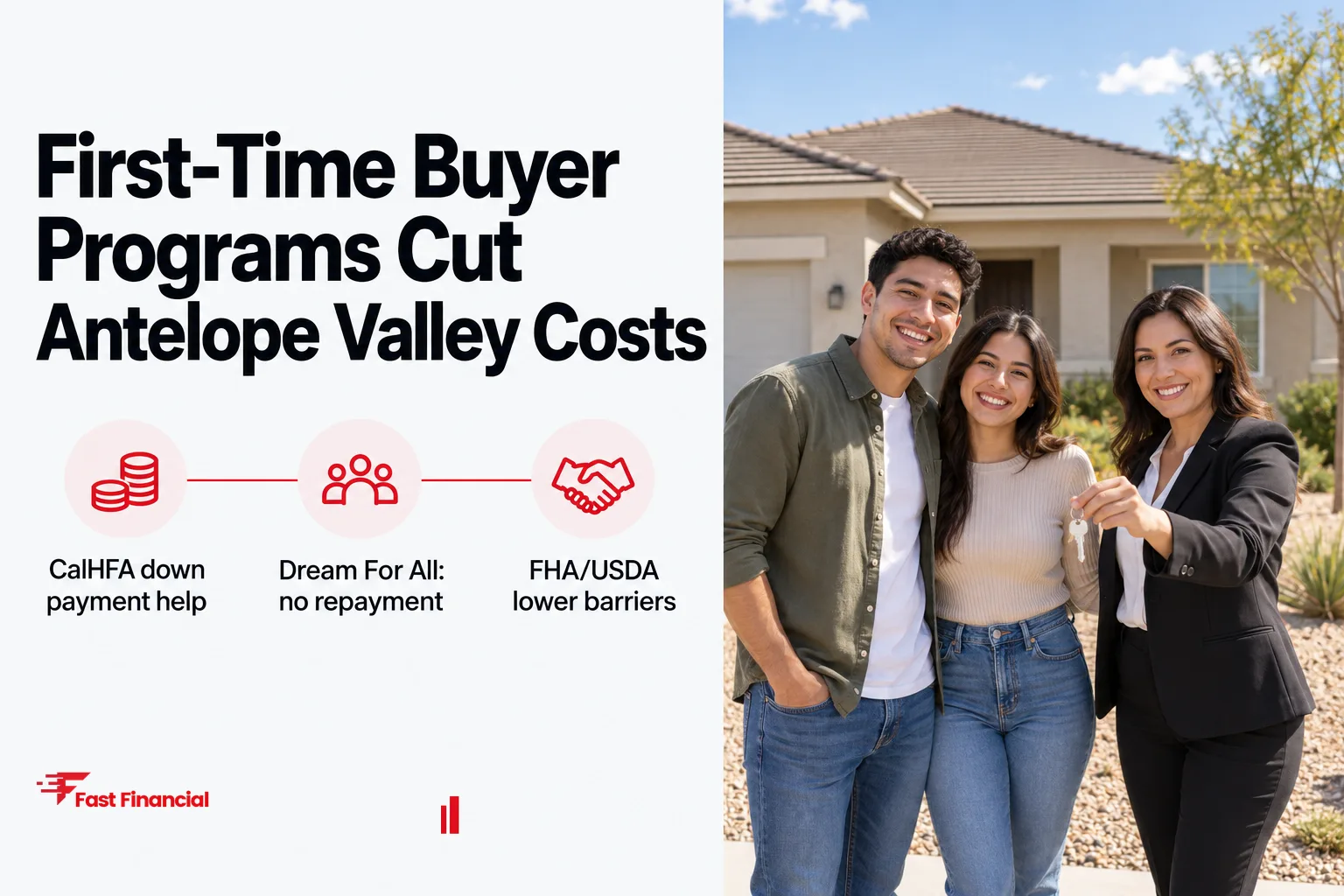
First-time buyers in Lancaster, Palmdale, and the surrounding Antelope Valley have real options — state programs, federal loan types, and layered assistance that can meaningfully cut what you need to bring to closing. The key is knowing which programs you actually qualify for and how to use them together.
What first-time homebuyer programs are available in California?
California offers more assistance than most states, largely through the California Housing Finance Agency (CalHFA). The main categories:
- CalHFA loan programs — first mortgage options paired with down payment and closing cost assistance
- California Dream for All — a shared appreciation loan that covers up to 20% of the purchase price
- FHA loans — federally backed mortgages with low down payment requirements and flexible credit guidelines
- USDA loans — zero-down financing for buyers purchasing in eligible rural or suburban areas
Each program has its own income limits, purchase price caps, and credit requirements. Most of the Antelope Valley falls within the eligible footprint for several of these — and AV home prices often give you more headroom against the caps than buyers see in coastal LA.
What is CalHFA's MyHome Assistance Program?
MyHome is CalHFA's core down payment assistance product. It's a deferred-payment junior loan — no monthly payments. It becomes due when you sell, refinance, or pay off the first mortgage.
The assistance can go toward your down payment, closing costs, or both. It layers on top of CalHFA's own first mortgage options (conventional and FHA). The entire package — first loan plus assistance — closes in one transaction.
To use MyHome, you complete a CalHFA-approved homebuyer education course before closing. That's not a bureaucratic hurdle; it's one of the most useful things a first-time buyer can do. You'll walk away knowing exactly what you're signing.
What is the California Dream for All program?
Dream for All is the state's shared appreciation loan. California covers up to 20% of your purchase price as a down payment. When you later sell or refinance, the state gets back that same percentage of the home's appreciated value — not a fixed dollar amount, a share of the gain.
The program is heavily oversubscribed. California has run it as a voucher lottery in recent cycles because demand far exceeds available funding. You apply during the open enrollment window, receive a voucher if selected, and then have a window to find a property. Don't assume it's available on demand — check current program status with a CalHFA-approved lender.
When it works, Dream for All can dramatically shrink your first mortgage balance. The long-term math depends on appreciation, but for buyers who plan to stay five to ten years or longer, the tradeoff often pencils out.
Do these programs cover buyers in Palmdale and Lancaster specifically?
Yes — the Antelope Valley sits squarely within CalHFA's service area, and prices in Palmdale and Lancaster regularly come in well below the statewide purchase price caps. That's an advantage: more of the purchase price falls within program limits, so assistance dollars go further.
USDA eligibility is a separate angle worth checking. Parts of Quartz Hill and certain unincorporated areas in the AV still qualify for USDA Rural Development loans — zero down payment and no private mortgage insurance. The eligibility map updates periodically, so you need to run a specific property address through the USDA tool to confirm. A city-center address in Lancaster or Palmdale proper typically won't qualify; suburban and unincorporated parcels have a better shot.
How do I qualify for first-time homebuyer programs?
Requirements vary, but here's what matters across most programs:
First-time buyer definition. You haven't owned a primary residence in the past three years. On joint loans, both borrowers typically need to meet this threshold for CalHFA programs.
Income limits. CalHFA caps income by county and household size, updated annually. Los Angeles County limits are published on CalHFA's site. Going over the income limit doesn't disqualify you from buying — it just removes the state assistance layer.
Credit score. FHA is more flexible than conventional, but lenders often set overlays. In practice, a 640–660 FICO is frequently the floor for assisted programs; stronger scores open more doors. Dream for All has its own published minimums.
Homebuyer education. Required for CalHFA programs. A HUD-approved course covers the material — most are online and take a few hours. It's worth doing even if you're not sure you'll use CalHFA.
Owner-occupancy. Every program here requires the property to be your primary residence. None apply to investment properties or vacation homes.
Can I combine multiple programs?
Yes — and that's often the right move. The most common stack is a CalHFA first mortgage paired with MyHome down payment assistance. Some buyers use Dream for All as the down payment layer alongside a conventional or CalHFA first loan.
What you can't do is stack two assistance programs on the same loan. One first mortgage, one assistance source. Your lender should walk through which combination gets you to closing with the least out-of-pocket while keeping every loan inside program guidelines.
The Antelope Valley's price range means you often have room to use assistance money efficiently — covering closing costs entirely rather than splitting it between costs and down payment, for example. The exact structure depends on your numbers.
Frequently asked questions
Do I need 20% down to buy a home in the Antelope Valley?
No. FHA loans require as little as 3.5% down. Conventional loans with private mortgage insurance go as low as 3–5%. USDA and VA loans require zero down for eligible buyers. Assistance programs can cover part or all of the minimum down payment requirement.
Is California Dream for All accepting applications right now?
The program opens in periodic enrollment windows and is allocated by lottery when oversubscribed. Availability changes frequently — confirm current status before building it into your plan. A CalHFA-approved lender can tell you whether the enrollment window is open.
What's the income limit for CalHFA programs in Los Angeles County?
Limits vary by household size and are updated each year. A lender who regularly originates CalHFA loans will pull the current figures for your specific household. If you're near the edge, it's worth checking — the limits are higher than many buyers expect.
Does USDA cover homes in Lancaster or Palmdale?
City-center addresses in Lancaster and Palmdale typically don't qualify. Parts of Quartz Hill and some unincorporated AV areas often do. The only way to confirm eligibility is to run a specific address through the USDA property eligibility tool.
How do I get started?
Get pre-approved with a lender who actively originates CalHFA transactions — not every lender is approved to do them. That first conversation maps your income, credit, and target price against the programs you qualify for, so you know exactly what you're working with before you make an offer.
Fast Financial is a California mortgage broker, NMLS #2226871. Loan programs, income limits, and assistance availability change — verify current terms with a licensed loan officer. Equal Housing Opportunity.