
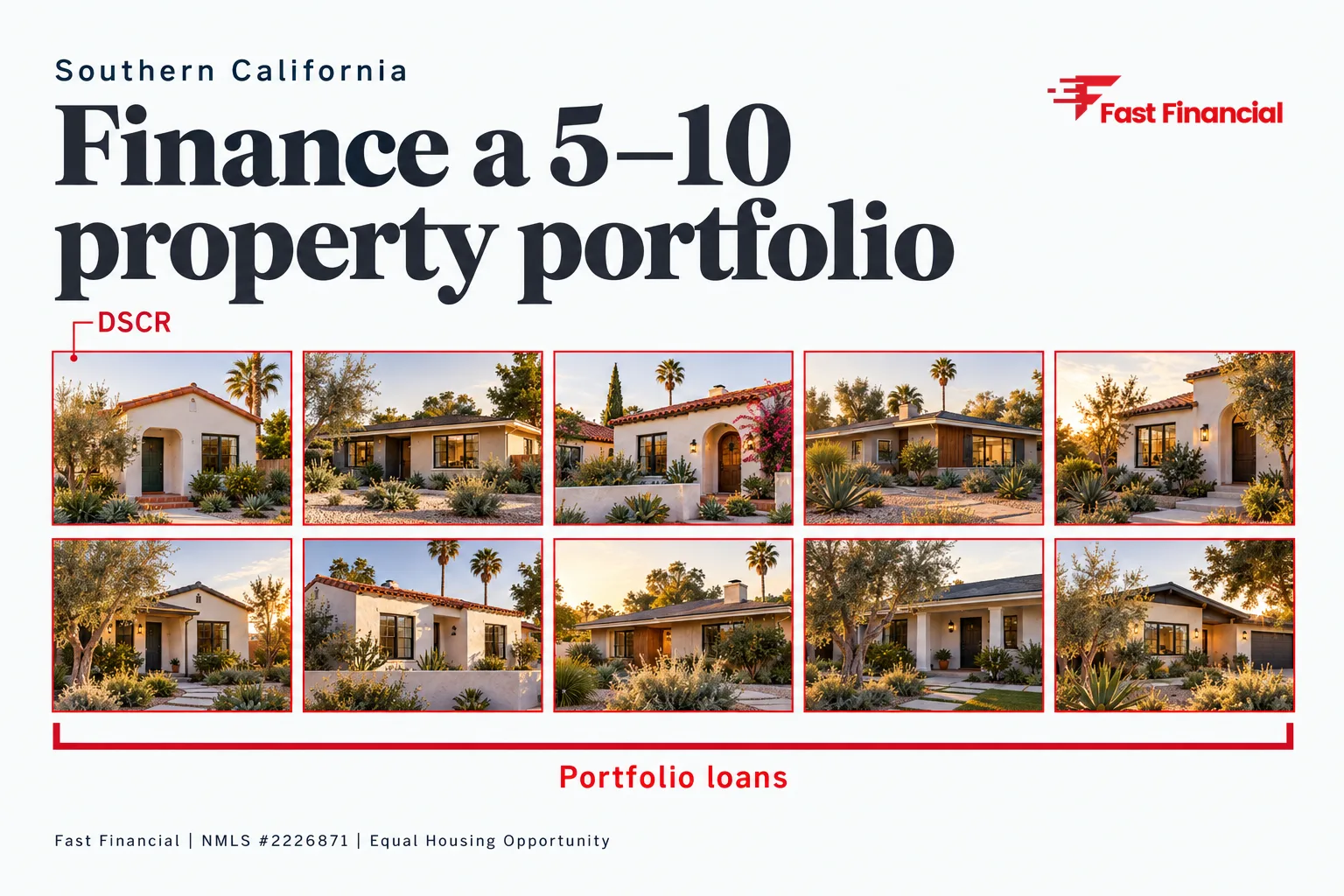
Building a rental portfolio past four properties in Southern California means conventional financing stops carrying the load — DSCR loans and portfolio lending are the two tools that actually scale.
Most investors hit a wall somewhere between properties five and ten. The culprit isn't ambition or deal flow — it's underwriting. Conventional loans backed by Fannie Mae and Freddie Mac have guidelines that make scaling increasingly difficult once you hold multiple financed properties. Every new loan stacks against personal debt-to-income, and W-2 income can only carry so much weight. The fix is a structural shift: qualify on the asset's income, not yours.
What Changes When You Cross Four Financed Properties?
Conventional guidelines allow up to ten financed properties per borrower, but the requirements tighten significantly at properties five through ten: higher reserve requirements, stricter credit standards, more documentation. For active investors, the real ceiling often feels lower.
Understanding the difference between a primary residence loan and an investment property mortgage is the starting point. From there, the strategy is matching the right non-conventional product to each stage of growth. The investors who scale past property five aren't necessarily wealthier — they're using the right structures.
What Is a DSCR Loan — and Why Do Portfolio Investors Use It?
DSCR stands for Debt Service Coverage Ratio. The concept is direct: does the property generate enough rental income to cover its debt payments? If it does, the loan qualifies — regardless of what the borrower earns personally.
That's the shift. You're not qualifying you; you're qualifying the deal.
DSCR loans in California underwrite on the rent the property produces (or could produce, based on a market rent analysis) relative to the monthly principal, interest, taxes, insurance, and HOA. Lenders look for that ratio comfortably above 1.0 — the higher the DSCR, the stronger the file. A property that rents for meaningfully more than it costs to hold is a clean loan.
What makes DSCR ideal for portfolio building:
- No personal income documentation required — no W-2s, no tax returns, no DTI calculation tied to your salary
- Each property stands alone — you're not stacking debt against a single income stream
- Scales repeatably — a deal that pencils on cash flow is a deal you can finance
For the full underwriting picture, what is a DSCR loan and who qualifies walks through exactly how these loans are structured.
What Is a Portfolio Loan?
A portfolio loan is a mortgage the lender holds on its own books rather than selling to the secondary market. Because it never passes through Fannie Mae or Freddie Mac guidelines, the lender sets its own rules — and that flexibility is the point.
Portfolio lenders can:
- Finance properties held in an LLC or trust
- Cross-collateralize multiple properties under one loan structure (a blanket loan)
- Underwrite on overall portfolio health rather than property-by-property DTI
- Move faster with fewer documentation requirements
The trade-off is that portfolio loans are typically priced higher than agency-conforming loans, and terms vary significantly by lender. But for an investor with five to ten rentals scattered across LA County or the Antelope Valley, the flexibility often justifies the spread. DSCR and portfolio lending frequently overlap — many DSCR loans are portfolio products, and both fall under the broader non-QM loan category.
How Investors Build From One to Ten Properties
The scaling playbook for a Southern California rental portfolio looks roughly like this:
Properties 1–4: Conventional financing works. You're inside Fannie/Freddie guidelines, documenting personal income, building equity in your first assets.
Properties 5–7: Shift to DSCR. Each new acquisition underwrites on its own cash flow. Personal income stays out of the equation. Reserves matter — most DSCR lenders want several months of payments per property across the portfolio.
Properties 8–10: Blanket loans or a portfolio lender who knows your track record. At this stage, a single point of contact who understands investment lending is worth more than chasing the lowest-cost option on any individual deal.
One of the most effective scaling tools at any stage: a cash-out refinance on an appreciated property to pull equity for the next acquisition's down payment. Southern California values have run hard in many submarkets — investors who bought in Palmdale or Lancaster several years ago are sitting on real equity that a DSCR cash-out can redeploy.
For investors targeting below-market or value-add acquisitions, financing distressed assets in California adds another layer worth understanding before you make an offer.
What Lenders Actually Look At
Even though DSCR loans don't use personal income, the borrower still gets underwritten:
Credit: A stronger score opens better pricing and terms. Lenders care, even on asset-based loans.
DSCR ratio: The higher the property's rental income relative to PITI, the cleaner the file. Properties that barely break even present risk; properties with strong coverage are compelling.
Reserves: Expect lenders to require liquid reserves across your whole portfolio. More properties means more reserve requirements.
Property type: Single-family, 2–4 unit, small multifamily, and short-term rentals are all underwritten differently. Know which category your target falls into before you run the numbers.
Experience: Portfolio lenders often ask how many properties you've managed and for how long. Track record matters.
If you hold assets in an LLC or trust, disclose that upfront — not all lenders accommodate entity vesting, but many portfolio lenders do. For Southern California investors, a Los Angeles mortgage broker familiar with non-QM and portfolio products is worth more than a conventional bank trying to make your deal fit a checklist.
And if the portfolio spans the LA metro up into the Antelope Valley, note that higher-balance acquisitions in core LA markets may also bring jumbo loan territory into the picture on select properties.
Frequently Asked Questions
Can I use a DSCR loan to buy properties in an LLC?
Many DSCR and portfolio lenders allow LLC vesting — it's one of the primary reasons investors prefer them over conventional loans, which generally require individual borrowers. Disclose your entity structure at the start so your lender can match you to a compatible product.
Is there a maximum number of properties I can finance with DSCR loans?
Unlike conventional guidelines, DSCR lenders don't apply a fixed cap at ten properties. Each deal is evaluated on its own cash flow. Investors with large portfolios do use DSCR as a primary financing tool — what evolves at scale is reserve and experience requirements, not an arbitrary property count.
Do I need to show tax returns to qualify for a DSCR loan?
No — that's the defining feature. DSCR loans use a market rent analysis or executed lease to qualify the property. Your personal tax returns, W-2s, and employment history aren't part of the underwriting file.
What's the difference between a DSCR loan and a portfolio loan?
DSCR is an underwriting method: the property qualifies on its rental income. Portfolio is a lending model: the lender holds the note in-house. They frequently overlap — most DSCR loans are portfolio products — but a portfolio lender may also use hybrid income calculations that go beyond a strict DSCR formula.
Where do I start if I already have four conventional loans?
Map your current portfolio first: equity positions, cash flow on each property, existing loan balances. Then have a strategy conversation with a lender who handles non-QM and DSCR — the sequencing of which loans to tap for equity and which properties to finance next matters more than any single rate.
Ready to see where your portfolio stands? Call Fast Financial at (661) 512-4141 or get your situation reviewed online. We work with investors across Southern California on DSCR, portfolio, and blanket loan strategies. If you're in the Antelope Valley, our office is local — 190 Sierra Ct Ste 324, Palmdale, CA 93550. Licensed in California, NMLS #2226871.