
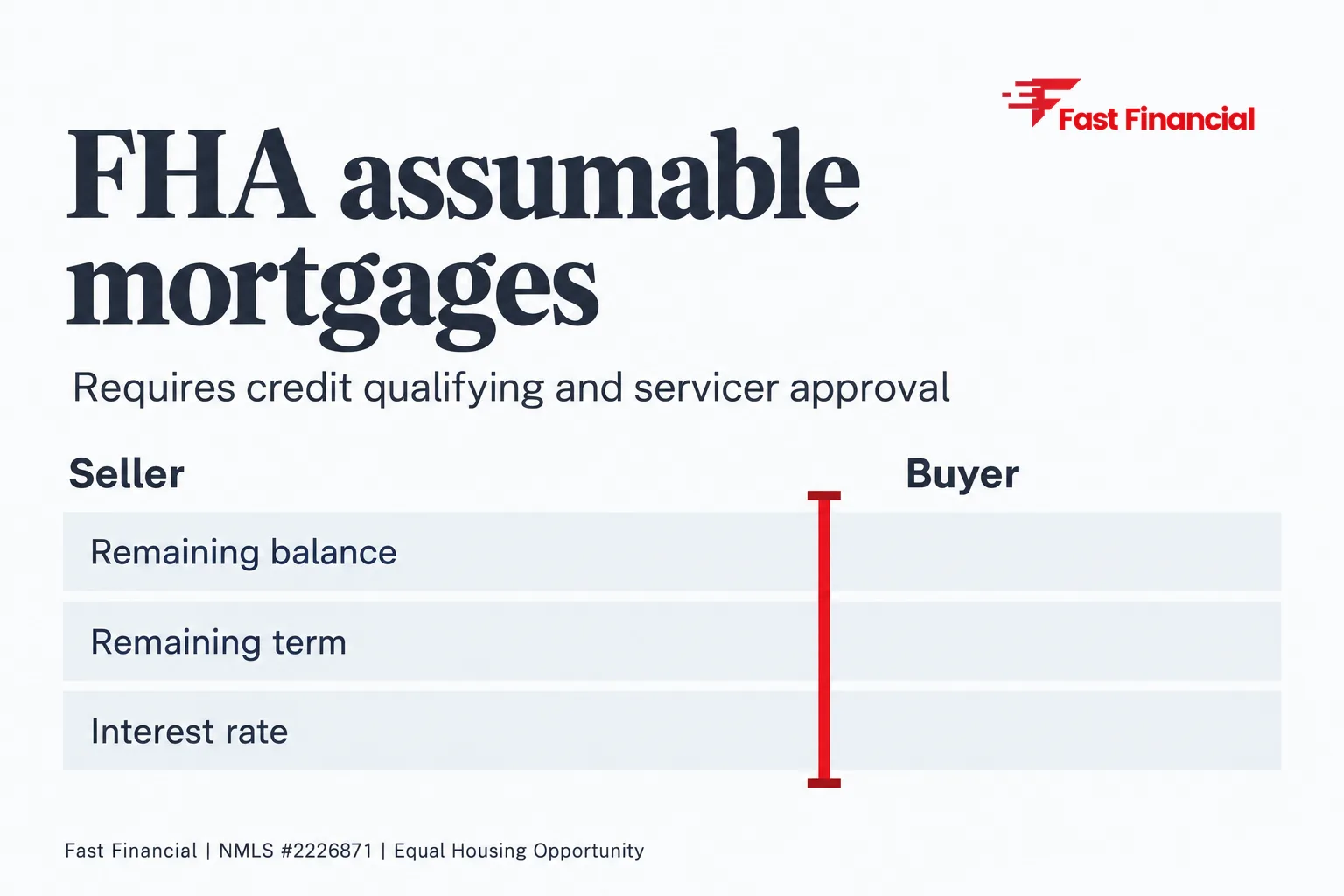
FHA loans are assumable — a qualified buyer can take over the seller's existing FHA mortgage, inheriting its remaining balance, term, and rate. That's a real advantage in the right situation, but it's not automatic. You have to qualify, and the servicer has to approve it.
Here's what the process actually requires.
What Does "Assumable" Mean for an FHA Loan?
When you assume a mortgage, you step into the original borrower's shoes. You take over their remaining loan balance, their remaining term, and their interest rate — exactly as it stands. The lender doesn't write a new loan. They transfer the existing one to you, pending approval.
FHA loans have been assumable since the program began, but the rules changed in 1986. Loans originated on or after December 1, 1986 require the buyer to credit-qualify through the servicer — the assumption is not automatic. Loans from before that date are freely assumable with no credit review, but those are rare in today's market.
The bottom line: if you're eyeing a home with an existing FHA loan, plan for a formal approval process before the assumption closes.
Who Qualifies to Assume an FHA Mortgage?
The buyer must meet the servicer's credit and income standards — essentially the same bar you'd clear for a new FHA loan. What lenders actually look at:
Credit score. FHA has a minimum credit threshold, and the servicer handling the assumption may apply its own overlay on top of that. If your credit affects your mortgage eligibility generally, it affects your assumption eligibility too. What credit score you need for a mortgage in California covers the baseline expectations worth knowing before you start.
Debt-to-income (DTI). The servicer will verify that your income covers the assumed payment plus your other obligations, within FHA's DTI guidelines. How much income you need to buy a house in California explains how lenders think through this calculation.
Occupancy intent. If the original loan was for a primary residence, FHA requires the assuming buyer to also intend to occupy the home as their primary residence. An investor cannot simply assume a primary-residence FHA loan.
Funds to close the equity gap. The assumption only covers the remaining loan balance — not the full purchase price. If the home has appreciated, you're responsible for the difference. That gap gets paid at closing, either in cash or through a second lien. Know this number before you fall in love with the property.
What Does the FHA Assumption Approval Process Look Like?
Unlike getting a new mortgage, there's no shopping for a lender. The assumption must go through the existing servicer — the company currently collecting payments on the loan. You don't choose your lender here.
The general process:
- Request the assumption package from the current servicer. They're required to provide it.
- Submit a full credit application — income docs, bank statements, ID, credit authorization.
- Servicer underwrites the file using FHA guidelines and their own overlays.
- HUD or the servicer issues approval. Supervised lenders (banks, savings institutions) can approve assumptions internally. Non-supervised lenders typically need HUD sign-off.
- Sign the assumption agreement, which transfers the loan obligation to you and legally binds you to its terms.
- Close. The deed transfers, the assumption gets recorded, and you become the borrower of record.
Processing times vary by servicer. Build 45 to 90 days into your purchase timeline — this is not a 30-day process. Communicate that clearly in your offer. There is also a processing fee, capped by HUD guidelines; ask the servicer for the exact amount upfront.
Is the Seller Released from Liability?
Not automatically — and this is the detail that catches sellers off guard.
Until the servicer formally approves the assumption and releases the seller from liability, both parties remain on the hook. If you default after closing, the servicer could pursue the original borrower. Sellers who want a clean break need a novation — a formal written release from the loan obligation.
Some servicers issue the release automatically with assumption approval; others require a separate written request. Sellers should never assume they're off the note without a document confirming it.
From the buyer's side, note that you're assuming a loan the seller originated — pull the payment history as part of your due diligence before signing anything.
How Does Mortgage Insurance Factor In?
FHA loans carry mortgage insurance premium (MIP) — an upfront premium paid at origination plus an annual premium baked into the monthly payment. When you assume the loan, you inherit the MIP structure already in place on that loan, not the structure currently required for new originations.
Depending on when the original loan was made, the inherited MIP terms may differ from what a new FHA borrower would pay today. That can be a meaningful detail in the overall cost comparison. This guide to mortgage insurance explains how FHA MIP is structured and when it falls off.
Is an FHA Assumption Always the Right Move?
It depends on what you're comparing against. Assumption makes the most sense when the existing loan has favorable terms, the equity gap is manageable, you qualify under FHA standards, and the property still meets FHA condition requirements.
If the equity gap is large, you may end up financing it at current market rates through a second lien — which means you're effectively blending two loans, and the math gets complicated fast. Compare the combined cost against a fresh FHA or conventional loan before committing to the assumption path.
One more factor: an assumption doesn't reset the term. You inherit whatever remains on the amortization schedule. If 21 years remain on a 30-year note, you're taking on a 21-year payoff — not a fresh 30. That changes the monthly picture and the long-term interest cost.
For first-time buyers in the Antelope Valley who are weighing every angle, first-time homebuyer programs in the Antelope Valley may surface other options worth comparing before you lock into an assumption strategy.
Frequently Asked Questions
Does the property need a new FHA appraisal for an assumption?
Not automatically. Unlike a new FHA purchase loan, an assumption doesn't universally trigger a new appraisal requirement. That said, the servicer may order one under their own guidelines — confirm early. If an appraisal is required, the property must meet FHA's minimum property standards.
Can an investor assume an FHA loan?
Generally, no. FHA loans are issued for primary residences, and the owner-occupancy requirement carries through to the assuming buyer. If the original borrower used the home as their primary residence, an investor cannot assume that loan. Exceptions are narrow — confirm with the servicer.
What happens if the seller's loan is in default?
The loan must be current to assume. A delinquent FHA loan isn't eligible for assumption while it's delinquent — the servicer won't process it. The seller would need to bring the loan current before the assumption can proceed, which changes the transaction economics entirely.
How does an FHA assumption differ from a refinance?
A refinance replaces the existing loan with a new one in your name, at current rates and terms. An assumption transfers the existing loan as-is. They serve different purposes — a refinance gives you fresh terms; an assumption gives you the original borrower's terms. Understanding how mortgage rates work can help you think through which direction makes more sense for your situation.
Where do I start if I want to assume an FHA mortgage?
Contact the current servicer directly and request the assumption package. At the same time, have a mortgage broker review the full picture — the loan balance, the equity gap, your qualification profile, and how this compares to current alternatives. Get your situation reviewed here.