
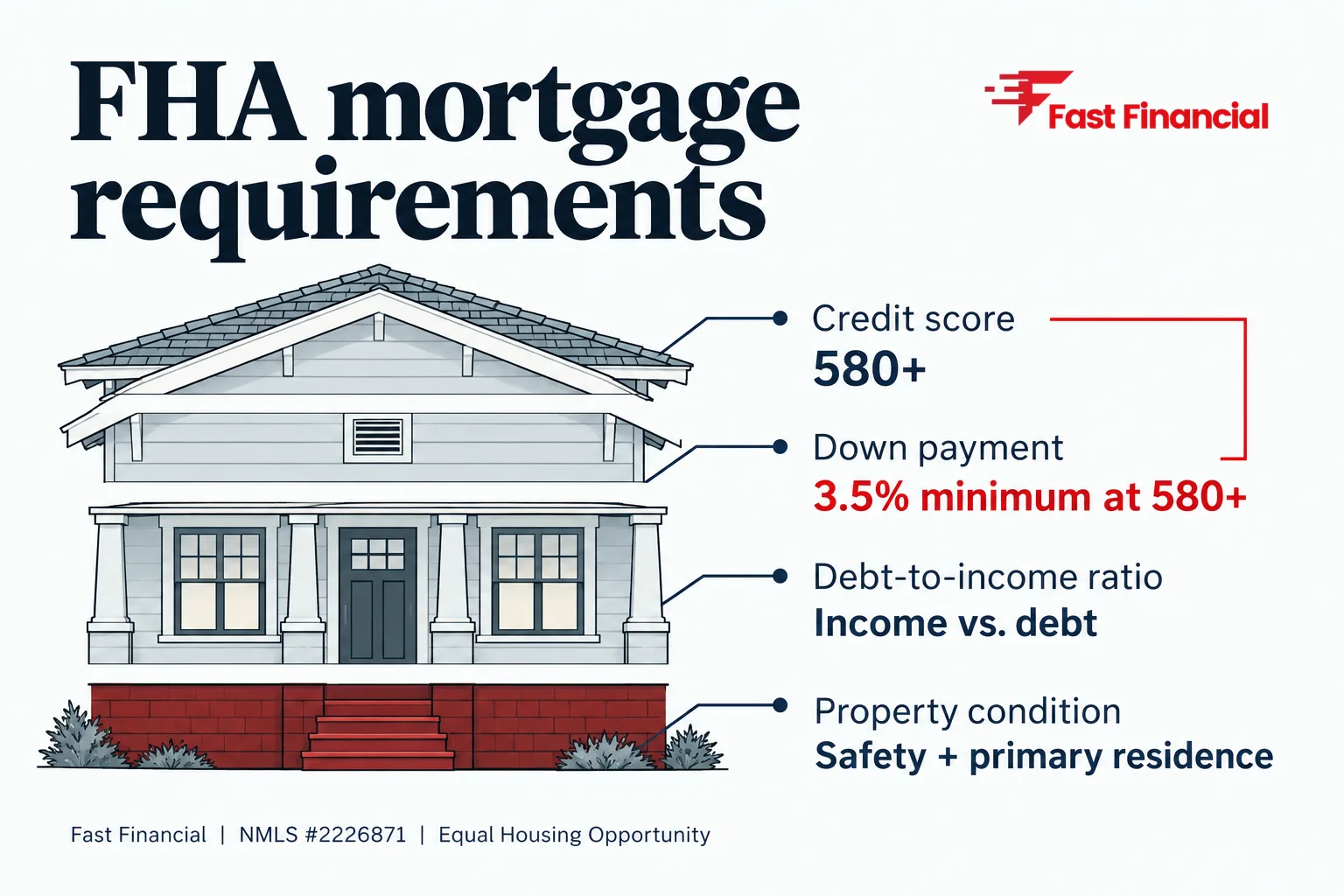
To qualify for an FHA loan, you need to satisfy four requirement buckets: credit score, down payment, debt-to-income ratio, and property condition. Check all four and FHA is one of the most accessible paths to homeownership available in California — especially for buyers with limited savings or imperfect credit.
Here's how each requirement actually works.
What credit score do you need for an FHA loan?
The FHA sets two credit score thresholds that determine how much you need to bring to closing.
Borrowers with a 580 or higher score qualify for the minimum 3.5% down payment — a HUD program requirement. Borrowers scoring between 500 and 579 can still get FHA financing, but HUD requires a higher down payment at that level. Below 500, FHA won't insure the loan at all.
In practice, individual lenders often layer on their own overlays — internal minimums above FHA's published floor. The HUD floor and the minimum your specific lender will accept aren't always the same number. If you're not sure where you stand, here's what credit score lenders actually need for a mortgage in California — including how your score shapes your file beyond just the pass/fail line.
What are the income requirements for an FHA mortgage?
FHA doesn't set a minimum income dollar amount. The number that matters is your debt-to-income ratio (DTI) — your total monthly debt obligations divided by your gross monthly income.
FHA guidelines allow a DTI up to 43% in most scenarios, with room to stretch beyond that when compensating factors are strong: deeper cash reserves, a solid long-term payment history, or residual income well above the threshold. Lenders run your file through FHA's automated TOTAL Scorecard to determine the actual ceiling for your situation.
Two years of consistent employment history is the standard expectation. W-2 employees are straightforward. Self-employed borrowers need two full years of tax returns and careful income documentation — here's how self-employed borrowers qualify for a mortgage in California under FHA and other programs. If you want to map your income against a realistic purchase price, this breakdown of how much income you need to buy a house in California gives you a working framework.
What is the FHA down payment requirement?
The minimum down payment for borrowers with a 580+ credit score is 3.5% of the purchase price. That's a HUD program requirement, not a lender add-on.
That down payment can come from your own savings, a gift from a qualifying family member, or certain down payment assistance programs. Not all DPA programs pair cleanly with FHA loans, so confirm compatibility before you build your plan around a specific assistance source.
For California buyers, assistance programs exist specifically for the Antelope Valley region. First-time homebuyer programs in the Antelope Valley covers what's currently available if you're buying in Lancaster, Palmdale, or the surrounding area.
What does FHA require for the property itself?
FHA insures the loan — which means HUD has a direct stake in the property. It must meet FHA Minimum Property Standards (MPS), and it must serve as your primary residence. You cannot use an FHA loan for a vacation home or a pure investment property.
An FHA appraisal does two jobs simultaneously: it's a valuation and a basic health-and-safety review. The appraiser looks at roof condition, plumbing, electrical systems, and structural integrity. If a property has flagged issues, the seller typically has to remedy them before the loan can close. Here's a full breakdown of how FHA appraisals work — useful reading if you're buying a property with known condition concerns.
One important distinction: an FHA appraisal is not a home inspection. FHA does not mandate a buyer inspection, but getting one independently is almost always the right move.
How does FHA mortgage insurance factor in?
FHA loans carry two layers of mortgage insurance:
- Upfront MIP (UFMIP): A one-time premium collected at closing or rolled into the loan balance.
- Annual MIP: Divided into monthly installments added to your payment — in most cases, for the life of the loan.
This is the core trade-off with FHA. The program is highly accessible, but MIP doesn't cancel the way private mortgage insurance on a conventional loan can. If you're weighing your options, this comparison of FHA versus conventional mortgages breaks down when each loan type wins financially. Veterans and active-duty servicemembers in particular should run the comparison — VA loans frequently outperform FHA on total cost when eligibility exists.
Is FHA the right loan for your situation?
FHA is a strong fit when your credit is in the 580–640 range, your savings are limited, or you're a first-time buyer looking for a lower barrier to entry. It pairs well with certain CalHFA assistance programs and is widely used across the Antelope Valley and greater Los Angeles area.
Where FHA gives ground: borrowers with strong credit and a solid down payment often find that a conventional loan costs less over the loan's life once lifetime MIP is factored in. And if you've ever served in the military, VA financing should be the first comparison you make — not the last.
The goal is to get into the right loan, not just any loan. A quick rate and structure review from Fast Financial (NMLS #2226871) shows you exactly where you stand — no cost, no commitment.
Frequently asked questions
Can I qualify for FHA with a recent bankruptcy or foreclosure?
Yes, but HUD imposes mandatory waiting periods. FHA guidelines require at least two years from a Chapter 7 bankruptcy discharge and three years from a foreclosure or short sale. Lenders verify these timelines at underwriting, and documented extenuating circumstances may support exceptions in limited cases.
Does FHA require a home inspection?
FHA does not mandate a buyer home inspection — that's separate from the required FHA appraisal. The appraisal confirms value and basic habitability; a full inspection goes deeper into systems, structure, and deferred maintenance. For a property you're financing over decades, skipping the independent inspection is rarely the right call.
Can I use an FHA loan to buy a duplex or multi-unit property?
Yes. FHA allows financing on 1–4 unit properties, provided you occupy one unit as your primary residence. Standard DTI and income requirements still apply, and the entire property still goes through the FHA appraisal process.
Are there FHA loans for renovation or new construction?
Yes — the FHA 203(k) rehab loan lets you finance purchase and renovation in a single loan. For new construction, FHA construction products exist with their own process and draw schedule. How FHA construction loans work walks through the mechanics if you're considering that path.
What's the difference between FHA and a non-QM loan?
FHA is a government-backed, fully documented program with HUD-defined guidelines. Non-QM loans — bank statement, DSCR, asset-based — are privately underwritten and follow lender-set criteria. Non-QM is typically the move when FHA's documentation requirements or owner-occupancy rules don't fit your profile. This guide to non-QM mortgages covers the landscape.