
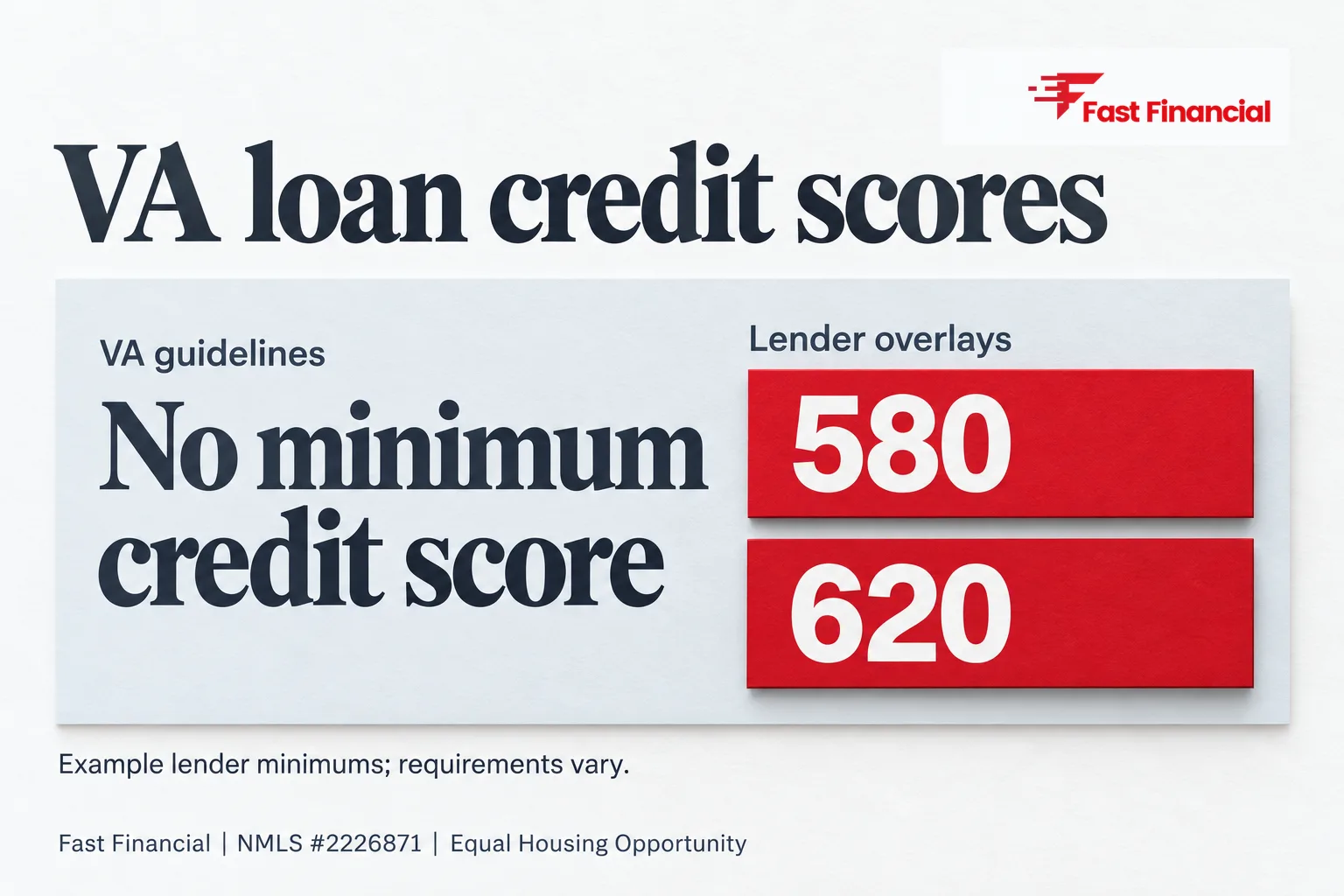
The VA doesn't set a minimum credit score for VA loans — lenders do. That distinction matters more than most veterans realize when they start shopping for a home.
Does the VA Have a Minimum Credit Score?
No. The Department of Veterans Affairs guarantees a portion of each VA loan but leaves credit-score floors entirely to individual lenders. The VA's own guidelines don't list a minimum number anywhere.
What the VA does require: a Certificate of Eligibility (COE), a debt-to-income review, and — uniquely — a residual income standard. That residual income test is one of the most borrower-friendly underwriting criteria in the mortgage industry. But a hard credit floor? Not from the VA itself.
The numbers you see floating around online — 580, 620, 640 — are lender overlays, not federal rules.
What's a Lender Overlay?
An overlay is a requirement a lender adds on top of the government program's guidelines. VA lenders take on underwriting risk even on guaranteed loans, so they protect themselves by setting their own credit floors.
In practice, the most common VA overlay is somewhere in the 580 to 620 range. Some lenders work below that with strong compensating factors — robust residual income, significant liquid reserves, or a clean payment history despite the score. Others hold firm at 620 regardless of the rest of the file. The landscape varies by institution.
That variability is why the lender you choose matters as much as the program itself. If one institution says no, another may say yes — especially when you're working with a broker who can run your file across multiple options.
If you want the full picture on what makes VA loans structurally different from other programs, why VA loans are amazing — the benefits and advantages breaks it all down.
How Does Your Score Affect the Loan Even Without a Hard Floor?
Your score still drives pricing. Lenders use risk-based pricing models — a lower score typically means less favorable terms, which you'll feel across the life of the loan.
The structural advantage of VA loans is that there's no private mortgage insurance (PMI), which can offset some of that gap. But the score still matters. If you're on the bubble between tiers, even a modest improvement before you apply can put you in front of a wider range of lenders with more competitive options.
Here's how lender positioning generally breaks down by score range, based on what we see working with VA borrowers across California:
| Score Range | Lender Position |
|---|---|
| 740+ | Strong. Most lenders compete for this profile. |
| 700–739 | Solid. Approval with few conditions at most institutions. |
| 660–699 | Good. Most VA lenders here with some variation in terms. |
| 620–659 | Approved by the majority of VA lenders; more conditions possible. |
| 580–619 | Fewer lenders at this tier; overlays vary significantly by institution. |
| Below 580 | Very limited options; strong compensating factors required. |
These aren't guarantees — every file is different. For more on how credit scoring mechanics work inside a mortgage underwriting file, our guide on how credit scores affect mortgages goes deep on what lenders are actually reading when they pull your report.
What Else Do VA Lenders Look At?
Credit score is one input in a multi-factor underwriting decision. VA lenders also review:
- Residual income — what's left after all monthly obligations and estimated living expenses. The VA publishes minimum residual income tables by region and family size. Meeting or exceeding those thresholds can compensate for a lower score.
- DTI (debt-to-income ratio) — most VA lenders target under 41%, though exceptions exist when residual income is strong.
- Employment and service history — stable employment or military service record, typically two years.
- Property condition — VA appraisals have minimum property requirements. Fixer-uppers can create complications.
For California veterans in the Antelope Valley and the Edwards Air Force Base corridor, there are additional eligibility nuances for active duty, Guard, and Reserve borrowers. Our VA loan guide for Edwards Air Force Base homebuyers covers the specific programs and documentation requirements for that community.
How to Strengthen Your Score Before You Apply
If you're below where you want to be, the right move is often to wait 60 to 90 days and build — not to accept a loan at worse terms. Here's what actually moves the number:
- Pay down revolving balances. Credit utilization is the fastest-moving variable in your score. Dropping card balances can shift your score within one to two billing cycles.
- Don't open new accounts. Hard inquiries and new tradelines temporarily suppress your score — avoid both while you're preparing to apply.
- Dispute inaccuracies. Pull all three bureaus (Experian, Equifax, TransUnion) and dispute anything that isn't yours, especially collection accounts.
- Ask about a rapid rescore. Mortgage lenders can sometimes request a rapid rescore through their credit vendor, updating your file in days rather than waiting for the monthly cycle.
If you're buying in Lancaster, Palmdale, or elsewhere in the Antelope Valley, our credit score guide for Lancaster homebuyers is specific to that market and the programs available there.
VA vs. FHA: Which Is Better for Lower Scores?
For veterans, VA almost always wins structurally — even at lower credit scores. No down payment, no PMI, and the residual income standard is more borrower-friendly than FHA's DTI-only approach.
FHA requires 580 for maximum financing (and higher down payment below that). VA lenders who'll go below 580 may still deliver better structural terms than an FHA loan at the same score. The comparison is worth running on your specific file.
Our side-by-side breakdown of FHA vs VA loans walks through the key differences clearly. And if you're exploring California first-time buyer resources, first-time homebuyer programs in the Antelope Valley covers what stacks alongside VA for eligible buyers.
Do Navy Federal and Rocket Have Different Requirements?
Yes — every lender sets its own overlays. Navy Federal, Rocket Mortgage, and independent mortgage brokers each have their own thresholds, pricing models, and underwriting preferences. A score that triggers a decline at one institution may be approvable at another.
That variability is exactly why working with a broker — rather than applying directly to one lender — tends to produce better outcomes for borrowers with non-standard profiles. We run your file against multiple lenders and find the best fit, not just the first approval.
See where you stand — no commitment, no pressure. A quick review tells you which lender tier your file is in, where any gaps are, and whether it makes sense to move now or build for 60 days first. Fast Financial — NMLS #2226871 — is licensed in California.
Frequently asked questions
Is there a VA-mandated minimum credit score?
No. The VA itself does not set a minimum credit score. Individual lenders set their own overlays on top of VA guidelines — these typically range from 580 to 620 but vary by institution and file profile.
Can I get a VA loan with a 580 credit score?
Possibly, but your lender options narrow significantly below 620. Some lenders work with scores in the 580 range when residual income and other compensating factors are strong. Fewer lenders operate at this tier, and terms will reflect the additional risk.
Does a higher credit score get me a better VA loan?
Yes. VA loans don't carry PMI, which is a structural advantage — but lenders still use risk-based pricing. A stronger score opens up better terms and puts more lenders in competition for your business.
Do Navy Federal and Rocket Mortgage have different VA credit score requirements?
Yes. Every lender sets its own overlays independently. Shopping multiple lenders, or working with a broker who can place your file across several, is worth the extra step — especially if your score is below 660.
What's the fastest way to raise my credit score before applying?
Paying down revolving credit card balances is the fastest lever most borrowers have. Ask your lender or broker about rapid rescore options, which can update your file in days rather than waiting for the standard monthly reporting cycle.