
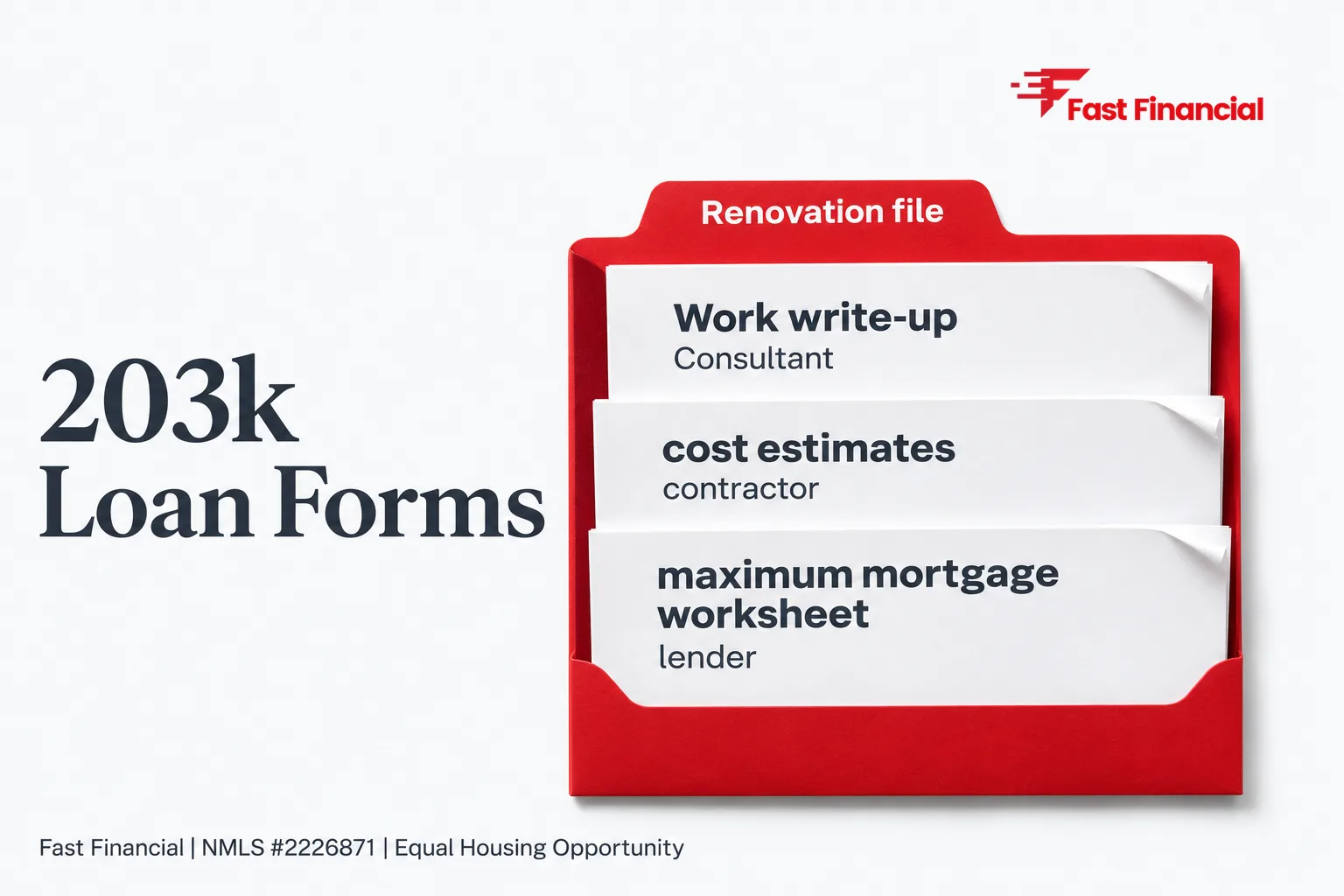
A 203(k) loan uses the same core application as any FHA mortgage, plus a renovation packet: a scope of work, contractor cost estimates, a rehabilitation loan agreement and draw paperwork. You won't fill out all of it yourself. Your lender, your 203(k) consultant and your contractor each own a piece.
Here's the map, so nothing surprises you mid-process. One caveat up front: HUD revises its forms, and lenders add their own versions. Your loan officer supplies the current set, so don't download random PDFs and fill them out on your own.
What forms do you fill out for a 203k loan?
Think in three buckets: the standard mortgage file, the renovation file, and the post-closing file.
| Bucket | What's in it | Who completes it |
|---|---|---|
| Standard FHA file | Loan application, income and asset documents, credit authorization, disclosures | You and your loan officer |
| Renovation file | Work write-up, cost estimates, contractor paperwork, maximum mortgage worksheet | Consultant, contractor, lender |
| Post-closing file | Draw requests, inspection reports, completion certificate | Contractor, consultant, you |
The first bucket is the same paperwork any FHA borrower sees. The second is what makes this a renovation loan, and it's where most delays happen.
What goes in the standard application package?
Expect the Uniform Residential Loan Application, authorization to pull credit, and the usual income and asset documentation. If you're new to how that works, see what credit report FHA uses and the FHA mortgage requirements.
The part that trips people up is debt-to-income. Lenders want a complete picture of your obligations before they size the loan. Our guide to debt-to-income ratio for a mortgage shows what gets counted.
What is the work write-up, and who prepares it?
The work write-up is the line-by-line scope of every repair and improvement you're financing. It's the document the whole loan is built on. Every item gets described, and the cost estimates tie back to it.
Your 203(k) consultant typically prepares it. For a more involved project, a consultant is required. For a lighter one, the lender may allow you to proceed without one. The Limited vs. Standard breakdown explains which path your project likely falls on and what repairs each covers.
Practical tip: be specific. "Update kitchen" gets sent back. Cabinets, countertops, flooring, appliances, electrical and plumbing changes each need their own line.
What do contractors have to provide?
Plan on collecting bids early. The paperwork on the contractor side usually includes:
- Itemized cost estimates that match the work write-up, line for line
- Contractor identification and license information, which your lender verifies
- Proof of insurance as the lender requires
- A signed contract or agreement for the work, which becomes part of the loan file
Get multiple bids if you can. Underwriters compare estimates against the consultant's numbers, and big gaps cause questions. Contractors who've worked on FHA renovation loans before tend to know this routine, which saves you time.
What is the maximum mortgage worksheet?
This is the lender-side calculation that determines how much the loan can be, based on the property's value and the renovation costs. You don't fill it out. But it's worth understanding, because it determines whether your project fits the loan.
The worksheet pulls together the purchase price or existing debt, the approved renovation costs, and the program's built-in allowances and contingency reserve. FHA also caps the loan by area limits. If you're in a high-cost market, check how limits shape your options. Our piece on the jumbo loan limit in California covers where conforming limits end.
What is the rehabilitation loan agreement?
At or near closing, you sign an agreement that spells out how the renovation money works. In plain terms: the renovation funds are held in escrow, the work has to be completed within a set window, and the money is released in stages as work gets done.
Read it closely. This is where you agree to the timeline, the inspection process and what happens if the scope changes. Any change to the original scope usually needs written approval through a change order, so keep your contractor from freelancing.
What paperwork comes after closing?
This is the part borrowers forget. The money for the work doesn't go to your contractor at closing. It's released through draws:
- The contractor completes a phase of work.
- A draw request goes in, with supporting documentation.
- The consultant or inspector verifies the work.
- The lender releases funds for the verified work.
- At the end, a final inspection and completion paperwork close out the renovation.
Every step leaves a paper trail, and every trail needs signatures. Skipped signatures stall draws, and stalled draws stall contractors. Stay on top of it. For the full sequence from offer to final draw, walk through the 203k loan steps.
How do you keep the paperwork from slowing you down?
Here's the move: front-load the work.
- Pick your path early. Know whether you need a consultant before you collect bids.
- Lock the scope before the estimates. Changing the write-up after bids come in means redoing both.
- Respond to conditions fast. Underwriters send requests for missing items. Slow replies are the top cause of slipped timelines. See what an underwriter does for why they ask what they ask.
- Keep copies of everything. Draw requests reference earlier documents.
Approval has its own checkpoints, covered in 203k loan approval, and the eligibility side is in 203k loan requirements. For the big picture, start with how to get a 203k loan.
Where can you get the actual forms?
From your lender. Fast Financial is a California-licensed brokerage (NMLS #2226871), and we walk borrowers through the full document set before anything goes to underwriting. You can also compare how repair financing fits your plans using our mortgage calculators. Rates and terms vary by borrower and market, so see where you stand before you commit to a project.
If you're in the Antelope Valley, our office is local to you at 190 Sierra Ct Ste 324, Palmdale, CA 93550. Call (661) 512-4141, stop by, or get your rate reviewed online.
Frequently asked questions
Is there one official 203k loan application form?
No. You complete the standard FHA loan application, and the renovation documents sit on top of it. Your lender gives you the current version of each.
Do I need a 203(k) consultant to complete the paperwork?
It depends on the project type. More extensive renovations require one, while lighter projects may not. Your lender confirms which applies to your file.
Can my contractor fill out the work write-up?
The consultant usually prepares it. Your contractor supplies the cost estimates and supporting documents that must match it.
What happens if the renovation plan changes after closing?
Changes generally need written approval through a change order before the work proceeds. Unapproved changes can hold up draws.
Where do I get the forms for a 203k loan?
Ask your lender. Forms get revised, and lenders may require their own versions, so use the set they provide.