
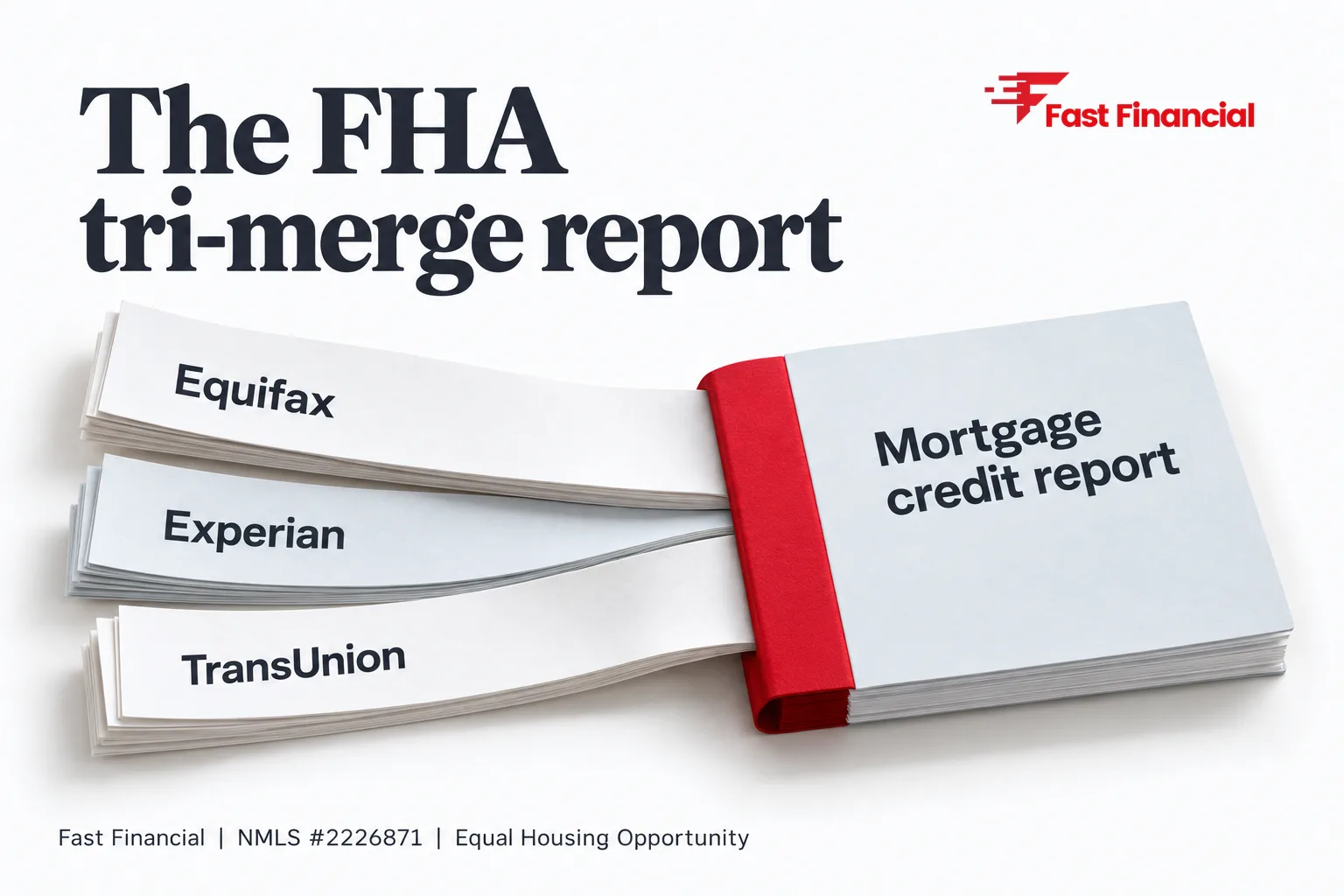
FHA lenders use a tri-merge mortgage credit report, which combines your files from all three bureaus (Equifax, Experian and TransUnion) into one document. It isn't a single bureau's report, and it isn't the free score on your banking app.
That gap explains most of the "my score says one thing, my lender says another" confusion. Here's what the report is, how the lender gets your score from it, and what to do before anyone pulls it.
What is a tri-merge credit report?
A tri-merge report is a mortgage credit report. The lender orders it through a credit reporting agency, which pulls your data from all three bureaus and merges it into one file. It lists your accounts, balances, payment history, collections, public records and inquiries. It also shows a score from each bureau.
Each bureau can hold slightly different information. A creditor might report to only two of the three. A late payment might show up at one bureau and not another. The tri-merge puts all of it side by side, so the underwriter sees the full picture and not just the version that looks best.
FHA doesn't run its own credit bureau. The loan is insured by the Federal Housing Administration, but the lender pulls and evaluates your credit under HUD's underwriting guidelines (HUD Handbook 4000.1). The report is a standard mortgage tool.
Which credit score does FHA actually use?
For a single borrower, the lender takes the three scores from the tri-merge and uses the middle one. Your highest and lowest scores are set aside.
With more than one borrower on the loan, the lender works out a middle score for each person. In practice, the lowest of those middle scores becomes the qualifying score. If you're buying with a spouse or co-borrower, the weaker credit profile can set the terms for both of you.
The scores are also not the ones you see for free online. Mortgage lenders generally use older FICO mortgage scoring models, and those can differ from the VantageScore or newer FICO versions on consumer apps. If you want to understand why the numbers vary, read our breakdown of FICO score vs. credit score.
Why does my score look different from what my lender sees?
Four things cause most of the difference:
- Different scoring model. Consumer apps often show a different model than the mortgage versions.
- Different bureau. A free app may pull from just one bureau. Your lender sees all three.
- Timing. Balances and payments update on different cycles at each bureau.
- The middle-score rule. The lender uses the middle of three scores, not your best one.
Don't be alarmed if the lender's number comes in lower than your app. It doesn't mean your credit changed. It means the lender is measuring with a different ruler.
Does the FHA credit pull hurt my score?
A mortgage pull is a hard inquiry, and it can cause a small, temporary dip. Scoring models generally treat several mortgage inquiries made in a short shopping window as one event. That means comparing lenders for the same loan type shouldn't stack up damage.
Shopping around is worth it, and so is doing it in a tight stretch of time. The terms, fees and overlays can vary a lot from lender to lender, even on the same FHA loan.
What does the underwriter look for beyond the score?
The score gets you in the door. The report itself is what the underwriter reads line by line. Here's what lenders actually look at:
| What they check | Why it matters |
|---|---|
| Payment history | Recent late payments carry more weight than old ones |
| Collections and charge-offs | May need to be explained or resolved, depending on the situation |
| Public records | Bankruptcy, judgments and liens need documentation |
| Revolving balances | High utilization signals risk and feeds your monthly obligations |
| New accounts and inquiries | Fresh debt can change your approval, so don't open any |
| Monthly debt payments | These drive your |
If you've had a past credit event, FHA is often more forgiving than other programs, but it comes with waiting periods and documentation. We cover the details in our guides to FHA loans after bankruptcy and mortgages after foreclosure.
What if I don't have much credit history?
FHA allows non-traditional credit in some cases. Instead of a standard score, a lender may document your history with items like rent, utilities and other recurring bills. These files are usually manually underwritten, which means more paperwork and a closer look.
It's workable, but not as smooth as a file with established tradelines. If you're in this spot, talk to a broker before you apply, so you know what documentation to gather.
How do I prepare before a lender pulls my report?
Here's the move, in order:
- Pull your free reports from all three bureaus. Check each one for errors, accounts that aren't yours, and balances that are wrong.
- Dispute real errors early. Corrections take time, and you want them fixed before you apply.
- Pay down revolving balances where you can. Lower utilization usually helps your score.
- Keep every account current. One new late payment can matter more than a pile of old good history.
- Don't open or close accounts. New debt changes your numbers and can complicate underwriting.
- Don't co-sign or finance a big purchase. A new car loan in the middle of the process is a classic file-killer.
If you want a deeper plan, see how to raise your credit score fast and what that means for a mortgage. For the minimums themselves, our FHA loan credit score requirements article lays them out. For the full qualifying picture, start with FHA mortgage requirements.
Where does the credit report fit in the FHA timeline?
The lender pulls it at the start, usually when you apply or get pre-approved. It can be pulled again before closing to confirm nothing changed. If new debt or a new inquiry shows up, the underwriter will ask about it, and your closing can slow down. We explain that in why an FHA loan takes so long to close.
If you're local, our guide to an FHA loan in Palmdale covers how lenders approach the Antelope Valley market.
Get your credit reviewed before you apply
Fast Financial is a California mortgage broker (NMLS #2226871). We review your credit the way a lender will, so you know where you stand before a pull affects anything, and we can compare options beyond FHA if your file points that way. Approval always depends on your full financial picture and underwriting guidelines.
Call us at (661) 512-4141, request a rate quote, or stop by the office at 190 Sierra Ct Ste 324, Palmdale, CA 93550. It's local to Antelope Valley borrowers.
Frequently asked questions
Does FHA use FICO or VantageScore?
FHA lenders generally rely on the FICO mortgage scoring models that come with a tri-merge report. The VantageScore shown on many free apps usually won't match what the lender sees.
Does FHA use the middle score or the lowest score?
For one borrower, the lender uses the middle of the three bureau scores. With multiple borrowers, the lowest of each borrower's middle scores is typically used.
Can I check the same report FHA lenders use?
Not exactly. You can get free copies of your reports from each bureau, and they show the underlying data. But the tri-merge report and mortgage scores come through the lender.
Will checking my own credit lower my score?
No. Checking your own reports is a soft inquiry and doesn't affect your score. A lender's mortgage pull is a hard inquiry.
Do I need perfect credit for an FHA loan?
No. FHA is designed to be more flexible than many other loan types, but you still need to meet credit, income and documentation guidelines. Talk to us about your specific situation.
Fast Financial is an Equal Housing Opportunity lender-broker. Loan programs, terms and approvals vary by borrower and are subject to underwriting. This is general information, not a commitment to lend.