
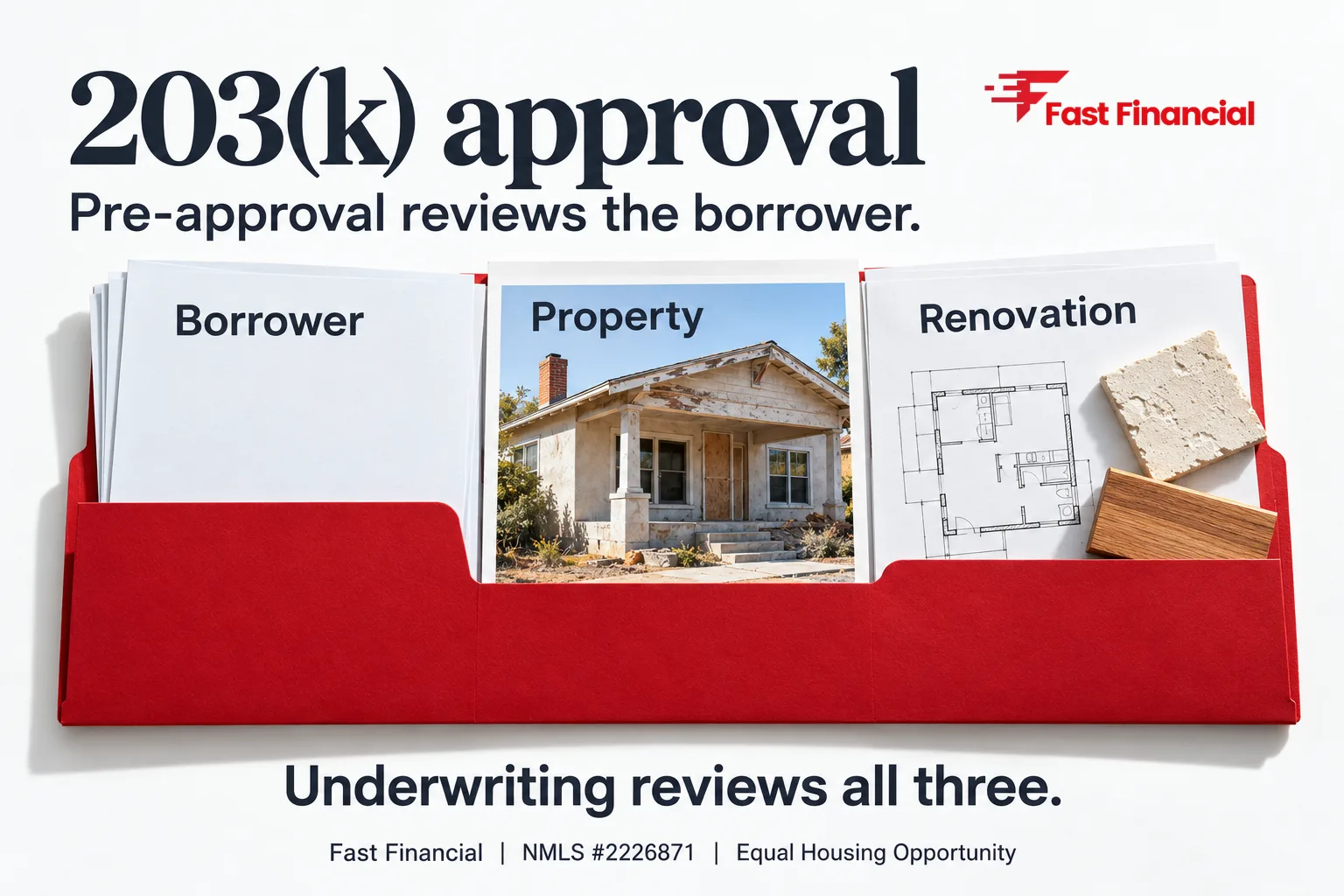
A 203(k) loan gets approved when you, the property, and the renovation plan all clear underwriting together. A standard FHA purchase only has to approve you and the house. A 203(k) also has to approve the work and the budget.
That extra layer is why the loan takes more paperwork and more coordination than a typical mortgage. It is also why it works for a house that would never qualify for ordinary financing in its current condition. Here's what lenders actually look at, and how to get ready.
What does 203k loan approval actually involve?
It involves three separate approvals that have to line up:
- The borrower. Credit, income, assets, and debt-to-income ratio, judged against FHA guidelines and the lender's own overlays.
- The property. It has to be an eligible one-to-four-unit home that you will occupy, and it has to be sound enough that the planned renovation makes sense.
- The renovation. A written scope of work, contractor bids, and a budget that the lender and the appraiser both accept.
If any one of the three is weak, the file stalls. Most delays I see come from the third one, because borrowers underestimate how much documentation the repair plan needs.
Is there a 203k loan pre-approval, and what does it tell you?
Yes. A 203(k) pre-approval is a lender's review of your credit, income, assets, and debts, ending in a letter that says what you can likely borrow. It is the first step, and it is worth doing before you shop.
What it does not do is approve the house or the repairs. That happens later, once you have a property under contract and a work plan in hand. Think of pre-approval as clearing the borrower side only.
Two practical points:
- Not every lender offers 203(k) loans. Many skip them because the process is hands-on. Ask directly before you invest time in an application.
- Pre-approval is not a commitment to lend. The final decision comes after underwriting reviews the full file. For a general walkthrough, see our guide to mortgage pre-approval in California.
What do lenders look at on the borrower side?
The borrower review looks a lot like any FHA file. Underwriters look at your credit history, your documented income, your cash for closing, and your debt-to-income ratio, which compares your monthly debts, including the new housing payment, to your income.
The general rules are covered in our breakdown of FHA mortgage requirements and FHA credit score requirements. Keep in mind that FHA sets the floor and individual lenders can set a higher one. Past credit trouble is not automatically a dealbreaker either. We've written about FHA loans after bankruptcy and mortgages after foreclosure for exactly that reason.
What does the renovation side of the approval require?
This is where a 203(k) differs from everything else. Depending on the scope of work, you will be on one of two tracks: the Limited 203(k) for lighter, non-structural repairs, or the Standard 203(k) for major work.
Typically the file needs:
- A detailed work write-up. Every repair, itemized, with materials and labor.
- Contractor bids. Usually from licensed, insured contractors who are willing to work under the draw process.
- A HUD-approved 203(k) consultant on the Standard track. The consultant visits the property, reviews the write-up and cost estimates, and produces the documents the lender relies on.
- A contingency reserve. Renovation budgets are built with a cushion for surprises.
The lender doesn't hand you the renovation money at closing. It sits in an escrow account, and the funds are released in stages, called draws, as inspected work is completed. Your contractor needs to be comfortable with that.
How does the appraisal affect your 203k approval?
The appraiser values the home based on its condition after the planned work is finished, not just the condition you see today. That "as-completed" value is what the loan is measured against, so the renovation plan and the appraisal have to tell the same story.
The appraiser also checks FHA minimum property standards. We cover that process in how FHA appraisals work. If the as-completed value comes in lower than the plan assumed, the numbers can change, so a realistic scope matters from day one.
What happens once the file reaches underwriting?
The underwriter reviews the borrower, the appraisal, the title work, and the renovation package as one file. Expect conditions, which are follow-up requests for documents or clarifications. Answering them fast is the single best thing you can do to keep the timeline moving.
If you're wondering why a government-backed file can drag, our post on why an FHA loan takes so long to close in California explains the common bottlenecks. A 203(k) has a few more moving parts than most, so build extra time into your purchase contract.
How do you get ready before you apply?
Here's the move, in order:
- Get pre-approved with a lender that actually closes 203(k) loans.
- Decide how big the project is, light repairs or structural work.
- Line up a consultant if you're on the Standard track, and collect contractor bids early.
- Write offers with the loan in mind, and give yourself a realistic closing window.
- Keep your finances steady. No new debt, no big unexplained deposits, no job changes without talking to your lender first.
For the full product overview, read our guide to the FHA 203(k) loan. If you're comparing this to financing for a veteran buyer, see the VA renovation loan.
Ready to see where you stand?
The number that matters isn't a rate quote. It's whether your file, the property, and the repair plan can all clear underwriting together. Fast Financial is a California mortgage broker, NMLS #2226871, and we can walk through your situation and tell you whether a 203(k) fits. Get your rate reviewed, call us at (661) 512-4141, or stop by our office at 190 Sierra Ct Ste 324, Palmdale, CA 93550. If you're buying in the Antelope Valley, see how FHA loans work in Palmdale. Rates and terms vary by borrower and market, and approval is subject to underwriting.
Frequently asked questions
Can I get a 203k loan pre-approval before I find a house?
Yes. Pre-approval reviews your credit, income, assets, and debts, so it doesn't require a specific property. The property and renovation plan get reviewed later, after you're under contract.
Who approves a 203(k) loan?
The lender's underwriter makes the decision, following FHA guidelines. On the Standard track, a HUD-approved consultant prepares the renovation documents the underwriter relies on.
Does the appraisal use the home's current value or its value after repairs?
The appraiser values the home as it will be once the planned work is complete. The appraisal also confirms the property will meet FHA minimum property standards.
Do I have to live in the home?
Yes. A 203(k) is for owner-occupants, so you generally can't use it for a pure investment purchase. Investors should look at options like DSCR loans in California or a hard money loan.
Is 203(k) approval guaranteed if I have good credit?
No. Credit is one of three approvals. The property and the renovation plan also have to qualify, and the final decision always rests with underwriting.