
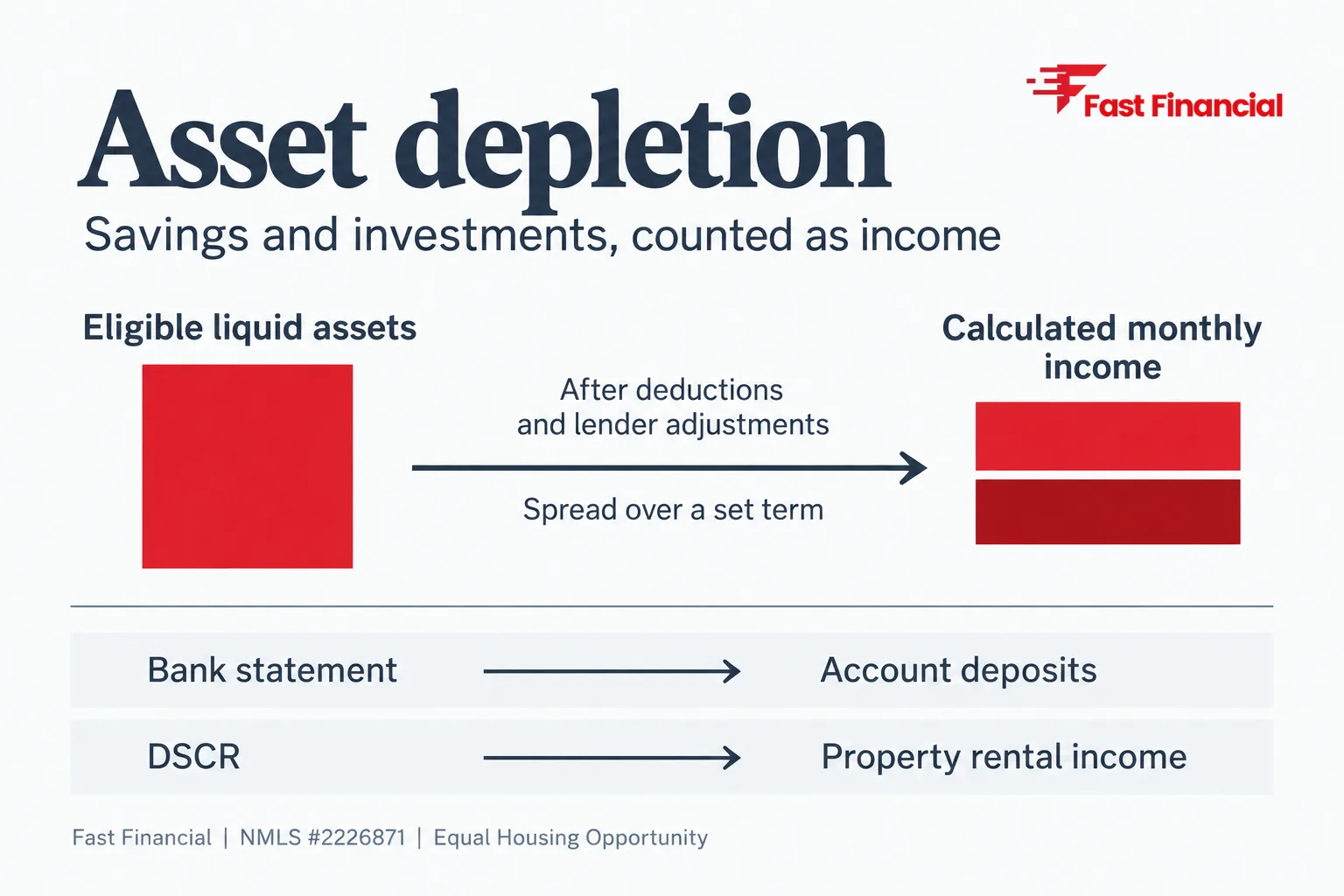
An asset depletion mortgage loan lets you qualify on what you own, not what you earn. The lender treats your verified liquid assets as an income stream, so a borrower with substantial savings but little W-2 or tax-return income can still show they can repay. The real question is whether it's the right tool for you, or whether another non-QM program fits better.
This guide covers who this loan is built for, how it compares to the other options, and what lenders actually look at.
What is an asset depletion mortgage loan, in plain terms?
Underwriters normally need income to calculate your debt-to-income ratio (DTI). With asset depletion, the lender takes your eligible assets, subtracts what you need for the down payment, closing costs and reserves, and spreads the rest over a set number of months. The result is a calculated monthly "income" that goes into the DTI math.
The exact divisor, the haircut applied to each asset type and the minimum asset level all vary by lender and program. That's why two lenders can look at the same portfolio and land on different qualifying figures. For the full calculation walkthrough, see our deeper guide on qualifying with assets instead of income.
Who is an asset depletion loan actually built for?
In practice, it fits borrowers whose balance sheet is strong but whose tax returns don't show it:
- Retirees who live on savings and haven't started Social Security or pension draws, or whose draws are small next to their net worth.
- Recent business sellers who just turned a company into cash and have no ongoing income yet.
- Early retirees and career-changers between chapters, with investments carrying them.
- High-net-worth borrowers whose income comes through trusts, partnerships or irregular distributions that are hard to document cleanly.
- Heirs and settlement recipients with significant liquid assets and limited earnings history.
If that sounds like you, you're probably in non-QM territory. Here's what a non-QM loan is and when it makes sense.
Which assets count toward qualifying?
The assets have to be liquid, seasoned, and in your name or accessible to you. Lenders typically weigh them differently:
| Asset type | How lenders typically treat it |
|---|---|
| Checking, savings, money market | Usually counted in full |
| Brokerage accounts (stocks, bonds, mutual funds) | Often counted after a discount for market volatility |
| Retirement accounts (IRA, 401(k)) | Often discounted further for taxes and early-withdrawal penalties, depending on your age and access |
| Business accounts | Case by case; usually needs proof you own the business and can withdraw the funds |
| Real estate, vehicles, collectibles | Generally not counted, because they aren't liquid |
The number that matters is your eligible asset total after these haircuts, not the face value on your statements. Expect to provide recent statements for every account, and be ready to explain large deposits.
How does asset depletion compare to bank-statement and DSCR loans?
These three programs get grouped together, but each solves a different problem. Here's the move: match the program to where your strength actually is.
| Asset depletion | Bank statement | DSCR | |
|---|---|---|---|
| Qualifies on | Liquid assets converted to income | Deposits from business or personal accounts | The property's rental income |
| Best for | Retirees, business sellers, asset-rich borrowers | Self-employed with steady cash flow | Real estate investors |
| Property type | Primary, second home, or investment (varies) | Primary, second home, or investment (varies) | Investment property only |
| Personal income docs | Not required in the usual sense | Statements instead of tax returns | Generally not required |
| Key risk factor | Asset level and liquidity | Consistency of deposits | Rent-to-payment coverage |
If you run a business with strong monthly deposits, a bank-statement approach may qualify you for more. See mortgage options for small business owners who write off everything. If you're buying a rental, the property can carry itself with DSCR loans in California. Asset depletion stands out when you have neither steady deposits nor a rental, just a strong balance sheet.
Some borrowers combine approaches. A lender may let you count modest pension or Social Security income and add an asset-depletion figure on top. Ask about it, because it can change the picture.
Can I use asset depletion on a jumbo loan in Los Angeles?
Often, yes. Many asset depletion programs are offered at jumbo loan sizes, which matters in Los Angeles County, where home prices regularly exceed the conforming limit. Lenders usually expect stronger credit, more reserves and a meaningful down payment at those loan sizes. The exact requirements vary by program and borrower.
For the bigger picture on large-balance financing, read jumbo loans in Los Angeles for high-net-worth borrowers. If the purchase is in a trust or LLC, review how vesting works in California before you sign the purchase contract, because vesting affects which lenders and programs are available.
Do celebrities and public figures use asset depletion loans?
Yes. It's a common fit for entertainment, sports and public figures whose income is lumpy, paid through loan-out corporations, or front-loaded into a few big years. Qualifying on assets can be simpler than reconstructing years of irregular income. Fast Financial handles these files discreetly, with one point of contact, and signs an NDA on request. See how private-client mortgage lending works.
What does the process look like, step by step?
- Inventory your accounts. List every liquid account: balances, owner names, and whether it's a retirement account.
- Check seasoning. Lenders want funds that have sat in your accounts for a period, or a clear paper trail for recent transfers (like sale proceeds from a business).
- Get an eligible-asset estimate. A broker applies each program's haircuts and divisor so you can see a realistic qualifying figure before you shop for homes.
- Compare programs. Run the same file through asset depletion, bank-statement and hybrid options. This is where a broker earns their keep, because each lender's formula is different.
- Underwriting. Expect a close review of statements, large deposits and reserves. Here's what an underwriter actually controls.
- Close. Funds for the down payment and closing costs come out of the same accounts, so plan your liquidity around closing day.
What are the trade-offs?
Asset depletion is a non-QM product, so pricing and terms are typically different from a conventional loan. The cost depends on your credit, the size of your down payment, your asset level, the property and the market. Lenders also look harder at reserves, because your assets are doing double duty as both income and cushion.
The upside is flexibility. You don't have to take taxable distributions just to create income on paper for a mortgage. That decision should be coordinated with your CPA or financial advisor, not made by a loan application.
Frequently asked questions
Do I need a job to get an asset depletion mortgage loan?
No. The program exists for borrowers who qualify on assets rather than employment. You still need acceptable credit, documented liquid assets and enough reserves to satisfy the lender.
Can I use asset depletion to buy an investment property?
Many programs allow it, but it varies by lender. If the property will be a rental, a DSCR loan that qualifies on the rent may be the cleaner option, so compare both.
Will an asset depletion loan force me to spend down my savings?
No. "Depletion" is only the math lenders use to turn assets into a monthly figure. You don't have to actually withdraw the money each month. Your down payment, closing costs and required reserves do come from your accounts.
Is asset depletion available through Fannie Mae or Freddie Mac?
The agencies have narrow provisions for counting assets in limited situations, but most asset depletion lending happens through non-QM programs with their own guidelines. A broker can tell you which path your file fits.
How long does an asset depletion loan take to close?
It depends on the file, the lender and the property, and there's no guaranteed timeline. Organized statements and a clean paper trail for large deposits are what keep it moving.
See where you stand
Whether asset depletion works for you comes down to your eligible-asset figure, and every lender calculates it a little differently. Fast Financial (NMLS #2226871) is a California-licensed mortgage broker. We'll run your accounts through multiple programs and show you which one fits.
Call us at (661) 512-4141 or visit our office at 190 Sierra Ct Ste 324, Palmdale, CA 93550. You can also get your rate reviewed online. Rates, terms and eligibility vary by borrower and market, and approval isn't guaranteed. Equal Housing Opportunity.