
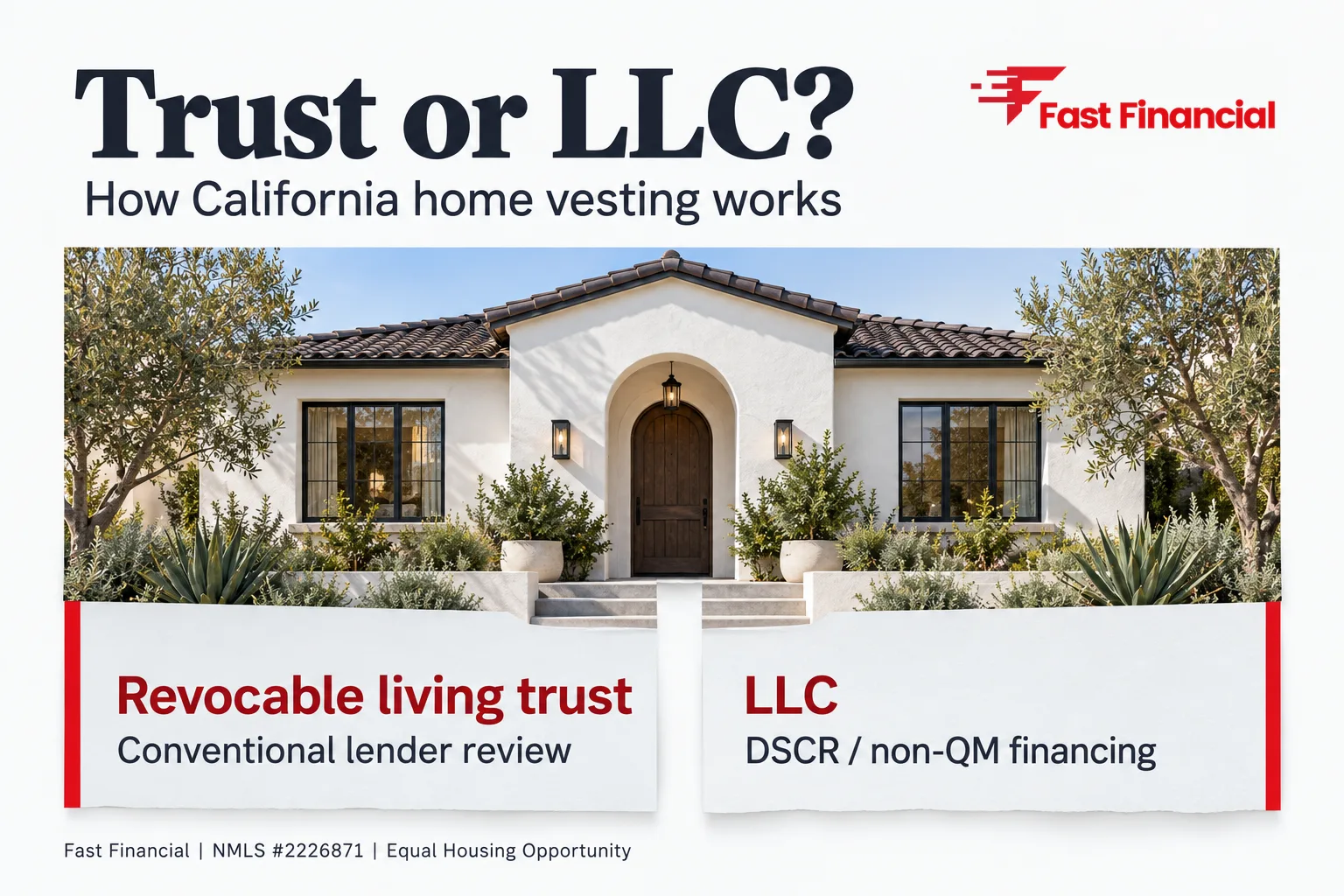
You can buy California real estate in a living trust or LLC — but how you hold title shapes everything: your financing options, your liability exposure, your privacy, and what happens to the property when you die. The structure you choose determines which loan programs you qualify for and whether a conventional lender will touch the deal at all.
What Does "Vesting" Actually Mean?
Vesting is how ownership is recorded at the county. Every California deed answers the question: who legally owns this property, and in what capacity? Options include an individual, joint tenants, community property, a revocable living trust, or a legal entity like an LLC. Each carries different implications for probate, liability, taxes, and financing — and lenders have very different rules depending on which box you're in.
Why Do Buyers Use a Living Trust?
The most common trust structure is the revocable living trust, and the most common reason is probate avoidance.
In California, probate is public, slow, and expensive. An estate with real property in it can sit in probate court for a year or longer. Assets held in a revocable trust pass directly to beneficiaries without court involvement — faster and private.
One thing a living trust does not do: protect your assets from creditors. Because you control and can revoke the trust at any time, courts treat its assets as yours. A slip-and-fall plaintiff can reach trust assets just as easily as your personal bank account. If liability shielding is the goal, a trust isn't the tool.
What Does an LLC Actually Protect?
An LLC creates a legal wall between you and the property. If a tenant sues over a habitability issue or an injury, the claim targets the LLC's assets — not your personal accounts, your primary home, or your retirement savings.
For rental investors building a portfolio, that separation matters. Privacy is a real benefit too: an LLC's members aren't always publicly disclosed at the county recorder level, though California's beneficial ownership reporting requirements have tightened, so work with an attorney to understand exactly what's shielded.
The cost side: California charges a minimum $800 franchise tax annually on LLCs. Add separate bookkeeping requirements and a more complex loan process, and the structure adds friction — but for income-producing properties, the liability protection usually justifies it.
Can You Get a Conventional Mortgage in an LLC's Name?
No. Fannie Mae and Freddie Mac conforming loans require an individual borrower. You cannot originate a new purchase in an LLC's name and access standard 30-year financing.
The tool investors use instead: DSCR loans in California. A Debt Service Coverage Ratio loan qualifies based on the property's rental income rather than your personal income — and it can be made directly to an LLC as borrower. No W-2, no DTI calculation, no tax returns required.
If you haven't encountered DSCR before, read through what a DSCR loan is and who qualifies — it's the most practical financing tool for rental investors who want entity-level ownership.
More broadly, LLC-vested purchases fall into non-QM loan territory — portfolio lenders, private money, and specialty programs. Terms are less standardized than conforming loans. That's not a dealbreaker; it means you need a broker who actively works those channels.
The Due-on-Sale Clause — and the Garn-St. Germain Exception
This is where investors get caught. Transferring a property into an LLC after closing on a conventional mortgage can trigger the due-on-sale clause, which lets the lender demand immediate full repayment.
The Garn-St. Germain Depository Institutions Act (1982) carves out a specific exception — but only for revocable living trusts where the borrower remains a beneficiary and occupant. That protection does not extend to LLCs.
In practice, many lenders don't actively monitor transfers. "They probably won't notice" is not a risk-management strategy. If you want LLC ownership, structure the purchase that way from the start and finance it accordingly. Retrofitting after closing on a conventional loan is legally and contractually precarious.
How Lenders Handle Trust Vesting on a Conventional Loan
When you buy as trustee of your revocable living trust, most conforming lenders approve that — with documentation requirements:
- A copy of the trust agreement or a certification of trust
- Confirmation you are both trustee and a beneficiary
- Confirmation the trust is revocable
- Review of any trustee succession or co-trustee provisions that might affect the lender's lien rights
This is standard. It adds a documentation step, not a deal-killer. Tell your broker before you go under contract — not in the week before closing.
For higher-priced California purchases, trust vesting is routine. If you're working with a jumbo loan, review jumbo loan requirements in Los Angeles County to understand where conforming limits end and private financing begins. The Fast Financial team handles trust-vested transactions regularly — it's a known workflow, not a complication.
Can You Refinance or Pull Cash Out of a Trust or LLC-Vested Property?
Trust-vested properties are generally refinanceable through conventional channels under the same rules above.
LLC-vested properties require a non-QM refinance. If you later want to access equity, you'll work through the cash-out refinance route via a portfolio or DSCR lender. Factor that into your long-term cost analysis when choosing the structure upfront.
Trust vs. LLC: The Quick Framework
| Goal | Better Structure |
|---|---|
| Avoid probate on a primary residence | Revocable living trust |
| Protect from liability claims | LLC |
| Maintain conventional financing eligibility | Trust (primary) / individual (investment) |
| Finance a rental directly in the entity's name | LLC + DSCR or non-QM loan |
| Maximum ownership privacy | LLC (with California attorney guidance) |
Neither structure is permanent — and strategies vary based on loan type, lender, and how the property is used. The right move is to get the financing and vesting aligned before you're in escrow, not after.
As a Los Angeles mortgage broker working across California, Fast Financial structures these deals often. The conversation is easier when it starts early.
Frequently Asked Questions
Can I buy a primary residence in an LLC in California?
Yes — but not with conventional financing. LLC-vested purchases require non-QM or DSCR loans, which have different terms than conforming loans. Most owner-occupants use a revocable living trust instead, which preserves conventional loan access.
Does transferring my home to a living trust trigger the due-on-sale clause?
No. The Garn-St. Germain Act protects transfers of a primary residence to a revocable living trust where the borrower remains a beneficiary and occupant. Your lender will want to review the trust documents, but this transfer should not accelerate the loan.
Does a living trust reassess my property taxes in California?
No. A transfer to your own revocable living trust is not a change of ownership under California law and does not trigger Proposition 13 reassessment. Your base year value carries over unchanged.
Can a DSCR loan be made directly to an LLC?
Yes — that's one of the primary use cases for DSCR financing. The loan qualifies on the property's rental income, and the LLC is the borrower of record. It's the standard path for investors who want entity-level ownership without using personal income documentation.
How do I get started if I want to buy with trust or LLC vesting?
Talk to your mortgage broker before you sign a purchase agreement — not after. The entity structure determines which loan programs are available and how title must appear on the contract. Get your rate reviewed, call Fast Financial at (661) 512-4141, or visit our office at 190 Sierra Ct Ste 324, Palmdale, CA 93550 to work through the structure before you're in escrow.
Fast Financial | NMLS #2226871 | Licensed in California
Rates, terms, and program availability vary by borrower qualifications, property type, and market conditions. This content is for informational purposes only and does not constitute a commitment to lend. Equal Housing Opportunity.