
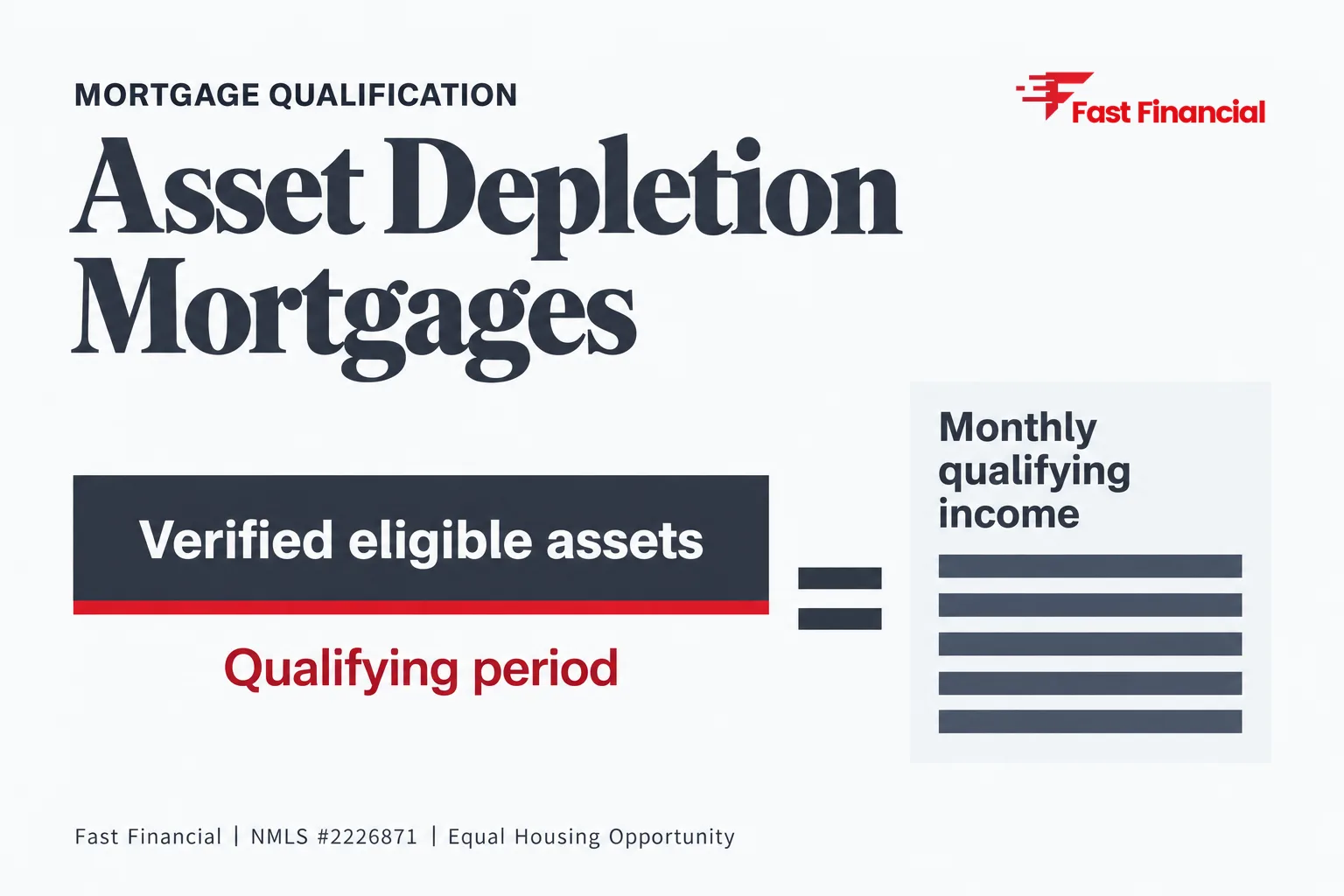
Asset depletion lets you qualify for a mortgage using the value of your liquid assets — no W-2, no pay stub, no employer letter required. If you look income-poor on paper but you're sitting on substantial savings, brokerage accounts, or retirement funds, this is the program built for you.
Here's how it works, who it fits, and what lenders actually look at.
What Is an Asset Depletion Mortgage?
An asset depletion mortgage — also called asset dissipation or asset amortization — is a non-QM loan that converts your verified liquid assets into a hypothetical monthly income figure. That number flows into the debt-to-income (DTI) calculation the same way a paycheck would.
The lender isn't assuming you'll liquidate your portfolio. They're spreading your eligible assets over a qualifying period to produce an imputed income. Underwriting then works from that figure — same process, different source.
This is how a retired surgeon with a seven-figure brokerage account but no current salary qualifies for a California home loan. The money is real; conventional guidelines just don't know how to read it.
Who Is This Loan For?
Asset depletion is purpose-built for borrowers whose balance sheet doesn't match their tax return:
- Retirees living off portfolio distributions, Social Security, or savings rather than a salary
- Business owners who take minimal personal draw but hold significant personal or corporate assets
- Self-employed professionals whose write-offs push taxable income down — a situation covered in detail in how to get a mortgage when you're self-employed in California
- High-net-worth individuals with large brokerage, investment, or trust accounts
- Real estate investors who are asset-rich but W-2-light
If you've worked through how much income you need to buy a house in California and your documented earnings fall short, asset depletion is often the cleanest path.
How Do Lenders Calculate Asset Income?
The formula varies by lender, but the mechanics are consistent across most programs.
Step 1 — Identify eligible assets
Lenders typically accept:
- Checking and savings accounts
- Brokerage and investment accounts (stocks, bonds, mutual funds, ETFs)
- CDs and money market accounts
- Retirement accounts (401k, IRA) — usually counted at a discount
What typically doesn't count:
- Real estate equity (illiquid)
- Business accounts (unless vested in your name)
- Assets pledged as collateral elsewhere
- Non-vested stock options
Step 2 — Apply required discounts
Retirement accounts commonly receive a haircut — a percentage of the balance is excluded to account for potential taxes and early-withdrawal penalties. Each lender uses its own schedule; expect the discount to be meaningful.
Step 3 — Divide over the qualifying period
The remaining eligible asset total gets divided over a set number of months — often aligned with the loan term, sometimes a shorter period depending on the program structure. The result is the monthly imputed income that feeds the DTI calculation.
Every lender runs this slightly differently. An experienced Los Angeles mortgage broker who works these programs regularly can tell you which structures are most favorable for your specific asset mix before you ever submit an application.
What Credit and Equity Requirements Apply?
Asset depletion is a non-QM product — it sits outside Fannie Mae and Freddie Mac guidelines, so lenders set their own minimums. In practice, most programs expect a strong credit profile. Understanding what credit score you need for a mortgage in California gives you a baseline before you shop.
LTV requirements also tend to be more conservative than conventional loans. Plan for a meaningful down payment or solid existing equity if you're refinancing. The higher-quality your credit and the lower your LTV, the better the program options available to you.
Asset Depletion vs. Other Non-QM Programs
Asset depletion is one tool in the non-QM toolkit. Depending on your situation, a different program — or a combination — might fit better.
Bank statement loans — If you're self-employed with consistent deposits but low taxable income, bank statement loans use 12–24 months of business or personal deposits to document income. Better fit when cash flow is real but not easily shown on returns.
DSCR loans — If you're buying or refinancing an investment property, DSCR loans qualify you on the property's rental income — your personal income doesn't enter the picture. Fast Financial offers DSCR loans across California for investors at various portfolio sizes.
Jumbo asset depletion — Los Angeles County property values frequently push into jumbo territory. Asset depletion works at the jumbo level for borrowers who qualify; jumbo loan requirements in Los Angeles County breaks down what to expect on the collateral and credit side.
What Documents Do You Need?
This is a fully documented loan — "alternative" refers to the income source, not the verification standard. Be ready to provide:
- Account statements — typically 2–3 months for bank and brokerage accounts; some programs require longer history for retirement accounts
- Proof of ownership — all accounts must be titled in your name or a qualifying trust or entity
- Liquidity evidence — some lenders want confirmation that assets can be accessed within a stated timeframe
- Standard mortgage package — credit, title, appraisal, and identity docs — same as any loan
Underwriting is more manual than a conventional file, so timelines can run a bit longer. Work with someone who does this regularly — asset depletion is not a set-it-and-forget-it file for a generalist processor.
Why California Makes This Relevant
California's high price points — particularly across Los Angeles, the San Fernando Valley, and the Antelope Valley — mean jumbo loan sizes are common. That reality aligns well with asset depletion: borrowers with large enough asset portfolios to qualify tend to be buying at exactly those price points.
If you're purchasing or refinancing in Palmdale, Lancaster, or anywhere in the Antelope Valley, Fast Financial is local — our office is at 190 Sierra Ct Ste 324, Palmdale, CA 93550. We know these markets and work the full spectrum of non-QM programs.
Get a rate review to see where you stand, or call (661) 512-4141 to talk through your asset picture before you start the application process. Exploring refinance options is also on the table if you already own and your income situation has shifted.
Frequently Asked Questions
Can I use retirement accounts like a 401k or IRA for asset depletion?
Yes — retirement accounts typically count, but lenders apply a discount to the balance to account for taxes and potential penalties on early withdrawals. The exact discount varies by lender and program. The portion that remains after the haircut flows into the imputed income calculation.
Do I need any employment income at all, or is it fully asset-based?
Most programs allow pure asset-based qualification with no employment income requirement. Some lenders will supplement documented income with asset-derived income if you have both sources. The structure depends on the specific program and lender guidelines.
How is this different from a stated-income loan?
Completely different. Stated income — largely eliminated after 2010 — let borrowers declare income without verification. Asset depletion uses fully verified account statements and documented balances to derive an income figure. Nothing is taken at your word; everything is sourced and cross-referenced.
Do the assets need to stay in my account after closing?
No — the assets demonstrate qualifying ability, not an ongoing requirement. That said, most lenders require post-closing reserves, meaning enough liquid assets remaining after your down payment and closing costs to cover several months of housing expenses. The reserve requirement is separate from the depletion calculation.
Does asset depletion work for refinances, not just purchases?
Yes. The program covers both purchase and refinance transactions. If you own your home and your income profile has changed since your original mortgage, asset depletion may open the door to a refinance that conventional underwriting would decline.
Fast Financial | NMLS #2226871 | Licensed in California | 190 Sierra Ct Ste 324, Palmdale, CA 93550 | (661) 512-4141. Rates, terms, and qualification vary by borrower and market conditions. This is not a commitment to lend.