
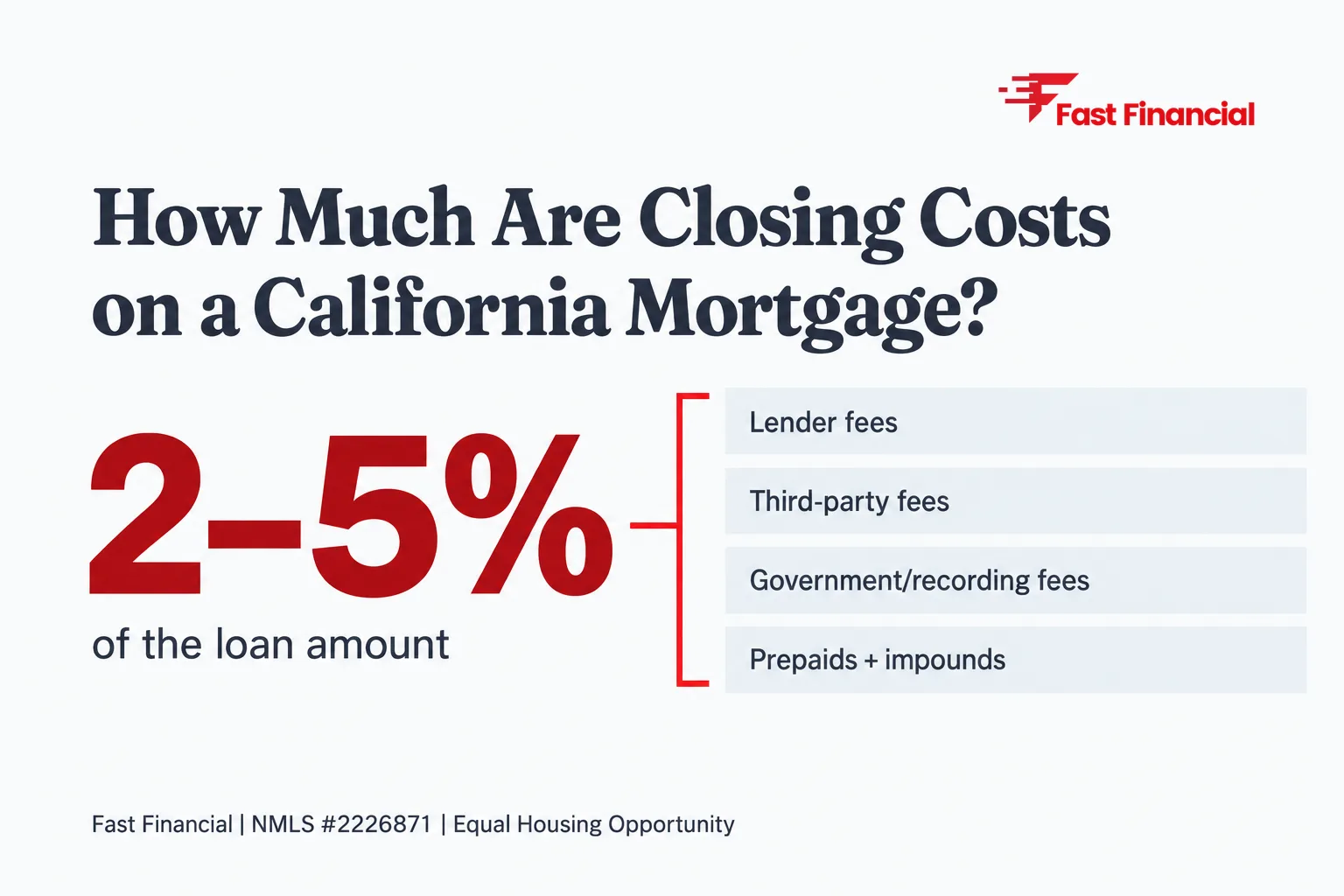
Plan on 2–5% of the loan amount in closing costs — on a $700,000 California purchase, that's roughly $14,000 to $35,000 out of pocket before you hand over a down payment. The range is wide because these costs depend on your loan type, the county, your lender, and what you negotiate. Here's how to read the line items so nothing surprises you at the closing table.
What Counts as a Closing Cost?
Closing costs are every fee you pay to get the loan funded and the title transferred — lender charges, third-party services (title, escrow, appraisal), government fees, and prepaid items like insurance and property tax impounds. The Loan Estimate you receive within three business days of applying itemizes all of it. The Closing Disclosure, due three days before closing, shows the final locked numbers.
If something on either document isn't clear, ask. That's literally what the forms are for.
How Do California Closing Costs Break Down?
Lender Fees
These go directly to your lender and are the most negotiable part of the stack.
| Fee | What It Is |
|---|---|
| Origination fee | The lender's charge for processing and funding your loan — may be 0–1% of the loan amount |
| Discount points | Optional prepaid interest to buy down your rate — each point = 1% of the loan |
| Underwriting fee | Flat fee for underwriting review; $500–$1,500 is typical |
| Rate lock fee | Usually baked in, but can be a line item on some programs |
Lenders are not required to charge an origination fee. Some don't. Shop and compare — you'll see real differences here.
Third-Party Fees
You pay these to vendors the lender requires. You have the right to shop for some of them (your Loan Estimate will flag which ones).
- Appraisal: $500–$900 for a standard single-family home. Jumbo or complex properties run higher.
- Title insurance: California buyers typically pay for the lender's title policy; sellers cover the owner's policy in most counties (though this is negotiable). Title premiums are regulated by the state, so rates don't vary wildly — but the title company you use can affect closing/escrow fees layered on top.
- Escrow fees: California is an escrow state, not an attorney state. You'll pay an escrow officer to manage the transaction. Fees vary by company and purchase price — typically $1,500–$3,000 split between buyer and seller, though that split is negotiable.
- Notary/signing fee: $150–$300 for the closing appointment.
Government Fees and Transfer Taxes
Recording fees go to the county recorder's office to make the deed and mortgage a matter of public record — usually a few hundred dollars.
Transfer taxes are where California gets county- and city-specific:
- County transfer tax: $1.10 per $1,000 of sale price in most California counties. On a $700,000 home, that's $770 — and it's typically a seller cost, though everything in a real estate contract is negotiable.
- City transfer taxes: Some cities layer on their own. Los Angeles City charges an additional $4.50 per $1,000 (Measure ULA added a mansion tax above certain thresholds). San Francisco has a tiered city transfer tax that scales steeply at higher price points. If your property is inside city limits, check city-specific rules.
As a buyer, your transfer tax exposure is usually low to none — but know what's in play so you can negotiate intelligently.
Prepaids and Escrow Impounds
These aren't fees — they're money you're putting into accounts to cover future obligations. They still show up at closing.
- Prepaid homeowners insurance: Most lenders want 12–14 months upfront at closing.
- Prepaid property taxes: If you're setting up an impound account (which most conventional and FHA loans require unless you put down 20%+), expect 2–6 months of property taxes deposited at closing, depending on where you are in the tax calendar.
- Prepaid interest: Interest accrued from your closing date through the end of that month. The later in the month you close, the lower this number.
Prepaids typically add $3,000–$6,000 to your closing number on a California purchase — sometimes more in high-tax areas.
What Does the Total Actually Look Like?
A rough model for a conventional purchase in California:
| Category | Estimated Range |
|---|---|
| Lender fees | $1,000–$4,000 |
| Third-party fees (appraisal, title, escrow) | $3,000–$6,000 |
| Government/recording fees | $200–$600 |
| Prepaids + impounds | $3,000–$8,000 |
| Total | $7,500–$18,500+ |
These numbers shift based on loan size, property location, loan type, and lender. FHA loans carry an upfront mortgage insurance premium (1.75% of the loan) that can significantly change your total. Jumbo loans may have higher lender fees. Non-QM programs vary widely.
The Loan Estimate is your real number. Get one — or compare several.
Can I Reduce My Closing Costs?
Yes. Here are the moves that actually work.
Negotiate seller concessions. In a buyer's market, sellers often agree to credit 2–3% of the purchase price toward closing costs. This is the biggest lever available. It doesn't lower the purchase price — it reduces what you bring to closing.
Shop the third-party services you're allowed to shop. Your Loan Estimate flags which vendors you can choose independently. Title companies and escrow officers don't all charge the same fees — comparing two or three can save $500–$1,500.
Take lender credits. You can accept a slightly higher interest rate in exchange for the lender covering some or all of your closing costs. This is the structure behind "no-closing-cost" loans — the costs don't disappear, they're offset by the rate. Whether this makes sense depends on how long you plan to hold the loan.
Ask what's negotiable on lender fees. Underwriting fees, processing fees, and similar line items are sometimes waived or reduced, especially for strong borrowers or repeat clients. It doesn't hurt to ask directly.
When Do I See the Final Numbers?
You'll receive a Loan Estimate within three business days of submitting a complete application. Review it carefully — this is your benchmark.
Three business days before closing, you'll receive the Closing Disclosure. Compare it line-by-line to the Loan Estimate. Some fees are subject to a 0% tolerance (they can't increase at all). Others allow up to a 10% increase. A few have no cap. If numbers jumped without explanation, flag it with your lender immediately.
Ready to see where you actually stand? We review your full loan scenario — costs, rate options, and structure — before you're locked into anything. Get your rate reviewed.
Fast Financial Mortgage — NMLS #2226871. Licensed by the California Department of Financial Protection and Innovation. Terms and closing costs vary based on borrower qualification, loan type, and market conditions. This content is for informational purposes only and does not constitute a loan commitment or guarantee of specific terms.
Frequently asked questions
Are prepaids the same as lender fees?
No. Prepaids fund future insurance, property-tax, and interest obligations even though they appear at closing.
Can a seller help with buyer closing costs?
Yes. A negotiated seller concession can credit part of the purchase price toward closing costs.
When does a borrower receive final closing figures?
The Closing Disclosure arrives three business days before closing and can be compared with the earlier Loan Estimate.