
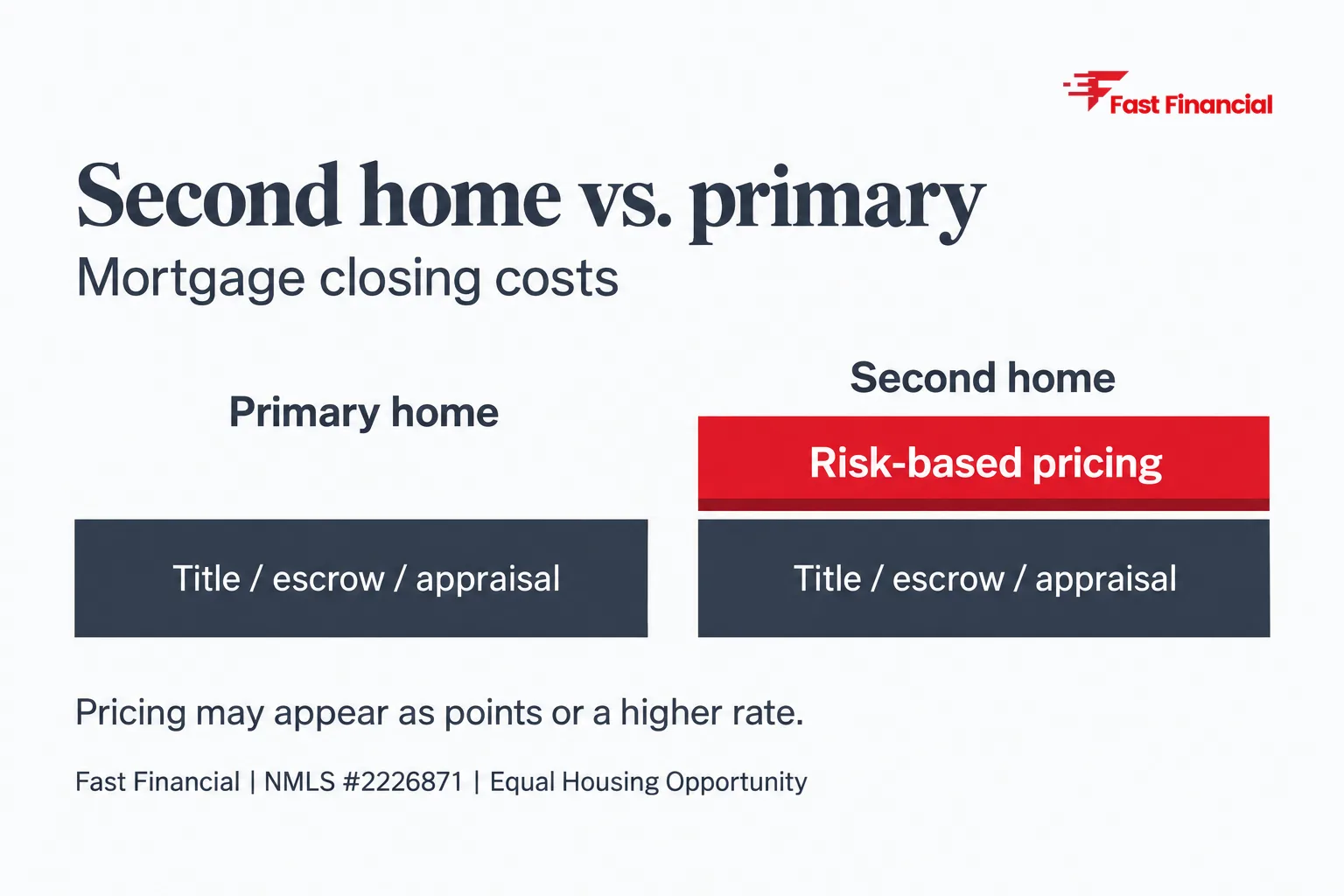
Second home closing costs run higher than a primary purchase — driven by risk-based pricing adjustments, stricter reserve requirements, and the absence of low-down programs that primary buyers often rely on. Here's where the gap shows up and how to budget for it.
Buying a place in Big Bear, Palm Springs, or anywhere else you plan to escape to part of the year? Budget differently than you did for your main home. Second home loans are standard conventional products, not exotic programs, but lenders price them as higher risk. That pricing difference lands on your Loan Estimate.
What closing costs are the same on both loan types?
Most third-party fees don't shift based on occupancy. Expect similar costs on both sides for:
- Title insurance (owner's and lender's policy)
- Escrow and settlement fees
- Appraisal (though second homes may require stronger comparable support)
- Recording fees
- Prepaid interest and initial escrow impounds for taxes and insurance
- HOA transfer or move-in fees, if applicable
You'll see all of this itemized on your Loan Estimate, which lenders are required to deliver within three business days of application. Understanding what's on that document before you sign saves real confusion at the closing table.
Where do second home costs diverge from a primary purchase?
This is the part that surprises most buyers — and where planning ahead pays off.
What are loan-level price adjustments and why do they matter?
Fannie Mae and Freddie Mac set risk-based pricing adjustments — called loan-level price adjustments (LLPAs) — that stack onto the base cost for second home loans. Primary purchases, especially for first-time buyers with strong credit, often avoid the same LLPA tiers.
These adjustments show up as discount points or a higher note rate, depending on how your lender structures the deal. Your credit score and loan-to-value ratio are the two biggest levers — a stronger credit profile and more equity both reduce the adjustment. This is why getting a pre-approval that actually maps your LLPA exposure matters before you're in contract.
Why is the required down payment larger on a second home?
Primary home buyers can access programs with minimal down payment requirements — certain conventional options, FHA, VA, and first-time homebuyer programs in the Antelope Valley and across California that bring the barrier down significantly.
None of those apply to a second home. Lenders require a meaningful equity stake upfront, which demonstrates genuine financial commitment to a property you won't occupy full time. A larger down payment does double duty: it lowers your LTV (reducing LLPA exposure) and typically keeps you clear of mortgage insurance requirements.
Does mortgage insurance apply to second homes?
It depends on your down payment size, not the loan type. Unlike FHA — where mortgage insurance is required regardless — conventional PMI is triggered by your LTV. Bring enough equity and you may avoid it entirely. How mortgage insurance works on a conventional loan is worth reviewing before you decide how to structure your down payment.
Do lenders require more cash reserves on a second home?
Yes — and this trips up a lot of buyers. Reserves aren't a closing cost line item, but lenders verify you have them at closing. For a second home, most lenders require documented liquid reserves covering several months of housing payments — for both the subject property and your primary home simultaneously.
That means liquid assets beyond the down payment and closing costs. Know this going in. Positioning your cash correctly before you apply avoids last-minute scrambles.
Is a second home the same as an investment property?
No — and the distinction is significant. A second home is a property you personally occupy for part of the year, without treating it as a primary income source. An investment property — even a single-family home that looks identical — follows a different pricing and qualification structure entirely.
Investment properties carry higher LLPAs, stricter reserve requirements, and open the door to income-based programs like DSCR loans in California that second homes can't use. Lenders examine rental income history, lease agreements, and stated occupancy intent during underwriting. Misclassifying the property creates problems that surface at approval — not before. The full breakdown of primary vs. investment property differences is worth reading before you submit anything.
For a broader look at how second home financing stacks up at the qualification level, primary vs. second home mortgages covers the structural differences.
Does loan size affect second home closing costs in California?
In California's coastal and mountain markets, a second home can push well into jumbo territory. Jumbo loans — above the conforming loan limit — operate outside Fannie/Freddie guidelines and follow their own pricing structure. Jumbo loan requirements in Los Angeles County walks through what that means for qualification and cost. If the property is in a high-cost ZIP, confirm the current conforming limit before assuming conventional pricing applies to your loan.
Can you refinance a second home later the same way?
The mechanics are the same, but the LLPA pricing tier carries over. Second home refinances are priced the same way as second home purchases — the risk adjustments don't disappear because the original loan closed. Refinance options exist for second home owners, but run your break-even math with the LLPA layer factored in before locking.
What's the move before you write an offer?
Get pre-approved early — before you're in contract on a property. A solid mortgage pre-approval for a second home should surface:
- Your estimated LLPAs based on credit score and down payment
- Reserve requirements for both properties combined
- Whether the property qualifies as a second home vs. investment under lender guidelines
- Whether your loan amount triggers jumbo pricing
That review eliminates surprises at the closing table. See where you stand before you make an offer.
Frequently asked questions
Are second home closing costs always higher than a primary purchase?
Generally yes, primarily because of loan-level price adjustments (LLPAs) that apply to second home loans. These add to lender fees or discount points in ways that many primary borrowers — especially first-time buyers — avoid entirely.
Can I use an FHA or VA loan for a second home?
No. FHA and VA loans require the borrower to occupy the property as a primary residence. Second home financing runs through conventional programs only, which means Fannie/Freddie guidelines govern the down payment, credit requirements, and pricing.
What if I plan to rent out the second home occasionally?
Occasional short-term rentals may be acceptable, but a pattern of regular rental income can cause underwriters to reclassify the property as an investment property — which changes the loan program, pricing, and qualifying math. Be upfront about your plans when you apply.
Do reserve requirements cover my primary home too?
Yes. Most lenders require liquid reserves covering several months of payments on both your primary home and the new second home. Position your assets before you apply — it's one of the most common second home approval stumbling blocks.
Does my credit score affect what I pay at closing on a second home?
Significantly. LLPA grids are credit-score sensitive — a stronger profile reduces your risk-based pricing adjustments and lowers what you'll pay. How credit scores affect mortgage costs breaks down the mechanics in full.
Fast Financial, NMLS #2226871, licensed in California. Rates, terms, and eligibility vary by borrower and market conditions. Equal Housing Opportunity. This content is for educational purposes only and does not constitute a commitment to lend.