
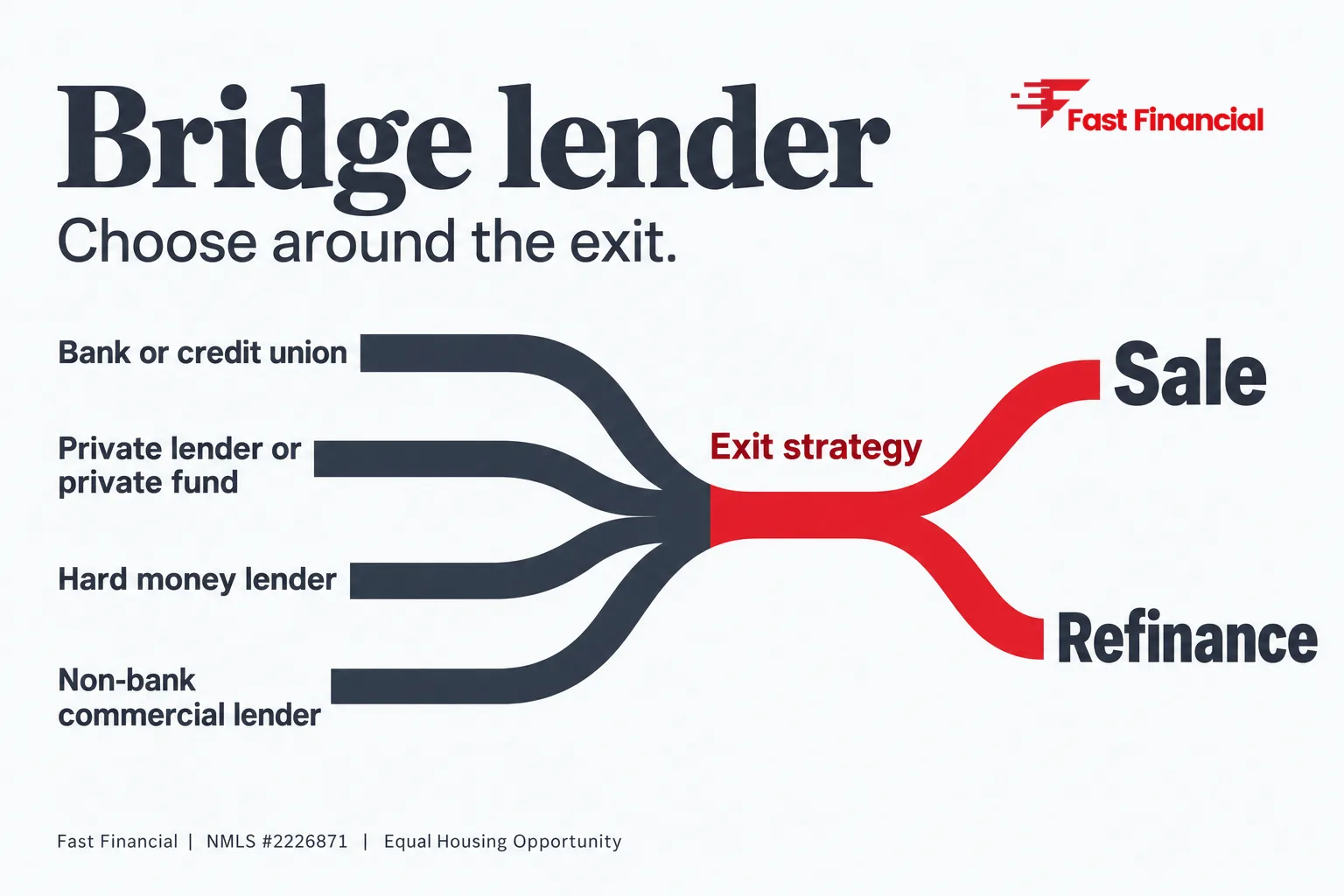
A bridge lender is a lender that funds short-term financing to cover the gap between buying a property and reaching a permanent exit, like selling the old home, refinancing, or finishing a renovation. The loan is built around the exit, so the lender cares about how you get repaid at least as much as your paycheck.
If you're searching for one, you're probably on a clock. Here's how bridge lenders actually work, which type fits which deal, and what to check before you sign anything.
What is a bridge lender?
A bridge lender specializes in short-term, asset-focused loans. The borrower has a gap: money is tied up in a property that hasn't sold, a purchase has to close before a refinance can, or a property needs work before a traditional lender will touch it.
The bridge lender fills that gap, then gets repaid when the exit happens. If you want the loan product itself explained, start with what a bridge loan is and how it works for homebuyers and investors. This article is about the lender on the other side of the table.
Who counts as a bridge lender?
There's no single type. In practice you'll run into four:
| Lender type | Typical strength | Typical tradeoff |
|---|---|---|
| Bank or credit union | Often the lowest cost | Slower, tighter guidelines, stricter on the borrower |
| Private lender or private fund | Flexible, fast decisions | Higher cost, more focus on the property |
| Hard money lender | Speed and tolerance for rough properties | Usually the highest cost, short runway |
| Non-bank commercial lender | Handles larger and multi-unit deals | Heavier documentation on the asset |
Hard money is the label most people use for the speedy, property-driven end of this spectrum. What a hard money loan is and when it makes sense in California covers that lane in more detail.
What do bridge lenders actually look at?
Less about your tax return, more about the deal. Here's what lenders actually look at:
- The property. Value, condition, location, and how marketable it is if the plan goes sideways.
- The equity position. How much of your own money is in the deal, and how much cushion the lender has.
- The exit strategy. Sale, refinance, or both, and whether it's realistic on the schedule you're proposing.
- The borrower's track record. Experience matters more for investors and rehab projects.
- Credit and liquidity. Lower-weight than on a traditional loan, but not ignored. Lenders want to see reserves.
Banks and credit unions that offer bridge products still lean on your income and debt-to-income ratio. Private and hard money lenders mostly don't, which is a big reason borrowers go there.
Which bridge lender fits which deal?
The right lender depends on what's on the other side of the bridge.
Buying before you sell your current home. A homeowner who needs to close on the next place before the old one sells usually wants the most conservative lender who can move on the timeline. This is the case where a bank or credit union option, or a HELOC vs. second mortgage comparison, might beat a true bridge product.
Fix-and-flip or rehab. Investors usually go to private or hard money lenders because the property often isn't financeable by conventional standards yet. In the high desert, fix and flip loans for Antelope Valley investors run on this model.
Buying a distressed or non-warrantable property. When the house can't pass a conventional appraisal today, a bridge lender can fund the purchase and the repair, then you refinance into permanent financing. See how to finance a distressed asset in California.
Rental or multi-unit acquisitions. Investors often bridge the purchase, stabilize the property, and then move into a long-term rental loan. DSCR loans in California are a common takeout because they qualify the property on its rental income instead of your W-2.
What does a good bridge lender do differently?
Speed matters, but speed alone is how borrowers get burned. Look for these:
- A clear written explanation of the cost. Interest, origination charges, and any exit or extension fees should all be on paper before you commit. Ask for the loan estimate or term sheet and read it line by line.
- A realistic timeline. A lender who promises everything will close on a date they can't control is a warning sign. The appraisal and title work set the pace, and appraisal and loan contingencies can affect your purchase terms.
- A defined extension policy. Deals run late. Know what happens, and what it costs, if your exit slips.
- Straight talk about prepayment. Some bridge loans penalize early payoff, which hurts if your sale closes quickly.
- Licensing you can verify. In California, lenders and brokers should be licensed. Check the license on the California Department of Financial Protection and Innovation (DFPI) or Department of Real Estate (DRE) lookup, depending on the license type, and the NMLS Consumer Access site for mortgage licenses.
What are the real risks of a bridge loan?
The loan is only as safe as the exit. If the home doesn't sell, the refinance doesn't qualify, or the rehab runs over budget, you're holding a short-term loan with a maturity date and a price that wasn't designed for long holding. That can mean extension fees or forced decisions.
Before you commit, run a bad-case version of your plan. Ask what happens if the sale takes longer, if the appraisal comes in low, or if rates and lending guidelines shift while you're waiting. Our mortgage calculators help you stress-test what carrying two properties for a while would feel like.
Should I go direct or work with a mortgage broker?
Going direct to one lender gets you one lender's terms. A broker can compare options across several sources, which matters in a market where bridge pricing and guidelines vary a lot lender to lender. Fast Financial is a California mortgage broker (NMLS #2226871), and we start by checking whether a bridge is the right tool at all, because sometimes a refinance, a second lien, or a Los Angeles mortgage broker conversation about timing solves it more cheaply. Learn more about Fast Financial before you reach out.
Here's the move: define your exit first, then pick the lender, not the other way around.
Frequently asked questions
What is a bridge lender?
A bridge lender is a lender that provides short-term financing to cover a gap, such as buying a new property before selling an old one. The loan is repaid through a sale, refinance, or other planned exit.
Are bridge lenders the same as hard money lenders?
Not exactly. Hard money lenders are one kind of bridge lender, typically the fastest and most asset-focused. Banks, credit unions, and private funds also offer bridge-style financing with different pricing and requirements.
Can I get a bridge loan with bad credit?
Sometimes. Private and hard money lenders weigh the property and your equity heavily, so credit is less decisive than on a traditional loan. Expect the lender to price that risk, and expect to show reserves and a credible exit.
How fast can a bridge lender close?
Speed varies by lender, property, and how quickly title and appraisal work come back. Private and hard money lenders generally move faster than banks, but no responsible lender can promise a fixed date.
Do I need a bridge lender to buy before I sell?
Not always. Depending on your equity and income, a HELOC, second mortgage, or contingent offer may work. A broker can compare these against a true bridge product for your situation.
Ready to see where you stand?
Bridge financing is a timing tool, and the best result comes from matching the lender to your exit. Get your rate reviewed or call Fast Financial at (661) 512-4141. You can also visit our office at 190 Sierra Ct Ste 324, Palmdale, CA 93550 to talk through your options in person. Rates, terms, and approval depend on your situation and the market; nothing here is a commitment to lend.