
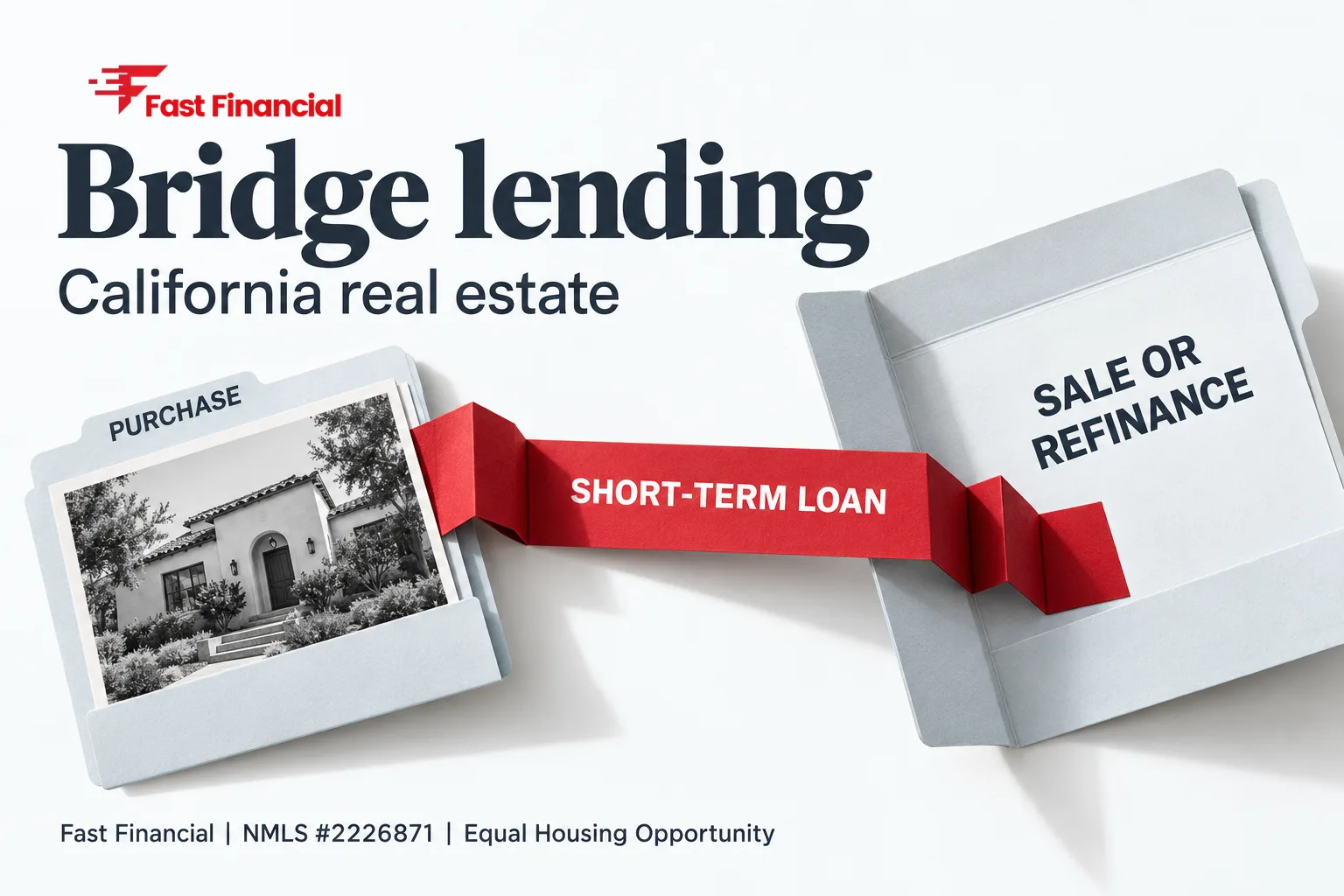
Bridge lending is short-term, asset-backed financing that covers the gap between what you need to close now and the long-term money that will replace it. The lender cares most about the property and your exit plan. Your tax returns matter less than they would on a traditional mortgage.
Here's how the category works, how residential, commercial and multifamily bridge lending differ, and what to check before you sign anything.
What is bridge lending?
Bridge lending is a short-term loan secured by real estate. It "bridges" a timing gap: you need to buy, fund a project, or free up cash before a permanent loan or a sale can happen.
A bridge loan is built to be repaid by an event. That event is usually a sale, a refinance into a long-term mortgage, or the stabilization of an income property. Lenders underwrite that event, not just your paycheck. For the borrower-level basics, start with what a bridge loan is and how it works. This article covers the lending side: who offers it, how deals are structured, and how to compare options.
Who actually uses bridge lending?
The common scenarios:
- Homeowners who need to buy before they sell. The new purchase closes before the old home does.
- Investors buying fast. A seller wants a quick close, and a conventional loan can't move on that schedule.
- Value-add buyers. The property needs work or lease-up before it qualifies for permanent financing.
- Borrowers with a non-standard file. The asset is strong, but the income documentation doesn't fit a conventional box.
If you're buying something that needs heavy repair, see how fix-and-flip loans work for Antelope Valley investors. For properties that are cheap because they're troubled, read how to finance a distressed asset in California.
How is residential bridge lending different from commercial bridge lending?
The mechanics are similar, but the underwriting differs.
| Residential bridge | Commercial / multifamily bridge | |
|---|---|---|
| Typical collateral | 1–4 unit home, often owner-occupied or a flip | Apartment buildings, mixed-use, retail, office |
| What drives approval | Equity, property condition, exit plan | Property income, occupancy, business plan |
| Exit | Sale of the old home or a refinance | Refinance into permanent debt or a sale after stabilization |
| Paperwork | Lighter on income, heavier on property | Rent rolls, operating statements, a written business plan |
Real estate bridge lending on a single home is mostly an equity-and-exit conversation. On commercial and multifamily bridge lending, the lender underwrites the building's income and your plan to improve it. If you're eyeing a larger residential income property, our guide to apartment loans in California shows what the permanent loan on the other side of the bridge looks like.
What do bridge lenders actually look at?
In practice, lenders weigh four things:
- The property. Location, condition, and how easily it could be sold or refinanced.
- Your equity or cash in the deal. A lender wants you to have real skin in the game.
- The exit strategy. This is the number one question. "How does this loan get paid off, and what if it takes longer than planned?"
- Your experience and liquidity. Investors with a track record and reserves get more flexibility.
Credit and income still matter, just differently than on a standard mortgage. Some bridge programs lean on the asset more than on income documentation. Others are closer to traditional underwriting. It varies by lender and by deal.
How do bridge lending rates and costs work?
Bridge lending rates are typically higher than long-term mortgage pricing, because the loan is short, the risk profile is different, and the lender is underwriting speed and flexibility. We won't quote numbers here. Pricing depends on the property, the borrower, the loan structure, and the market on the day you lock.
What matters is the total cost of the bridge, not the headline number. Compare these items across offers:
- Origination or lender fees
- Whether interest is paid monthly or accrues until payoff
- Extension options and their cost
- Prepayment terms
- Draw fees and inspection costs, if the loan funds renovations
- Third-party costs such as appraisal, title, and escrow
Ask every lender for a written breakdown of fees and the full cost to carry the loan if your exit takes longer than expected. Pricing you can't compare line by line isn't pricing you can trust. If you want a refresher on what a formal cost disclosure looks like, see what a loan estimate is.
Is a bridge loan the same as a hard money loan?
Not always. A hard money loan is one type of bridge financing. It's usually asset-based and fast, and it often comes from private lenders. Other bridge loans come from banks, credit unions, debt funds, or brokered programs with more traditional underwriting. Read what a hard money loan is and when it makes sense in California to see where that segment fits.
What are the alternatives to a bridge loan?
Before you commit, check whether something cheaper and simpler solves the same problem:
- A HELOC or second mortgage on the home you already own can fund a down payment without a short-term bridge. Here's HELOC vs. second mortgage.
- A cash-out refinance if your timeline allows it.
- A longer closing or a sale contingency in the purchase contract. See appraisal and loan contingencies in California.
- A DSCR or rental property loan if the property already cash-flows. Start with DSCR loans in California or our rental property loan guide.
The move is to price the bridge against these options. A bridge makes sense when speed or flexibility is worth the extra cost, and when your exit is realistic.
How do I choose a bridge lender?
Use this checklist:
- Get the exit in writing. Define it before you apply: sale, refinance, or stabilization.
- Stress-test the timeline. Ask what happens if renovation, lease-up, or a sale runs late.
- Compare full cost, not just rate. Use the fee list above.
- Check the lender's track record. Funding history, draw process, and payoff turnaround times all matter.
- Confirm licensing. In California, lenders and brokers should be properly licensed. Ask for the license number and verify it.
- Line up the permanent loan early. If the bridge pays off through a refinance, talk to that lender before you close the bridge. Renovation-financing paths like construction loan requirements can be part of the same plan.
A broker can help here. Fast Financial is a California mortgage broker, and we can look at your scenario, explain which structures fit, and help you compare options before you commit to one. We don't promise approval or terms. Those depend on your file.
Frequently asked questions
Is bridge lending only for investors?
No. Homeowners use bridge financing to buy before selling, and investors use it for acquisitions and renovations. The right structure depends on the property and the exit.
How fast can a bridge loan close?
Bridge loans generally close faster than conventional mortgages, but timing depends on the lender, the property, title, and appraisal. Don't assume a date until the lender confirms it in writing.
What happens if I can't pay off the bridge loan on time?
You may be able to extend it for a fee, refinance it, or sell the property, depending on the loan terms. Ask about extension options and default terms before you close.
Do bridge loans require good credit?
Credit still matters, but many bridge programs weigh the property, your equity, and your exit plan more heavily than a conventional loan does. Requirements vary by lender.
Can I use bridge lending on multifamily or commercial property?
Yes. Multifamily and commercial bridge lending is common for acquisitions and value-add projects. Lenders underwrite the building's income, occupancy, and your business plan.
Ready to see where you stand?
If you're weighing a bridge against other financing, get your rate reviewed and we'll walk through the options for your scenario. You can also call Fast Financial at (661) 512-4141, or visit our office at 190 Sierra Ct Ste 324, Palmdale, CA 93550. Learn more about Fast Financial, or use our mortgage calculators to run your own numbers first.
Fast Financial, NMLS #2226871. Equal Housing Opportunity. All loans subject to underwriting approval. Terms and availability vary by borrower, property, and market.