
Financing a rental property in California works differently than buying a home to live in — lenders underwrite it as an investment, which means stricter qualification standards, a different set of loan programs, and a credit profile that has to hold up under more scrutiny. The right structure depends on your income situation, how many properties you already own, and whether the rental income can carry the loan.
How Are Rental Property Loans Different from a Primary Home Mortgage?
Lenders treat investment properties as higher risk than owner-occupied homes. The logic is straightforward: if something goes wrong financially, a borrower is more likely to protect the roof over their head than a property someone else is renting.
That means lenders typically require a stronger credit profile, a larger down payment, and more cash reserves than they would for a primary purchase. Primary vs. investment home mortgages differ in several key ways — pricing, reserve requirements, and income calculation all shift when a property won't be owner-occupied.
The pricing gap between primary and investment property financing is real. Understanding it upfront helps you model deals accurately before you're under contract.
What Loan Types Work for California Rental Investors?
Conventional Investment Property Loans
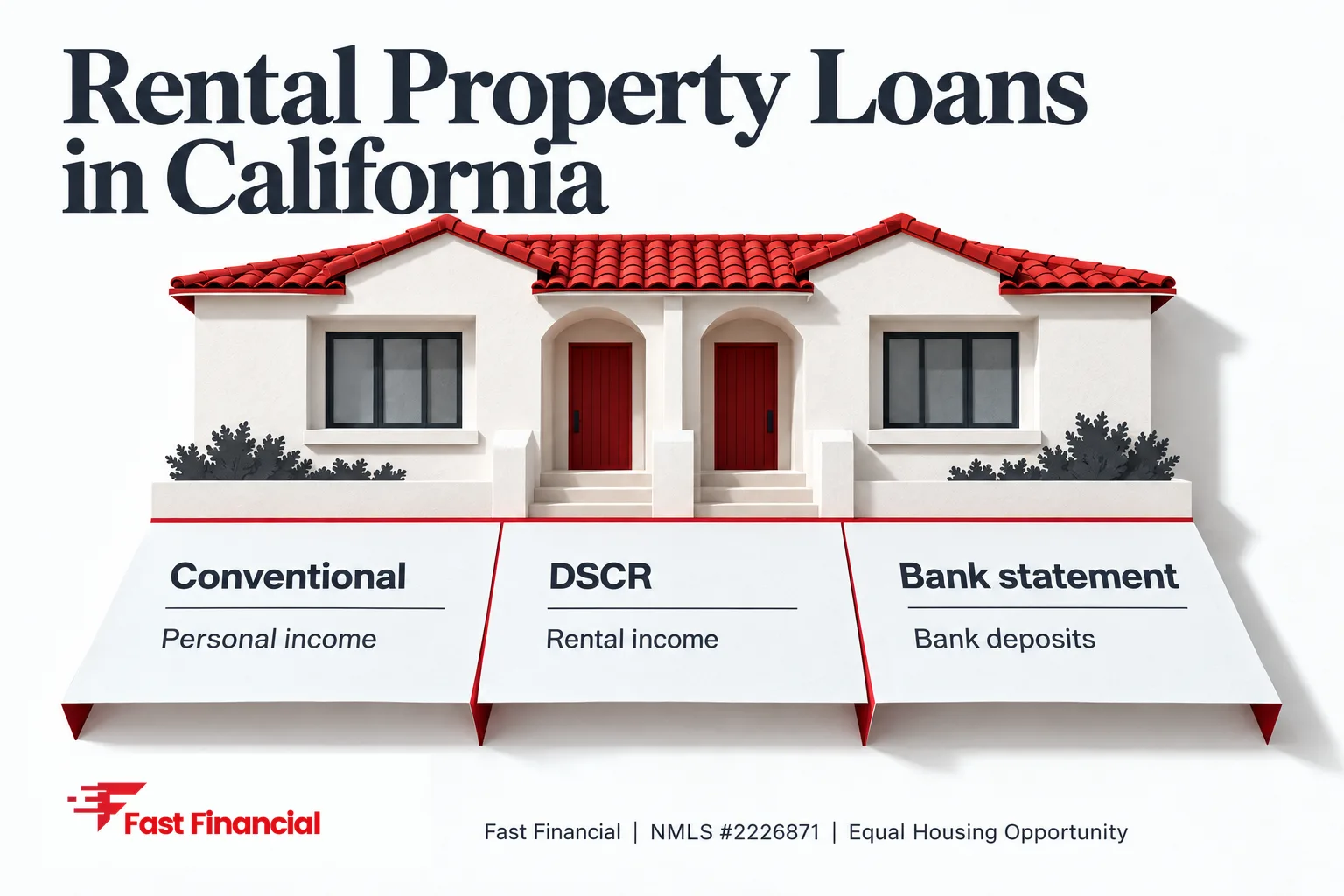
If you're a W-2 borrower or have strong documented income, a conventional loan through Fannie Mae or Freddie Mac guidelines is usually the benchmark to start. These require full income documentation — tax returns, W-2s, pay stubs — and the underwriter will use existing lease agreements and a portion of market rent to help offset the new payment in your debt-to-income ratio.
Conventional guidelines get stricter the more properties you already finance. Beyond a certain count, you move into portfolio lending territory and need to think differently about how you're structured.
DSCR Loans — the No-Income-Doc Option
DSCR (Debt Service Coverage Ratio) loans are built specifically for rental investors. Instead of qualifying on your personal income, the lender evaluates whether the property's rental income covers the loan payment. That ratio — DSCR — is the number that matters. A ratio at or above 1.0 means the rent covers the debt. Many programs want to see it higher.
DSCR loans in California are a strong fit for investors whose tax returns understate their income, who own multiple properties with complex DTI calculations, or who simply want to keep personal finances separate from the investment. If you want to understand the mechanics before applying, this walkthrough of what DSCR loans are and who qualifies covers the core concept.
Bank Statement and Non-QM Routes
Self-employed investors frequently hit a wall with conventional programs because taxable income — after deductions — doesn't reflect actual cash flow. Bank statement loans solve that problem: 12 or 24 months of deposits give the lender a cleaner picture.
For investors with non-standard income, non-QM mortgage programs open more pathways than a conventional-only approach. Self-employed borrowers especially benefit from knowing which documentation type matches which program before they apply — getting a California mortgage as a self-employed borrower starts with structuring your income correctly for the loan product you're targeting.
How Do Lenders Qualify You for a Rental Property Loan?
Credit. Investment property loans are more credit-sensitive than primary home loans. Your credit profile has a direct effect on which programs you can access and at what cost — this is one of the levers most worth optimizing before you apply.
Reserves. Lenders want cash in the bank after closing — not just enough to close, but enough to cover several months of payments across all financed properties. Reserve requirements scale with the size of your portfolio.
Income or DSCR. On a conventional loan, DTI is the gatekeeping metric, and rental income is factored in at a discount. On a DSCR loan, the property's income replaces personal income documentation entirely. Knowing which path you're on before you start shapes everything else.
Property condition. The rental has to be rentable. Lenders will order an appraisal and assess whether the property is market-ready. Properties in poor condition may require bridge financing first — distressed asset financing in California is a separate category worth understanding if you're targeting off-market or value-add deals.
What Does the Approval Process Look Like?
- Know your income story. W-2, self-employed, or DSCR — the answer determines your program.
- Pull your credit. Investment property loans are credit-scored with thinner margins than primary home loans. Know where you stand.
- Identify the property. Have a realistic rent estimate and a sense of the DSCR before you go to a lender.
- Get pre-approved. Start with a rate review to see what program fits your profile and what your numbers look like inside that program.
- Choose your structure. One property, a growing portfolio, or a blanket loan across multiple units — structure affects pricing, reserves, and documentation requirements.
California's price points mean rental property loans here frequently overlap with jumbo territory, especially across Los Angeles County. Working with an LA mortgage broker who actively works with investors means access to lenders who are actually pricing and closing these deals.
Why California Investors Use a Broker Instead of a Bank
A bank offers its own products. A broker works across multiple lenders — and that spread matters when your situation doesn't fit a conventional box.
Investment property lending has more variation in underwriting, overlays, and eligibility than primary home lending. One lender caps financed properties at four; another is comfortable at ten. One lender won't touch a property without 12 months of lease history; another has a DSCR program built for it. One lender has a rental-specific product priced aggressively; another treats investment properties as an afterthought.
If you're building a portfolio in the Antelope Valley, Los Angeles, or anywhere across California, the investor-specific programs — DSCR, bank statement, fix-and-hold — are where broker relationships pay off. Investors who are rehabbing before they rent should note that fix and flip loans for Antelope Valley investors are a different product category from permanent rental financing — many investors use bridge first, then refinance into a long-term rental loan once the property stabilizes.
Fast Financial is a California-licensed mortgage broker (NMLS #2226871). Loan programs, rates, and terms vary by borrower profile and market conditions.
Frequently Asked Questions
Can I use rental income to qualify for a rental property loan?
Yes, with caveats. Conventional loans allow a portion of documented rental income — from existing leases or a market rent analysis — to offset the new payment in your DTI. DSCR loans go further: the property's rental income is the primary qualification metric, replacing personal income documentation entirely.
What credit score do I need for a rental property loan in California?
Investment property loans are more credit-sensitive than primary home mortgages. The score threshold affects both which programs you can access and how those programs are priced. There's no single answer across all lenders, but the higher your score, the more doors open.
Do DSCR loans work for first-time investors?
Many DSCR lenders will work with first-time investors as long as the property's cash flow meets their coverage ratio requirements. Because the property does the qualifying — not your investment track record — first-timers with strong rentals can be competitive candidates.
Can I get a rental property loan if I'm self-employed?
Yes. Self-employed investors have strong options in the non-QM space — bank statement loans, DSCR loans, and asset-depletion structures can all work depending on your profile. The key is matching your income documentation to the right program before you apply.
What's the difference between a fix-and-flip loan and a rental property loan?
A fix-and-flip loan is short-term bridge financing for investors who buy, renovate, and sell. A rental property loan is long-term permanent financing for a property you plan to hold and lease. Your exit strategy determines which product you need — and the two are not interchangeable.