
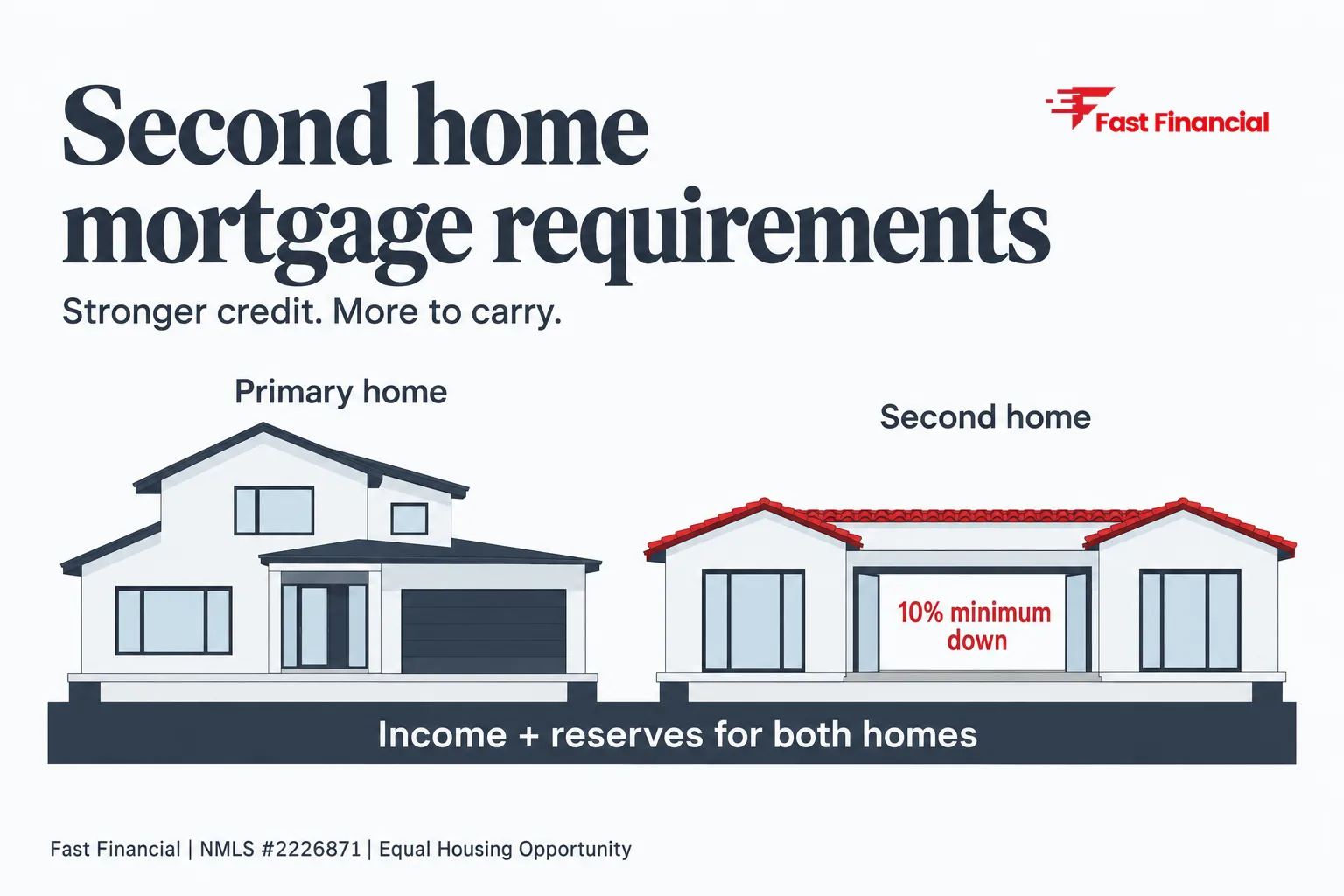
Quick answer: Second home loans are conventional mortgages for a one-unit home you live in for part of the year. Expect at least 10% down, a credit score of 620 or higher, and reserves that cover both homes for several months. The property can't be run as a full-time rental, and FHA and VA loans don't finance second homes.
To finance a second home, you'll need stronger financials than your primary purchase — a higher credit score, a minimum 10% down payment per Fannie Mae guidelines, and enough income to carry both mortgages comfortably. Here's exactly what lenders look at, and where most applications hit a wall.
How Is a Second Home Different From an Investment Property?
This distinction matters more than most borrowers expect, and getting it wrong causes real problems.
A second home is a property you personally occupy for part of the year. A vacation cabin, a condo in Palm Springs, or a weekend place near the coast — something genuinely for your use. It doesn't have to be used year-round, but your intent to personally occupy it has to be real.
An investment property is purchased primarily to generate rental income. Even occasional occupancy doesn't override the classification if rental is the primary purpose.
Why does it matter? Second home loans come with more favorable terms than investment property financing. Misrepresenting an investment purchase as a second home is mortgage fraud — lenders do verify occupancy intent during underwriting and can rescind or call the loan. If your real goal is rental income, DSCR loans in California are built for that scenario and qualify on the property's cash flow rather than your personal income.
See the full breakdown in Primary vs. Investment Home Mortgages: Understanding the Differences.
What Credit Score Do You Need for a Second Home Mortgage?
The conventional floor is 620, but second home applications in practice require more. Most borrowers getting approved land in the mid-to-upper 600s at minimum — and a score in the 700s gives you the most options.
Credit score shapes more than just approval. It affects your loan terms at every tier, which is why it's worth understanding before you apply. Here's how credit scores affect mortgages if you want to benchmark your profile and know what moves the needle.
How Much Do You Need to Put Down?
Per Fannie Mae and Freddie Mac guidelines, second home purchases require a minimum 10% down payment — significantly more than what's allowed on a primary residence conventional loan.
One hard rule: FHA and VA loans are not available for second homes. Those programs are tied strictly to primary residences. If you're purchasing a vacation or seasonal property, you're working with conventional financing or select non-QM products. Understanding the differences between FHA and conventional mortgages helps clarify why the product selection narrows here.
Your down payment also determines your LTV. A stronger down position generally makes the overall application cleaner — lower LTV is one of the factors underwriters look at when assessing risk on a second property.
What Debt-to-Income Ratio Do Lenders Require?
DTI — your monthly debt payments divided by gross monthly income — is critical on second home applications because lenders are now stacking both mortgages together.
Conventional guidelines generally allow DTI up to 43–45% through automated underwriting, though individual lender overlays vary. The practical reality: the more debt you're already carrying (primary mortgage, auto loans, student debt, credit cards), the harder it is to qualify for the additional payment.
Run the math before you shop. Add up your current monthly obligations and calculate the percentage of gross income they represent. That gives you a real read on how much room you have. A Los Angeles mortgage broker can model this for your exact profile and show you where you stand before you're in contract.
Do You Need Reserves to Qualify?
Yes — and this is where many second home applications stall. Lenders typically require post-closing reserves sufficient to cover payments on both properties for several months. This demonstrates you won't be stretched thin the moment you close.
Reserves must be liquid: checking, savings, or money market accounts. Retirement account balances can often count at a discounted percentage. Personal property and illiquid assets don't qualify.
Plan for at least two to six months of combined PITI (principal, interest, taxes, and insurance) across both properties as a general benchmark, though requirements vary by lender and loan structure.
What Does the Property Itself Need to Meet?
Not every property qualifies under second home guidelines. Lenders look for:
| Requirement | What It Means |
|---|---|
| Single-unit only | Two-to-four unit properties are classified as investment |
| Personal occupancy intent | You must use it yourself for part of the year |
| Not a timeshare | Timeshares are ineligible for second home financing |
| No rental pool arrangements | If the HOA requires you to participate in a managed rental program, it's likely reclassified as investment |
| Reasonable distance from primary | No hard federal rule, but lenders expect it to make sense as a seasonal or vacation property |
Can You Rent Out a Second Home?
Occasional or seasonal rental is generally permitted under second home guidelines. If you rent it out when you're not there, most lenders allow it.
The line gets crossed when rental becomes the primary purpose. If you're planning to rent the property for most of the year, expect the lender to reclassify it as investment property — which changes the qualifying standards and loan options entirely.
Be straightforward about your intent. Occupancy misrepresentation on a mortgage application is fraud, and the consequences are serious.
What Does the Second Home Mortgage Process Look Like?
The steps mirror a standard purchase, with extra scrutiny on income, assets, and property classification:
- Pull your credit and assess your DTI — know your numbers before applying. Here's what credit score you need to buy a house in Lancaster, CA as a California baseline.
- Document your income — W-2s, tax returns, and pay stubs for W-2 earners. If you're self-employed, bank statement loans offer an alternative documentation path.
- Verify your assets — down payment source, reserves, and any gift documentation.
- Get pre-approved — understand what mortgage pre-approval involves before you make an offer.
- Property appraisal — the property must appraise at or above purchase price under the second home classification.
- Underwriting and close — expect 30–45 days from application to funding in most cases.
California-Specific Considerations
In California's high-value markets — coastal SoCal, Palm Springs, Lake Tahoe, or even parts of the Antelope Valley — second home purchases often push above the conforming loan limit, which moves the transaction into jumbo territory. Jumbo loan requirements in Los Angeles County are worth reviewing if your purchase price is anywhere near that threshold.
If you're comparing your options, use the mortgage calculators to model different scenarios before you're in contract.
Ready to see where you stand? Get your rate reviewed — no pressure, no obligation, just a clear picture of what you qualify for.
Frequently asked questions
Can you use FHA or VA financing for a second home?
No. FHA and VA loans are restricted to primary residences. Second home financing runs through conventional guidelines or select non-QM products. There are no exceptions to this rule.
What's the minimum down payment required for a second home mortgage?
Fannie Mae and Freddie Mac guidelines set the conventional minimum at 10% for a second home — roughly double the floor on a primary residence conventional purchase. Some lenders may require more depending on your credit profile and the property.
Can I count rental income from a second home to qualify?
Generally no, not under conventional second home guidelines. If you plan to rent the property regularly, the lender may reclassify it as an investment property, shifting the qualifying standards entirely. Learn how primary and second home mortgages differ if you're weighing the two classifications.
Do I need to pay off my primary home to buy a second one?
No. You can carry both mortgages simultaneously — what matters is that your combined DTI stays within qualifying limits and that you have the required reserves to hold both.
What happens if a lender reclassifies my second home as an investment property?
Your required down payment increases, qualifying standards tighten, and some loan programs no longer apply. If your intent is actually to generate rental income, it's better to finance it correctly as an investment property from the start. DSCR loans are built for that scenario.