
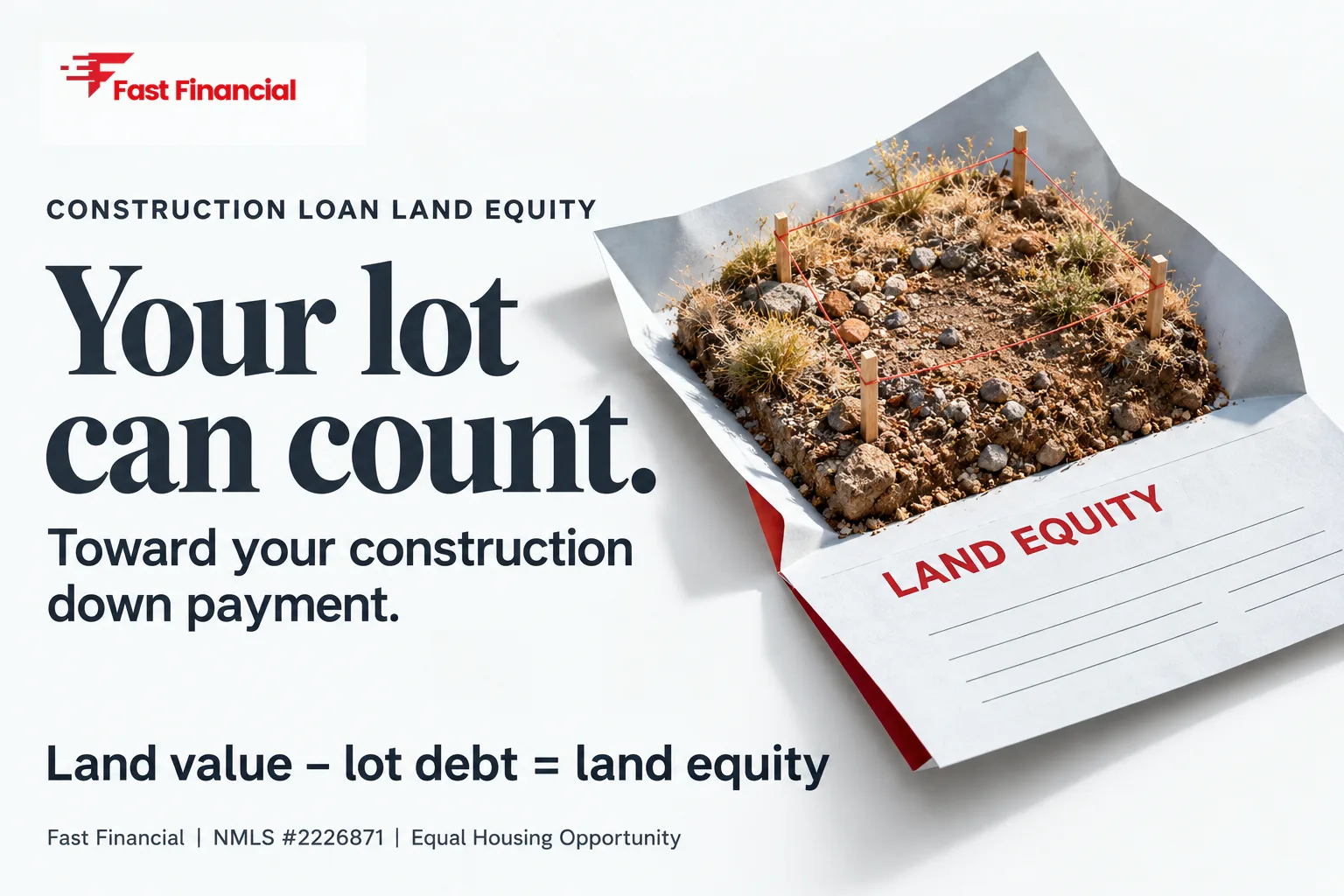
Yes, if you own your land, lenders can often count the equity in it as part of your contribution to a construction loan. In practice, that means a paid-off or lightly financed lot can replace some or all of the cash you'd otherwise bring to the table. Here's how the math works and what lenders actually look at.
What is land equity on a construction loan?
Land equity is the value of your lot minus anything you still owe on it. If you own it free and clear, the entire appraised value is equity. If there's a loan on it, only the difference counts.
Lenders treat that equity like a down payment. Instead of writing a check, you "pay in" with the dirt you already own. The loan then funds the build itself, usually released in stages as work is completed.
How do lenders calculate land equity?
The number that matters is the value of the finished project, not the lot alone. Lenders look at the total cost to build (land plus construction) and at the projected appraised value once the home is done. Your equity in the land is applied against that total.
Here's the basic framework:
| Step | What happens |
|---|---|
| 1. Land value | An appraiser values the lot as it stands today |
| 2. Subtract any lot debt | Remaining balance on the land is deducted |
| 3. Add construction costs | Verified by plans, a budget, and a builder contract |
| 4. Compare to the "as-completed" value | The appraiser estimates what the finished home will be worth |
| 5. Apply the lender's loan-to-value or loan-to-cost limit | Your land equity is credited toward the required contribution |
Each lender sets its own limits, and they differ by program, borrower profile, and property type. That's why a general online construction loan calculator with land equity can give you a rough picture but not a commitment. Our mortgage calculators are a good place to start sketching numbers, then a real review confirms them.
Does it matter when and how I bought the land?
It can. Lenders often want to see how the land was acquired.
- Bought recently with cash or a loan: Lenders generally use the lesser of the purchase price or the appraised value as the starting point.
- Owned for a long time: The current appraised value is typically the basis, which can work in your favor if the area has appreciated.
- Inherited or gifted: Documentation matters. Expect to provide proof of ownership and a clear title.
Your title also has to be clean. Liens, easements, or unresolved ownership questions can slow things down or stop a deal.
What else do lenders need besides the land?
Equity gets you part of the way. The rest of the file looks like a purchase loan with extra construction paperwork. Our guide to construction loan requirements covers it in detail, but the core items are:
- Approved plans, specs, and a line-item budget
- A licensed, insured builder with a signed contract
- Permits and utility access for the lot
- Credit, income, and asset documentation
- An appraisal based on the plans ("as-completed" value)
Your credit and debt load still count, too. If you want to understand that side, see how lenders measure debt-to-income ratio and what credit score is typically needed for a California mortgage.
Which loan programs allow land equity?
Several do, and they work differently:
- Conventional construction loans often let land equity serve as the borrower's contribution, with the lender setting the limits.
- FHA construction-to-permanent loans can account for land you already own. See how FHA construction loans work for the process.
- Renovation loans apply when you're buying and fixing, not building from scratch. Compare the FHA 203(k) and VA renovation options.
- Private or asset-based financing may fit unusual lots or complex borrowers. Our overview of asset-based financing explains the approach.
Which one fits depends on your credit, income documentation, timeline, and the project itself.
What are the pitfalls of using land equity?
A few things trip people up:
- Overestimating lot value. Your opinion and the appraiser's number can differ. Plan around the appraisal, not the asking price you saw nearby.
- Underestimating the build. Budgets that leave out site work, utilities, permits, or contingency run short fast.
- Skipping the permanent-loan question. Decide whether you want a one-time-close loan that converts to a permanent mortgage, or a separate construction loan followed by a refinance. Each has trade-offs.
- Ignoring the lender's builder rules. Many lenders vet the builder as closely as the borrower.
How do I see where I stand?
The move is to gather your land documents, a rough budget, and your builder's bid, then have the numbers reviewed against real programs. Fast Financial works with California borrowers, including homeowners and lot owners across the Antelope Valley and greater Los Angeles, and we can tell you quickly which structure fits. Learn more about Fast Financial or get your rate reviewed. Rates and terms vary by borrower and market, and nothing here is a commitment to lend.
Call us at (661) 512-4141 or stop by the office at 190 Sierra Ct Ste 324, Palmdale, CA 93550. If your lot is in Palmdale, Lancaster, or Quartz Hill, the office is local to you.
Frequently asked questions
Can I use land I own free and clear as my entire down payment?
Often it can cover a large share, and sometimes all of the required contribution, depending on the program and the appraised numbers. The lender confirms this after reviewing your plans, budget, and appraisal.
Does the land need to be paid off to count as equity?
No. Only your equity counts, which is value minus any balance owed. A lot with a loan on it can still contribute, but the remaining debt reduces the credit you get.
Is a construction loan calculator with land equity accurate?
It's a useful estimate, not a quote. Lender limits, the as-completed appraisal, and your qualifying profile all change the real result.
Can I use inherited or gifted land?
Generally yes, with clear title and documentation of ownership. The lender will still appraise it and review how it was transferred.
Do I need good credit to get a construction loan with land equity?
Credit still matters. Land equity helps with the cash side, but lenders also review credit, income, and debt, so those need to qualify on their own.
Fast Financial, NMLS #2226871. Equal Housing Opportunity. Not a commitment to lend. Programs, requirements, and availability vary by borrower and market.