
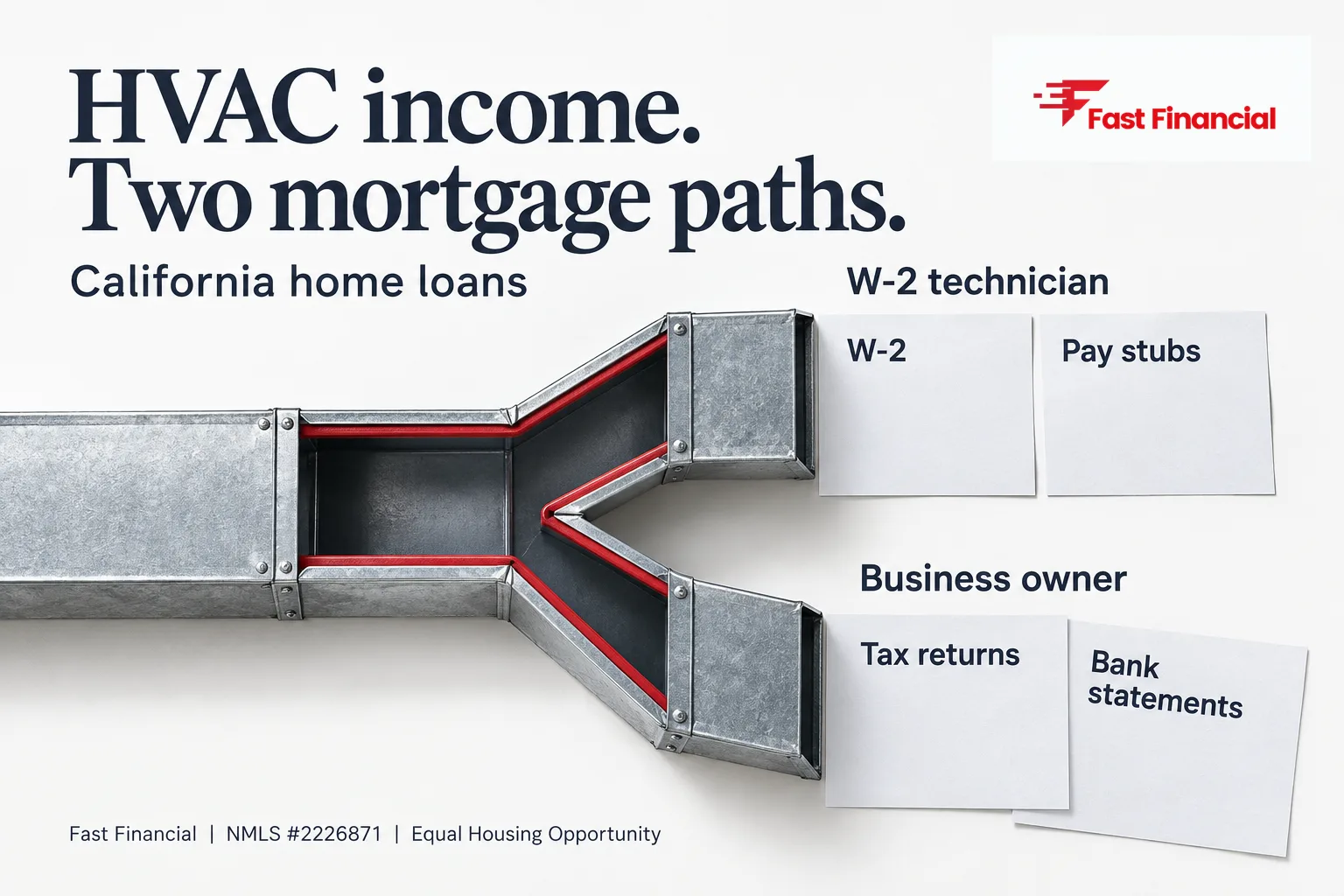
HVAC technicians and HVAC business owners can absolutely qualify for a mortgage — the key is knowing which income documentation path applies to you and which loan programs are built for how you actually get paid.
Why HVAC Income Looks Different to Underwriters
A strong income doesn't always show up cleanly on paper. HVAC techs on someone else's payroll qualify using standard income verification — pay stubs, W-2s, employment history. Straightforward.
HVAC business owners and independent contractors face a different challenge. Legitimate business deductions — company trucks, tools, equipment, fuel, insurance — reduce your taxable income. That's exactly how the tax code is supposed to work. The problem: conventional lenders calculate qualifying income off your adjusted figures, not your actual deposits.
If your business is thriving but your mortgage approval feels uncertain, that gap is usually why. Getting a mortgage when you're self-employed in California requires a different strategy than it does for a salaried borrower — and it's worth understanding before you start shopping.
W-2 HVAC Tech vs. HVAC Business Owner — Two Different Paths
If you're on someone else's payroll: Qualification works like most salaried borrowers. Two years of W-2 history, recent pay stubs, a steady employer. Overtime income can count if it's likely to continue — your employer may need to verify that in writing. Variable or seasonal hours typically get averaged across 24 months.
If you own the HVAC business: Conventional underwriting pulls from two years of personal and business tax returns. Net profit after deductions is what Fannie Mae and Freddie Mac use — not revenue, not gross deposits. If your write-offs are doing their job, that qualifying number is often lower than what you're actually earning.
How much income you need to buy a house in California is the first calculation — but it only works if you know which income figure underwriters will actually use.
What Loan Programs Actually Work for HVAC Borrowers?
Conventional loans are available to HVAC business owners if two years of tax returns show sufficient qualifying income. If the write-offs leave too little on paper, you need an alternative.
Bank statement loans are the go-to for HVAC owners in exactly this situation. Instead of tax returns, lenders average 12 or 24 months of business or personal bank deposits. Your actual cash flow drives the qualification — not your Schedule C. This is a non-QM mortgage product, and Fast Financial works with these directly. For a local breakdown, see bank statement loans for self-employed borrowers in Lancaster.
DSCR loans enter the picture if you own or want to buy investment properties. A DSCR loan in California qualifies you on the rental income of the property — your personal tax return doesn't factor in. HVAC business owners who invest in real estate often find DSCR the cleanest path to building a portfolio without their business write-offs becoming a problem.
FHA loans can work for W-2 HVAC techs with solid employment but thinner credit files or smaller down payments. Worth understanding the tradeoffs before you commit.
What Lenders Actually Look At
Whether you're running service vans out of Lancaster or handling residential calls in Woodland Hills, here's what underwriters focus on:
- Stability: Two years in the trade, or two years of business ownership. A consistent track record matters more than any single document.
- DTI (debt-to-income ratio): Your monthly debt obligations relative to qualifying income. This is the lever most people can work on ahead of time.
- Credit: No universal floor, but cleaner credit opens more programs. How credit scores affect your mortgage covers how lenders actually use the number.
- Documentation: Business owners should start gathering early. The self-employed borrower document checklist covers what you'll typically need.
- Reserves: Lenders want cash left over after closing. HVAC business owners are sometimes asked to show the company itself has working capital — not just personal assets.
Can I Use LLC or S-Corp Income to Qualify?
Yes — with the right documentation. If you pay yourself a W-2 salary from an S-corp, lenders can use that salary plus a share of your business's net income from Schedule E, provided the business is profitable and stable.
A single off year doesn't automatically disqualify you, but it limits options on conventional programs. Two years showing a consistent or upward trend is the strongest position. If you're in a growth phase, have the conversation now — there's often a clear line of sight to when the timing is right.
Already Own a Home? A Cash-Out Refi Can Fund Business Growth
Some HVAC business owners use built-up home equity to fund expansion — new equipment, fleet vehicles, or hiring. A cash-out refinance pulls equity from your home at mortgage rates, which are typically lower than business lines of credit. Use the mortgage calculators to model different structures before you commit to any one approach.
Buying in Palmdale, Lancaster, or the Antelope Valley?
High-desert conditions make HVAC work steady year-round here — and a lot of HVAC technicians and business owners in the Antelope Valley are buyers too. Fast Financial's office is local: 190 Sierra Ct Ste 324, Palmdale, CA 93550. Call (661) 512-4141 or come in. We know this market and work with trade-industry borrowers regularly.
If this is your first purchase, the first-time homebuyer programs available in the Antelope Valley are worth reviewing — there are down payment assistance options that change the math.
Get your rate reviewed at Fast Financial — NMLS #2226871. No hard credit pull required to start the conversation.
Frequently Asked Questions
Do I need two full years of self-employment to qualify?
Most conventional programs require two years, but some non-QM products allow one year of self-employment if you have prior W-2 history in the same trade. A consistent skilled-trades background often satisfies lenders on continuity.
Will my business deductions hurt my mortgage application?
On a conventional loan, yes — deductions reduce the income figure lenders use to qualify you. On a bank statement loan, no — your tax return isn't the income source. Which path fits depends on your actual numbers.
Can a 1099 HVAC contractor use a bank statement loan?
Yes. Independent contractors filing a Schedule C are treated as self-employed. If your returns don't show enough qualifying income, bank statement loans are available for 1099 workers too.
What if my HVAC business had a loss year recently?
One loss year isn't automatic disqualification, but it limits conventional options. Lenders typically average two years, so a strong recovery year helps. Non-QM programs tend to be more flexible depending on the overall picture and what the most recent year shows.
How do I start the process?
Reach out to Fast Financial — NMLS #2226871 — at (661) 512-4141 or request a rate quote online. We work with W-2 HVAC techs and business owners alike and will tell you straight which loan path makes sense for your situation.