
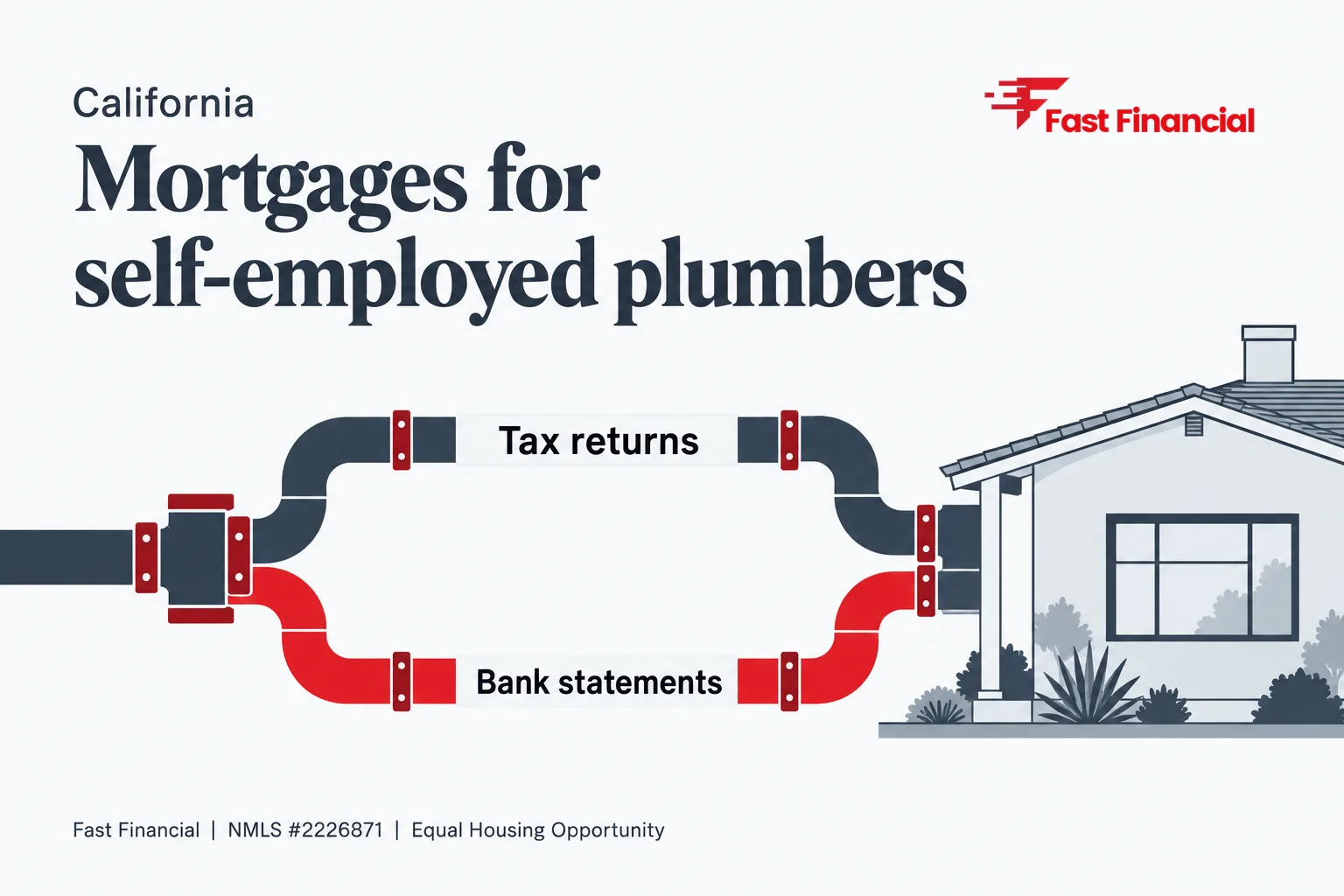
Self-employed plumbers can absolutely qualify for a home loan in California — the process just looks different than it does for a W-2 employee. The real friction isn't your income; it's that the same write-offs keeping your tax bill low also reduce what lenders see on paper. Here's how to work with that reality instead of fighting it.
Why Is Getting a Mortgage Harder When You're Self-Employed?
Lenders verify income using your taxable income — what's left after every business deduction. Run a successful plumbing business and legitimately write off tools, a work truck, materials, insurance, and subcontractor labor, and your gross revenue can be strong while your Schedule C net looks modest. That gap is the friction.
For a W-2 worker, income verification takes two minutes with a pay stub. For a self-employed plumber, the lender builds a picture from two years of tax returns, business documents, and sometimes bank statements — more moving parts, but absolutely workable with the right program. This is exactly the territory Fast Financial works in every day.
What Loan Programs Actually Work for Self-Employed Plumbers?
Not every program is built for your income structure. These are the ones that hold up:
Bank Statement Loans
Instead of tax returns, bank statement loans look at 12 to 24 months of business or personal bank deposits to verify income. If your deposits tell a stronger story than your Schedule C, this is often the right move. A plumber pulling consistent project revenue will typically show strong deposit patterns even when write-offs compress taxable income.
Bank statement loans for self-employed borrowers in Lancaster, CA walks through how the deposit analysis actually works — the mechanics apply to any California plumber regardless of location.
Non-QM Loans
Non-QM (non-qualified mortgage) programs exist because Fannie Mae and Freddie Mac guidelines don't fit every legitimate borrower. Bank statement programs fall under this umbrella, as do P&L-only loans and asset-depletion structures. If conventional underwriting keeps rejecting your application based on adjusted gross income, a non-QM path may be the answer. What Is a Non-QM Loan — and When Does It Actually Make Sense? covers who these programs are built for.
Conventional Loans (Two-Year Tax Return Path)
If your taxable income after deductions clears the debt-to-income hurdle and you have two full years of self-employment documented, a conventional loan is on the table. Fannie Mae and Freddie Mac allow self-employed income — they just require two years of personal returns plus a business return if you're filing as an LLC or S-corp. See Conventional vs. FHA Loan: Which One Actually Saves You Money? to understand how the qualifying standards differ.
FHA Loans
FHA follows similar two-year self-employment guidelines but offers more flexibility on the credit side. If your taxable income qualifies but your credit profile isn't pristine, FHA is worth running the numbers on.
What Documents Does a Self-Employed Plumber Need?
The document list depends on which program you're using.
For conventional or FHA (tax-return-based qualifying):
- Two years of personal tax returns (all schedules)
- Two years of business tax returns (for LLC, S-corp, or partnership filers)
- Current year-to-date profit and loss statement
- Two to three months of business bank statements
- Business license or California contractor's license
For bank statement loans:
- 12 to 24 months of bank statements (personal, business, or both depending on the lender)
- CPA-prepared P&L statement (required by many programs)
- Proof of self-employment (business license, contractor registration)
- No tax returns required — that's the core advantage
The self-employed borrower document checklist breaks this down in full. Pull it before you start gathering paperwork so nothing stalls your application.
What Does Your Credit Score Need to Look Like?
There's no universal cutoff — any lender quoting you a single number without seeing your file is guessing. In practice, conventional programs have minimum score thresholds in the mid-to-upper 600s; FHA is more accessible on credit; non-QM programs vary by lender but typically have their own floors. What credit score do you need for a mortgage in California? breaks down the program-by-program picture.
The bigger variable for self-employed borrowers isn't the score alone — it's the debt-to-income ratio. Your DTI is the ratio of total monthly debt payments to qualifying income. Choosing the right program changes which income number goes into that denominator, and that swing can determine whether you qualify at all.
How Can a Self-Employed Plumber Strengthen Their Application?
Keep two years of clean books. If you're planning to buy in the next 24 months, get your bookkeeping tight now. Lenders want consistent deposit patterns — erratic transfers raise underwriting questions that slow everything down.
Think carefully about deductions the year before you apply. Aggressive write-offs are smart tax strategy, but they compress the income figure lenders use. Talk to your tax advisor and mortgage broker together before filing. The optimal tax return for a buying year may look different than a normal one.
Separate business and personal accounts. Commingled accounts slow down the bank statement review. Clean separation makes the underwriter's job faster — and your closing faster as a result.
Get pre-approved before you start shopping. A pre-approval puts you on equal footing with W-2 buyers when you're making offers. Mortgage pre-approval: what you need to know explains what the process looks like and what to expect.
For a broader walkthrough of how the California self-employed mortgage process works from application to close, How to Get a Mortgage When You're Self-Employed in California is the full-depth read.
What If You're Buying an Investment Property?
If you're a plumber looking to add a rental property rather than a primary residence, DSCR loans are worth knowing. DSCR (Debt Service Coverage Ratio) loans qualify based on the rental property's income — your personal tax return doesn't factor into the underwrite at all. For a self-employed borrower whose adjusted gross income doesn't reflect actual cash flow, that's a meaningful path to building a portfolio without your write-offs working against you.
Frequently Asked Questions
Can a self-employed plumber get a mortgage with only one year in business?
Most conventional and FHA programs require two full years of self-employment. Some non-QM bank statement programs have more flexibility, particularly if you can document a prior history in the same field — such as two years as a W-2 plumber before going independent. The specifics depend on the program and the lender.
Will my business write-offs hurt my mortgage application?
On a tax-return-based loan, yes — deductions that reduce your taxable income reduce the income the lender counts. Bank statement loans sidestep this entirely by qualifying you on deposits instead of the return. Choosing the right program based on your actual income picture is the first decision to make.
Can I use both business and personal bank statements?
Most bank statement programs allow business statements, personal statements, or a combination. Which works better depends on where your deposits land and how an expense ratio calculation affects your business account deposits. Your broker should run both scenarios.
How much income do I need to qualify in California?
It depends on the purchase price, your down payment, and existing debt. How much income do you need to buy a house in California? walks through the framework. The key variable: which program you use determines how your income is calculated — and that number changes the entire math.
What's the next step?
Get your options reviewed at Fast Financial — we work with self-employed borrowers across California and identify which programs fit your actual income picture. If you're in the Antelope Valley, our office is local to you: 190 Sierra Ct Ste 324, Palmdale, CA 93550. You can also call us directly at (661) 512-4141. Fast Financial, NMLS #2226871.