
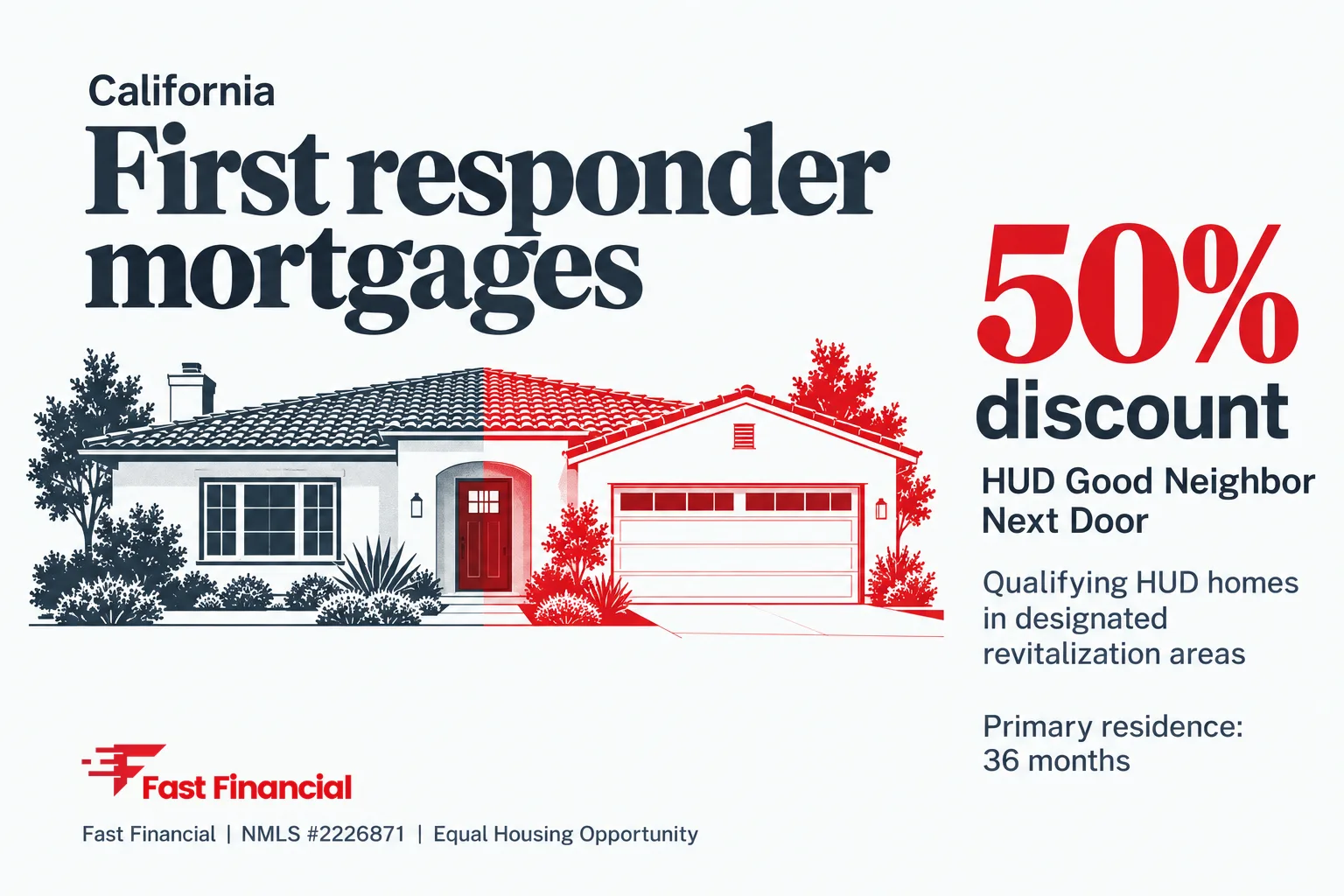
California law enforcement officers, firefighters, EMTs, and paramedics have real homebuying programs available — including a federal program that cuts the purchase price of qualifying homes in half. The challenge isn't eligibility; it's finding a broker who knows which levers to pull and how to structure shift-pay income correctly.
What Programs Are Actually Built for First Responders?
Not all of this lives in your union handbook. Here's what's worth knowing:
HUD Good Neighbor Next Door (GNND) is the standout. HUD sells foreclosed homes in designated revitalization areas to eligible law enforcement officers, firefighters, and EMTs at a 50% discount off the listed price. The only condition is that you live in the home as your primary residence for 36 months. Properties cycle through the HUD Homestore site on a seven-day lottery window — timing matters, and having financing ready before you see a listing is the move.
CalHFA programs aren't profession-specific, but many first responders qualify based on income thresholds — particularly in markets like the Antelope Valley where the gap between home prices and area median income is narrower than in LA proper. CalHFA pairs a first mortgage with a down payment assistance loan, which can meaningfully reduce what you need at closing. Before you apply, understand how much are closing costs on a California mortgage so there are no surprises at the table.
Homes for Heroes is a national affiliate network where participating real estate agents and lenders offer fee reductions to first responders, military, healthcare workers, and teachers. It's not a government program — savings vary by affiliate — but it's legitimate and worth asking about when you're comparing lenders.
VA loans for veteran first responders are often the most powerful option and the most overlooked. If you served in the military before moving into law enforcement or fire, your VA eligibility may be sitting unused. That changes the math on almost everything. Compare FHA vs. VA loans before you settle on a path — if VA is on the table, it usually wins.
How Does Shift Pay and Overtime Affect Qualification?
This is where first responder applications get complicated — and where the right lender makes a real difference.
Overtime and shift differentials count as qualifying income, but lenders require a two-year documented history and consistent patterns. For career law enforcement and firefighters, that history typically exists. The issue is how it's calculated: some lenders average the last 24 months; others use year-to-date. The method can swing your qualifying income significantly.
FLSA overtime under the 7(k) exemption — the standard for law enforcement and fire — works differently than standard W-2 overtime, and not every underwriter handles it correctly. This is a submission and lender-selection problem, not a qualification problem. For a broader look at income thresholds in this market, how much income do you need to buy a house in California is a practical starting point.
Which Loan Type Fits a First Responder's Profile?
FHA works well when credit needs some polish or cash reserves are tight. Qualifying thresholds are accessible and the down payment requirement is lower than conventional — but mortgage insurance stays in the picture until you refinance out of it. The conventional vs. FHA comparison breaks down when each one makes more sense.
Conventional is the better long-run structure for first responders with solid credit and enough down payment to avoid private mortgage insurance — or for those who want equity to grow without an insurance drag.
VA is the strongest tool available if you have military service history and haven't exhausted your entitlement. No minimum down payment requirement, no mortgage insurance, and a competitive underwriting process. Read the full rundown on VA loan benefits and advantages — when it's in play, it's rarely beaten.
The common mistake is defaulting to the credit union or the agency-affiliated lender without shopping the alternatives. At Fast Financial, we see this pattern regularly — first responders leaving real money on the table because they assumed their institutional lender had the best deal.
Does Your Credit Score Change the Options?
It affects pricing more than program eligibility. FHA, conventional, and VA each work across a broader score range than most people expect — the score changes what the loan costs, not usually whether you get one. Know where you stand before you apply. What credit score do you need for a mortgage in California lays out the thresholds across loan types.
What First Responders in the Antelope Valley Should Know
The Antelope Valley is home to a significant portion of LA County's law enforcement and fire workforce — and it's one of the more favorable markets in Southern California for first responders who want to own where they serve.
Home prices in Palmdale and Lancaster are considerably lower than in the LA basin, which opens more CalHFA programs by income threshold and stretches buying power further. How much house can I afford in Palmdale runs the actual numbers for that market. If you've never owned, the first-time homebuyer programs in the Antelope Valley article is worth your time — some city and county programs stack on top of CalHFA, and that combination changes the entry cost considerably.
Get pre-approved before you make an offer. Knowing your ceiling and having documentation ready is what lets you move when the right property surfaces.
Fast Financial is based in Palmdale — 190 Sierra Ct Ste 324, Palmdale, CA 93550 — and we work with first responders throughout the Antelope Valley and greater LA County. Call us at (661) 512-4141 to review your options, or come in to see where you stand.
Frequently asked questions
Do police officers and firefighters get special mortgage rates?
There's no universally mandated "first responder rate" — what exists are specific programs (GNND, CalHFA, VA) that reduce purchase price, down payment requirements, or insurance costs. Some lenders and affiliate networks also offer fee reductions. The combined effect can be significant, but it depends on which programs you qualify for.
Does overtime income count when applying for a mortgage?
Yes, with a two-year documented history and consistent pattern. Law enforcement and firefighter overtime — including FLSA 7(k) pay — qualifies, but the calculation method varies by lender. Working with a broker who knows how to present public-safety pay structures to underwriting correctly matters here.
What is the Good Neighbor Next Door program and who qualifies?
HUD's GNND program sells HUD-owned homes in designated revitalization areas at a 50% discount to eligible full-time law enforcement officers, firefighters, and EMTs employed by a state, local, or federally funded agency. The buyer must occupy the home as a primary residence for 36 months. Available inventory is listed on the HUD Homestore site.
Can I stack CalHFA assistance with other programs?
In many cases, yes. A CalHFA first mortgage can be paired with a CalHFA down payment assistance loan, and some county or city programs layer on top of that. Eligibility depends on income, property location, and current program availability. Get a rate quote to map out what stacks in your specific situation.
What if I served in the military before becoming a firefighter or police officer?
Your VA loan eligibility follows you into your civilian career. If you have an honorable discharge and meet service requirements, that entitlement is available until you use it — and it's the strongest financing tool most first responders have access to. A side-by-side look at FHA vs. VA loans shows why it's worth confirming your eligibility before you commit to another program.
Fast Financial | NMLS #2226871 | Licensed in California | Equal Housing Opportunity