
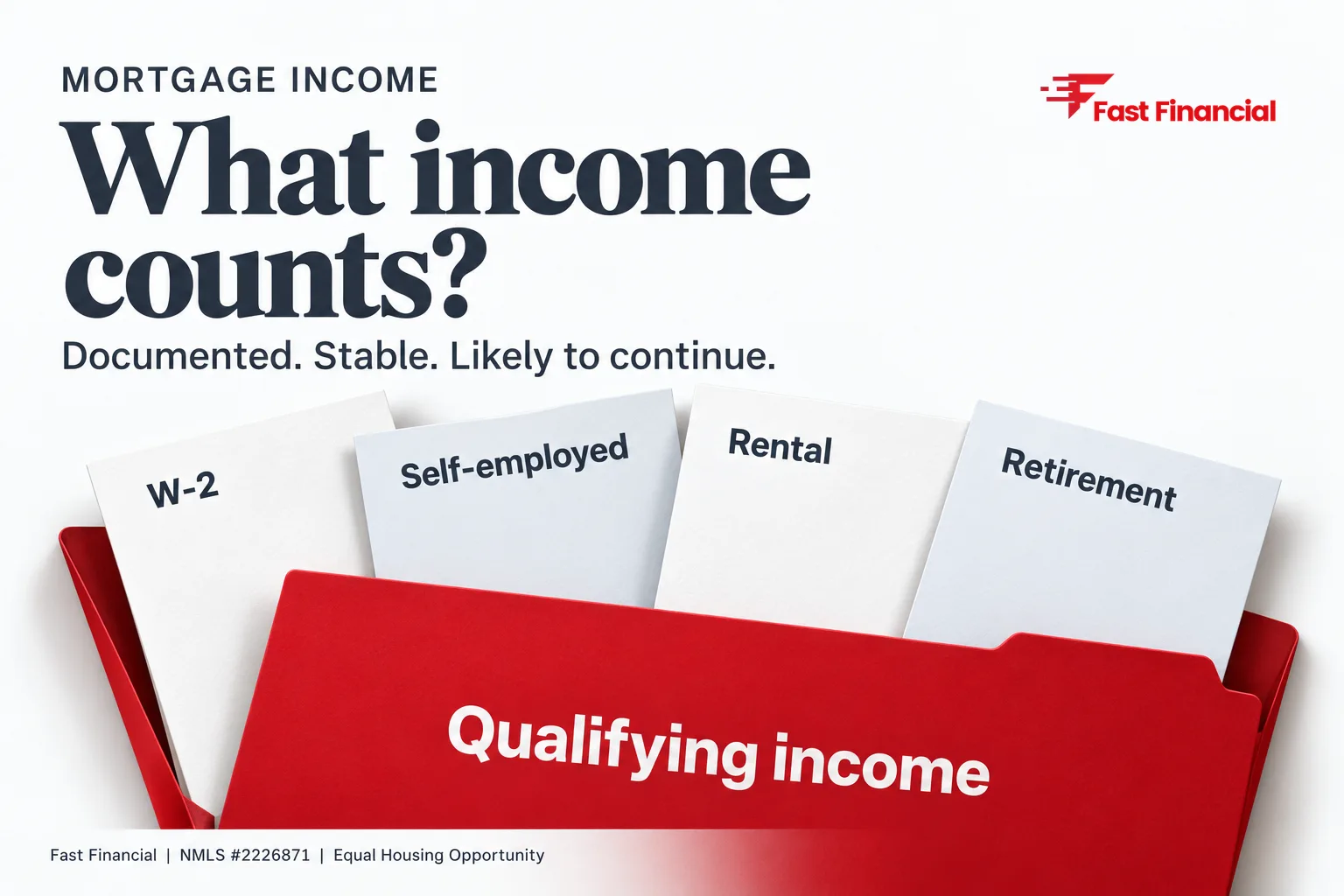
Lenders count income that is documented, stable, and likely to continue. Salary, hourly wages, commissions, self-employment profit, rental income, retirement and Social Security payments, and some other regular sources can all qualify. What matters is whether you can prove the income and whether it will keep coming.
The number that matters isn't what you earn on paper. It's what an underwriter can verify and use in your debt-to-income ratio. Here's how that works.
What is "qualifying income," and how do lenders decide?
Qualifying income is the monthly figure an underwriter uses to measure whether you can carry the loan. Lenders look at two things: history and continuance. They want to see that the income has been there and that it will likely continue.
In practice, that means paperwork. Expect pay stubs, W-2s, tax returns, bank statements, award letters, or lease agreements, depending on the source. If you can't document it, it doesn't count, no matter how real it is.
Does regular W-2 income count?
Yes. Base salary and hourly pay are the easiest income to use. The lender verifies your employer, your pay history, and your current pay, usually with recent pay stubs and W-2s.
Overtime, bonuses, and commission count too, but with a catch. Lenders generally want a multi-year track record and then average it. A bonus you received once won't be used. A bonus that shows up year after year usually will.
If your pay is mostly variable, see how lenders count commission income for real estate agents and how nurses and travel nurses get their income counted. The same averaging logic applies across professions.
What if I'm self-employed or a 1099 contractor?
Self-employed income counts, but lenders calculate it from your tax returns, not your gross deposits. That's where many business owners get surprised. If your returns show heavy write-offs, the income lenders use is the net figure after those deductions.
The documents lenders typically review:
- Personal and business tax returns
- A year-to-date profit and loss statement
- Business bank statements
- Proof the business has been operating for a meaningful stretch
If your tax returns understate your real cash flow, there are alternatives. Our guides on self-employed mortgages in California, 1099 mortgages, and small business owners who write off everything walk through both traditional and non-QM paths. A non-QM loan can qualify you on bank statements instead of tax returns.
Does rental income count?
Often, yes, but not dollar for dollar. Lenders usually discount rental income to account for vacancies and expenses, and they document it with a lease, tax returns (Schedule E), or an appraiser's market rent estimate on the property you're buying.
If you're buying an investment property, some programs skip personal income entirely and qualify the property on its own cash flow. That's the idea behind DSCR loans in California, where the property's rent versus its obligations is the main test.
What about retirement, Social Security, and pension income?
These count, and they're typically treated as stable. Lenders ask for award letters, benefit statements, or bank deposits showing the payments are received. Some tax-free income, like certain Social Security benefits, can be adjusted upward for qualifying purposes, since you don't owe tax on it.
Retirement accounts are a different question. You may be able to qualify using withdrawals or the balance itself even if you aren't drawing it down. We cover that in using retirement assets as mortgage income, and the broader concept in asset depletion mortgages.
What other income can lenders use?
Several less common sources can qualify when they're documented and expected to continue:
- Alimony or child support: counts if it's court-ordered and will continue for a minimum period after closing. You're never required to disclose it, but if you want it counted, you must document it.
- Disability income: counts with an award letter showing the benefit's duration.
- Military pay and allowances: counts, including housing and special pay when documented. See our VA loan guide for Edwards Air Force Base homebuyers.
- Part-time or second jobs: count when you have a history of holding them, generally a couple of years.
- Gig work: counts when it's documented on tax returns. Details in how gig income home loans work.
What income usually doesn't count?
Some money is real but rarely usable:
| Source | Why it's usually excluded |
|---|---|
| Cash income that's never reported | Can't be documented |
| One-time bonuses or windfalls | No pattern of continuance |
| Gifts | Treated as funds for closing, not income (see ) |
| Income that's ending soon | Won't continue long enough |
| Loan proceeds or savings withdrawals | Not earned income |
| Income from a job you haven't started or can't verify | No history to rely on |
Unreported cash is the big one. If it never touched a tax return or a bank deposit trail, an underwriter can't use it.
How does income turn into approval?
Your qualifying income feeds your debt-to-income ratio (DTI), which compares your monthly debts to your monthly income. A lower ratio gives you more room. We break down the math in debt-to-income ratio for a mortgage, and for a broader look at what you'd need to earn in this state, see how much income you need to buy a house in California.
Different programs weigh income differently. FHA, VA, conventional, and non-QM each have their own documentation standards, and approval always depends on the full file: income, credit, assets, and the property.
What's the move before you apply?
Here's how to get your income counted properly:
- Gather two years of tax returns and W-2s or 1099s. Organized documents speed up underwriting.
- Pull recent pay stubs and bank statements. They need to match what you report.
- List every income source. Don't leave out a legitimate source because it feels small.
- Avoid big changes right before applying. Switching jobs or pay structures can reset your history.
- Talk to a broker early. You may qualify through a program you didn't know existed.
A mortgage pre-approval is the fastest way to see which income lenders will actually use.
Frequently asked questions
Can I use income from a side job for a mortgage?
Often, yes. Lenders typically want a documented history of the side income, shown on tax returns, before they'll count it. A brand-new side gig usually won't qualify yet.
Does tip or cash income count?
It counts only if it's reported and documented. Income that appears on your tax returns or can be traced in your bank deposits can be used; unreported cash can't.
Can I qualify if my tax returns show low income because of write-offs?
On a traditional loan, lenders use the net income on your returns. If your write-offs reduce what you can qualify for, bank statement or other non-QM programs may offer another way to document your income.
Does my spouse's income have to be included?
No. You can apply on your own income alone. But if you apply together, both incomes and both sets of debts and credit are part of the file.
Ready to see what counts for you?
Every borrower's income looks a little different, and the right program depends on how yours is documented. Fast Financial can review your situation and show you where you stand. Get your rate reviewed, learn about Fast Financial, or call (661) 512-4141. You can also visit our office at 190 Sierra Ct Ste 324, Palmdale, CA 93550. If you're in the Antelope Valley, we're local to you.
Fast Financial, NMLS #2226871. Rates, terms, and approval depend on your individual qualifications and market conditions. Equal Housing Opportunity.