
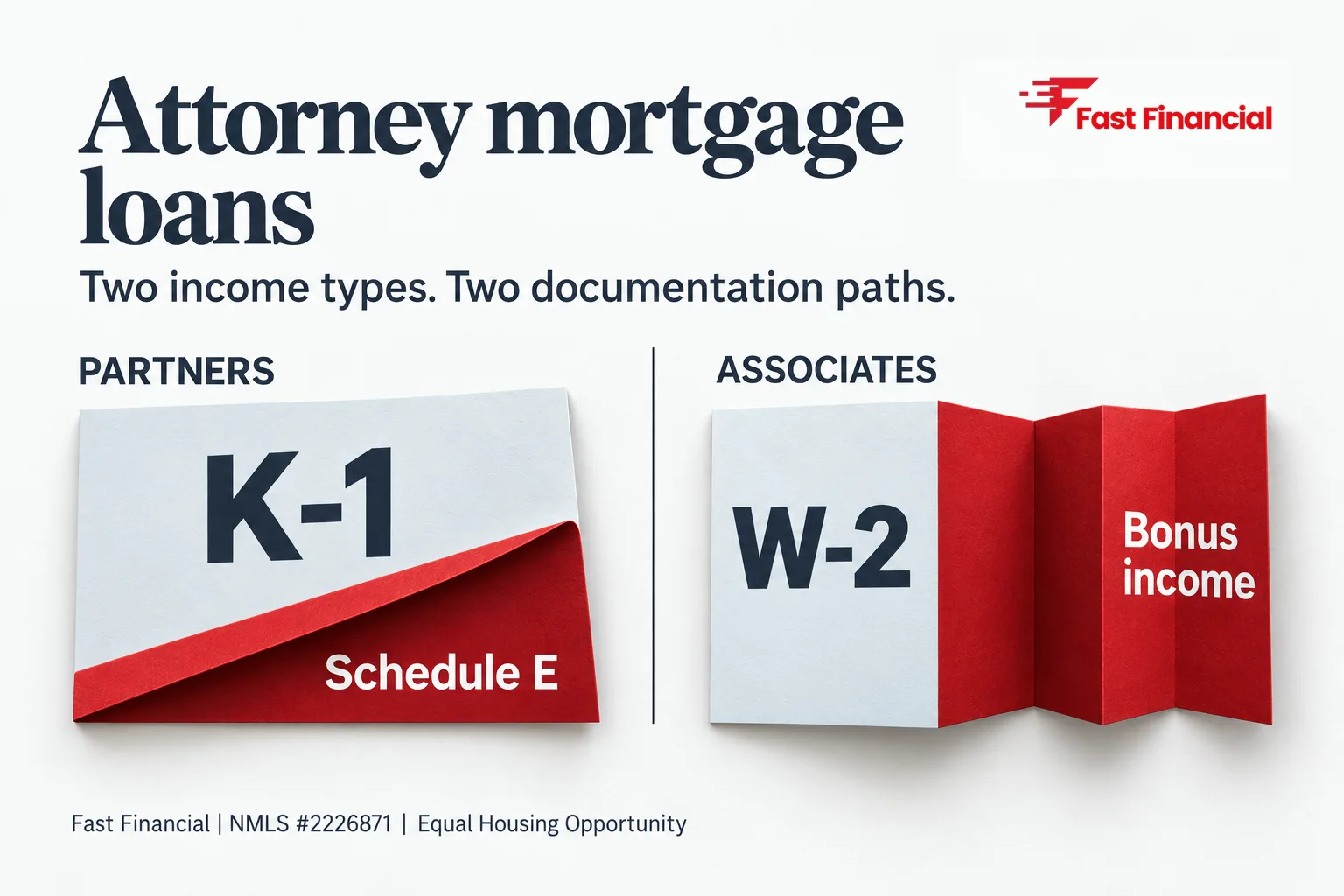
Attorneys qualify for mortgages — including large ones — but the underwriting looks different depending on whether you're a partner drawing K-1 income or an associate earning a base salary plus bonus. High income does not automatically mean easy approval. The key is knowing which documentation path fits your structure.
Why Attorney Income Is Harder to Underwrite Than It Looks
Conventional mortgage guidelines are built around W-2 earners with predictable monthly income. Attorneys often don't fit that mold cleanly.
Law firm partners typically receive K-1 income from a partnership — no W-2, potentially variable year-to-year earnings, and business deductions that reduce taxable income on paper. Associates may earn a steady base but receive year-end bonuses that swing considerably. Some attorneys run their own practices, which puts them squarely in self-employed territory.
The result: an attorney with strong real-world earning power can get flagged during underwriting because the income is difficult to document in the conventional way. That's a documentation problem, not an income problem — and there are paths through it.
How K-1 Income Is Qualified for a Mortgage
If you're a law firm partner, lenders generally want two years of personal federal tax returns plus two years of K-1s from the partnership. Qualifying income is calculated as a two-year average of your share of partnership earnings as reported on Schedule E — not your gross compensation, and not your actual distributions.
That distinction matters. Deductions that reduce your Schedule E income (and your tax bill) will also reduce what a lender counts toward qualification. A few other factors shape the underwriting:
- Income trend. Year-over-year growth supports approval. A declining trend will require explanation.
- Practice stability. Lenders typically want a current-year profit and loss statement and may request a CPA letter confirming the business is operating and income is ongoing.
- Ownership stake. Partners with significant ownership positions may qualify under self-employed guidelines that offer additional flexibility. Mortgage options for self-employed borrowers in California follow similar logic — many of the same programs apply.
How Bonus Income Is Treated by Lenders
Associates often earn a substantial portion of their total compensation through year-end bonuses. Lenders can count that income, but there are conditions.
For conventional loans, bonus income generally needs to be documented for at least two consecutive years and must appear reasonably likely to continue. W-2s for both years plus a recent pay stub showing year-to-date earnings typically satisfy this. A first-year bonus at a new firm — or a single exceptional year — may not count in full or at all.
Discretionary bonuses, contingency fee receipts, and variable draw structures are treated conservatively. Lenders may average only what was consistent across both years, or apply their own adjustment to volatile figures.
For context on how income interacts with California home prices, see how much income you need to buy a house in California.
Partners vs. Associates: The Underwriting Isn't the Same
These are two distinct borrower profiles, and treating them the same leads to surprises.
Law firm associates with a documented base salary and verifiable bonus history generally qualify under conventional or jumbo guidelines. The documentation load is heavier than a standard W-2 borrower, but the path is well-defined. The more common challenge is loan size — homes across Los Angeles and surrounding markets frequently push borrowers into jumbo territory. Jumbo loan requirements in Los Angeles County carry stricter reserve and credit requirements than conforming loans, and that's often the threshold attorneys are navigating.
Law firm partners are effectively self-employed in the eyes of a lender. Two years of returns, Schedule E analysis, and a business stability review are standard. The complication is that aggressive deductions — entirely legal and often advisable for tax purposes — can make taxable income look low relative to actual earnings. When that gap is significant, conventional underwriting may qualify you on a number that doesn't reflect your real financial position.
This is where non-QM loan programs become worth a serious look.
Which Loan Programs Work Best for Attorneys?
There's no single answer — it depends on income type, loan size, and documentation.
Conventional loans work well for associates with clean W-2 earnings and a documented bonus track record within conforming loan limits.
Jumbo loans are the most common path for attorneys buying in Los Angeles-area markets. They require more reserves and stronger credit, but they accommodate higher loan amounts that conforming limits can't reach.
Bank statement loans are a non-QM option built for borrowers whose tax returns understate their real deposits. Instead of tax returns, lenders qualify based on 12 to 24 months of personal or business bank statements. Bank statement loans for self-employed borrowers follow this structure — and the same logic applies to attorneys whose partnership deductions suppress Schedule E income.
Asset-depletion loans calculate a qualifying income from liquid assets — useful for attorneys with substantial investment portfolios or cash holdings relative to their documented income.
As a Los Angeles mortgage broker, Fast Financial works across conventional, jumbo, and non-QM channels. When one program doesn't fit, there are usually others worth reviewing.
What Documentation Do Attorneys Need?
Expect to pull together more than the average borrower. A working checklist:
- Two years of personal federal tax returns, all schedules
- Two years of K-1s (partners) or W-2s (associates)
- Most recent 60 days of pay stubs
- Most recent 60 days of bank statements
- Current-year profit and loss statement (partners and self-employed attorneys)
- CPA letter confirming business status and income continuity (sometimes requested)
The self-employed borrower document checklist covers most of what partners will need in detail. Being organized up front compresses timelines.
Getting mortgage pre-approval before you're under contract is especially important for attorneys — income documentation takes time to pull together, and sellers in competitive markets won't hold a property while you locate two years of K-1s.
Frequently Asked Questions
Can a law firm partner qualify for a mortgage on K-1 income alone?
Yes. Partners qualify under self-employed guidelines using a two-year average of Schedule E income. Consistent or growing K-1 earnings, a stable practice, and solid credit make this workable through conventional, jumbo, or non-QM programs. The documentation requirements are heavier than for a W-2 borrower, but the pathway is established.
Does my year-end bonus count toward my qualifying income?
It can — if you've received it for at least two consecutive years and it's reasonably expected to continue. Lenders typically average two years of documented bonus income. A first-year bonus or a single outlier year may not count at full value. Discretionary bonuses are treated more conservatively than guaranteed-structure compensation.
What if my taxable income is much lower than what I actually earn?
This is the core challenge for partners who deduct aggressively. Non-QM programs — bank statement loans, asset-depletion loans — exist specifically for borrowers whose returns understate their real financial picture. These programs use different qualifying methods and are worth examining when conventional underwriting falls short. See how non-QM loans work.
Do credit score requirements differ for attorney borrowers?
No — the same credit standards apply regardless of profession. Conventional loans, jumbo loans, and non-QM programs each have their own minimums, with jumbo typically requiring the strongest scores. Credit score requirements for California mortgages covers what to expect across loan types.
How do I find out which program fits my situation?
Start with a direct review of your income structure. Call Fast Financial at (661) 512-4141, or submit your information online and we'll match you to the right program and tell you exactly what documentation you'll need. Our office is at 190 Sierra Ct Ste 324, Palmdale, CA 93550, and we serve attorneys throughout Los Angeles County and California. Fast Financial | NMLS #2226871 | Equal Housing Opportunity.