
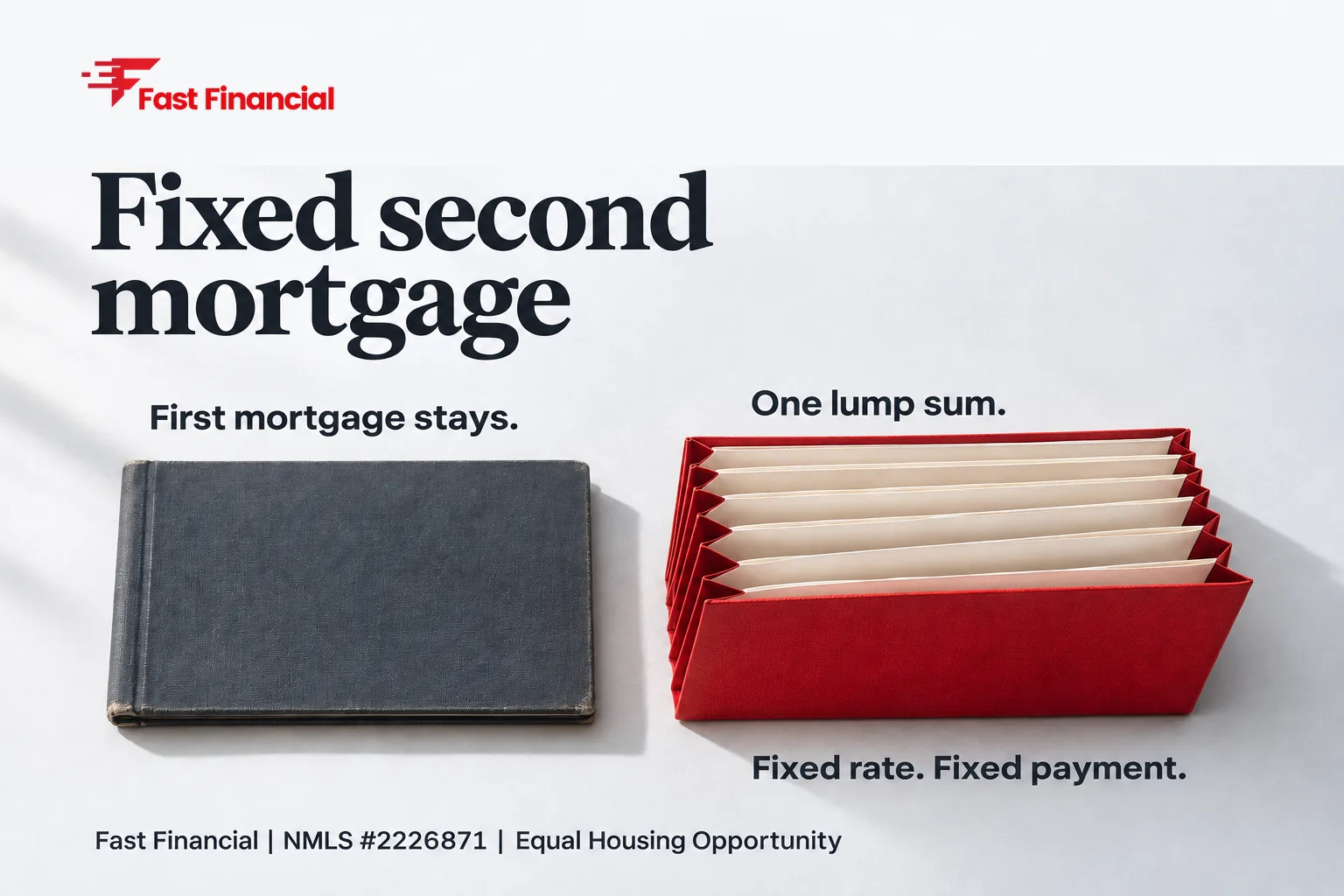
A fixed second mortgage is a loan secured by your home, behind your existing first mortgage, that pays out as one lump sum and carries a rate that stays the same for the life of the loan. Your payment doesn't change, and your first mortgage isn't touched. That predictability is the whole point.
At Fast Financial, we see this structure come up most when a borrower has a first mortgage worth keeping but needs a defined chunk of cash for a project, a payoff, or a purchase. Here's how it works and when it's the right move.
What is a fixed second mortgage?
It's a closed-end second lien. You borrow a set amount once, and you repay it on a fixed schedule with a fixed rate. Lenders also call it a home equity loan or a fixed-rate second.
The "second" refers to lien position. If the home were ever sold in a default, the first mortgage gets paid first and the second gets paid from what's left. Because the lender takes on that added risk, the rate on a second is typically different from what you'd see on a first mortgage. We don't quote specific rates here, because they vary by borrower, property, and market.
How is it different from a HELOC?
A HELOC is a revolving line you draw on as needed, usually with a variable rate. A fixed second is a single disbursement with one rate and one payment schedule from day one.
| Feature | Fixed second mortgage | HELOC |
|---|---|---|
| Funds | One lump sum at closing | Draw as needed |
| Rate | Fixed | Usually variable |
| Payment | Same every month | Changes with balance and rate |
| Best for | One-time, known cost | Ongoing or uncertain costs |
If you want the full comparison, we break it down in HELOC vs. second mortgage and in second mortgage vs. home equity loan. The short version: if you know the number, a fixed second keeps the math simple.
When does a fixed second beat a cash-out refinance?
Here's the move to check: compare what you'd give up on your first mortgage. A cash-out refinance replaces your whole loan. If your current first mortgage has terms worth protecting, a second lets you tap equity and leave it alone.
A fixed second often makes sense when:
- Your existing first mortgage has terms you don't want to give up.
- You need a defined amount, not an open-ended line.
- You want a payment you can budget around without watching the rate market.
A refinance may win when the first mortgage itself is the problem, or when rolling everything into one loan simplifies your finances. Our refinance options page covers that side, and when it makes sense to refinance in California walks through the decision.
What do lenders look at to approve a fixed second?
Lenders weigh the same core factors as any mortgage, with extra attention on how much total debt sits against the property.
- Combined loan-to-value (CLTV): your first mortgage balance plus the new second, measured against the home's appraised value. The more equity you keep after borrowing, the stronger the file.
- Credit profile: payment history and utilization drive pricing and eligibility. See what credit score you need for a mortgage in California.
- Debt-to-income ratio: the new payment is added to your existing obligations. Here's how DTI is calculated and what lenders allow.
- Property and occupancy: primary residence, second home, and investment property are underwritten differently, and guidelines are tighter as you move down that list.
- Documentation: income, assets, and a current first-mortgage statement.
Exact thresholds depend on the lender and loan program, so treat any number you read online, including from us, as a starting point, not a promise.
What will a fixed second cost me?
Beyond the rate, expect closing costs. These commonly include an appraisal, title and escrow charges, and lender fees, though some programs reduce or waive certain items. Our guide to California mortgage closing costs shows what each line is.
Two practical points:
- Your rate is set when you lock. Understanding how rate locks work helps you time that decision, and how mortgage rates are set explains why the rate on a second can differ from a first.
- You're adding a payment. Run your own numbers with our mortgage calculators before you commit to a loan amount.
Who is a fixed second a bad fit for?
It's not the right tool for everyone. Skip it, or pressure-test it hard, if:
- You can't comfortably carry both payments. A second lien is secured by your home, and missing payments puts the property at risk.
- You're borrowing for something with no clear return or end date, where a revolving line might fit better.
- Your first mortgage rate is no longer competitive and a full refinance would serve you better.
- Your income is irregular or self-employed. That doesn't disqualify you, but your documentation path matters. Non-QM options may apply, as we cover in what a non-QM loan is.
How do I get started?
Start with three numbers: your current first-mortgage balance, your honest estimate of the home's value, and the exact amount you need. From there, a broker can tell you whether a fixed second, a HELOC, or a refinance fits.
Fast Financial is a California mortgage brokerage (company NMLS #2226871). We shop the structure, not just the rate, and tell you straight when a second isn't the best option. Get your rate reviewed online, or call (661) 512-4141. You're also welcome to stop by the office at 190 Sierra Ct Ste 324, Palmdale, CA 93550.
Frequently asked questions
Is a fixed second mortgage the same as a home equity loan?
In practice, yes. Both terms usually describe a closed-end loan with a lump-sum payout and a fixed rate, secured by your home in second position.
Can I get a fixed second mortgage if I have a low-rate first mortgage?
Yes, and that's a common reason people choose it. Because the first mortgage stays in place, you keep its terms while borrowing against your equity separately.
Are fixed second mortgage rates higher than first mortgage rates?
Often they differ, because the lender sits behind the first lien and carries more risk. The actual difference depends on your credit, equity, property, and the market at the time you lock.
Can I use a fixed second mortgage on a rental property?
Some lenders allow it, but guidelines are stricter for investment properties than for a primary residence. If you own rentals, ask about options early, and see our overview of rental property loans in California.
Does a second mortgage affect my first mortgage?
It doesn't change your first mortgage's rate or terms, but it adds a new payment and a new lien on the home. Your combined debt is what lenders and future borrowing decisions will look at.
Fast Financial is an Equal Housing Opportunity lender. Rates and terms vary by borrower and market and are subject to underwriting approval. This article is general information, not a loan offer or financial advice.