
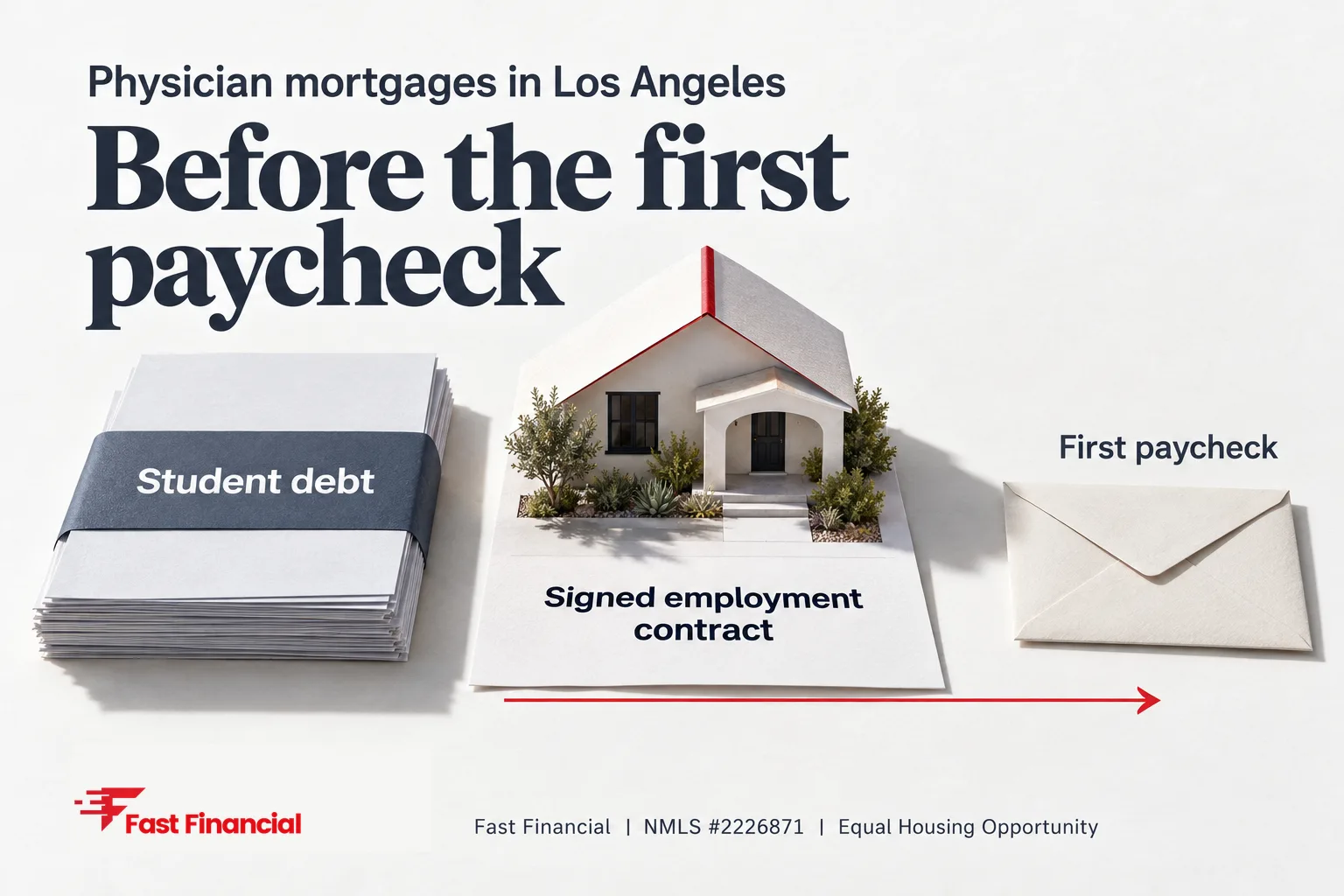
Doctor loans exist for exactly this moment: six-figure student debt, no W-2 history, and a start date still weeks out. Physician mortgage programs let qualifying medical professionals close on a Los Angeles home before the first paycheck clears — without hitting the debt-to-income wall that stops most borrowers cold.
Why Standard Mortgages Don't Work for Most New Attendings
Conventional underwriting runs on two rails: debt-to-income ratio and employment history. A new attending physician fails both on paper. Student loans crush a standard DTI calculation. A residency contract isn't two years of W-2s. The result: a fully credentialed physician — with strong income locked in — gets turned away by an algorithm that wasn't designed for their career path.
Los Angeles compounds the problem. Home prices routinely push into jumbo territory, and jumbo loan requirements in Los Angeles County layer on additional reserve and documentation standards that make conventional qualification even harder for a new grad.
What Is a Physician Mortgage Loan?
A physician mortgage is a specialized loan product structured around how doctors actually earn and borrow. Instead of counting your full student loan balance or standard amortization payment against your DTI, these programs either exclude deferred loans entirely or use the income-based repayment (IBR) amount — which is typically a fraction of what a conventional lender would count.
The other key feature: no private mortgage insurance (PMI), even at a low down payment. Conventional loans require PMI when you put down less than 20%. Physician programs waive it — the credential signals the creditworthiness, not the down payment size.
How Do Lenders Handle Student Loans for Doctors?
This is the underwrite that changes everything. Federal student loan servicers offer income-driven repayment plans where the monthly payment can be far below what a standard amortization would require. Most physician mortgage programs use the IBR payment — even if the loans are currently in deferment during residency — rather than a calculated percentage of the total balance.
In practice: if your IBR payment is minimal and your loans are in deferral, many physician programs count that reduced figure against your DTI. That single adjustment is often the difference between qualifying and not. Understanding your credit score position alongside your debt load is a smart first move before you start shopping.
Can I Get a Physician Loan With a Future Start Date?
Yes — and this is the other structural piece. Standard underwriting requires verified employment, meaning paystubs. Physician programs accept a signed employment contract with a confirmed start date, typically up to 90 days out, as proof of qualifying income.
That window matters. Most new attendings are coordinating job offers, residency graduation, and a home search simultaneously. A physician loan lets you get mortgage pre-approval and close before you've received a single paycheck. Offer letter, contract, license — that's the documentation stack.
Who Qualifies for a Physician Mortgage?
Most programs cover:
- Medical doctors (MD, DO)
- Dentists and oral surgeons (DDS, DMD)
- Podiatrists (DPM)
- Optometrists (OD)
- Pharmacists (PharmD) — varies by lender
- Veterinarians (DVM) — varies by lender
- Residents and fellows with a signed post-training contract
The credential is the qualifying factor. What you don't need: two years of employment history, a large down payment, or zero student debt.
Physician Loans vs. Conventional Loans in Los Angeles
| Feature | Conventional | Physician Loan |
|---|---|---|
| Student loan DTI treatment | Full calculated payment | IBR or excluded |
| PMI required | Yes, if less than 20% down | No |
| Employment proof | 2 years W-2 | Offer letter accepted |
| Loan size | Up to conforming limit | Jumbo-eligible |
| Income type | Standard W-2/1099 | Contract income accepted |
For Los Angeles purchases, physician programs often operate as portfolio or non-QM loans — outside Fannie/Freddie guidelines — which is what enables the flexible underwriting. If you're figuring out how much income you'd need to qualify for a target price point, this DTI treatment is the variable that changes the answer for physicians.
What About Doctors Who Are Already in Private Practice?
Once you've been practicing for a few years, the picture shifts. Many private-practice physicians are functionally self-employed, and self-employed borrowers have their own income documentation path — think bank statements, K-1s, and self-employed mortgage options rather than the new-contract playbook.
Physician loan programs don't always extend the same student-debt treatment to non-W-2 applicants, so the conversation moves toward what income documentation actually captures your earning picture. That's a specific underwrite — not a checklist, a conversation with a broker who knows both product categories.
What Should You Prepare Before Applying?
- Signed employment contract — start date, title, and base compensation clearly stated
- Medical license or pending licensure documentation — requirements vary by program
- Student loan servicer statement — showing current IBR payment or deferment status
- Residency completion documentation — diploma, certificate, or program letter
- Bank statements — reserves matter even when the down payment is low
- Clean credit profile — pull your own report before a lender does; how credit affects your mortgage is worth understanding in advance
Budget separately for closing costs — even with a low down payment, escrow, title, and lender fees need to be funded out of pocket.
Fast Financial is a California mortgage broker (NMLS #2226871) working with physicians and medical professionals across Los Angeles and Southern California. Call (661) 512-4141 or get your rate reviewed online to see where you stand before you commit to a purchase price.
Frequently asked questions
Can a resident or fellow use a physician mortgage?
Yes. Most physician loan programs accept residents and fellows with a signed employment contract confirming their post-training position. The contract stands in for the W-2 history a conventional lender would require.
Does a physician loan mean I'll get a better rate?
Not necessarily. The value in physician programs is the qualifying flexibility — student debt treatment and no PMI — not a discounted rate. Rates vary by borrower profile, loan size, and market conditions; the program removes the barriers, it doesn't guarantee a number.
Do physician loans work for jumbo purchases in Los Angeles?
Yes, and this is a primary reason LA-area physicians use them. Many doctor loan programs are specifically structured to handle loan amounts above the conforming limit, which is standard across much of LA County.
What if I have both federal and private student loans?
The IBR adjustment typically applies to federal loans only. Private student loans are usually counted at their standard monthly payment. Run the full DTI picture with your broker — the mix matters.
Is a physician loan the same as a non-QM loan?
Not always. Some physician programs are bank portfolio products that fall outside Fannie/Freddie guidelines without being formally labeled non-QM. The practical effect is similar: flexible underwriting a conventional lender won't offer. Understanding the non-QM category gives useful context for how these programs sit in the broader market.