
What Is Mortgage Insurance — and When Can You Stop Paying It?
Mortgage insurance protects the lender — not you. If that surprises you, you're not alone. Here's what it actually is, when you're required to carry it, and how to stop paying it.
What does mortgage insurance actually cover?
Mortgage insurance reimburses your lender if you default and the foreclosure sale doesn't recover the full outstanding balance. The borrower pays the premium. The lender collects if things go wrong.
There's no scenario where mortgage insurance pays your mortgage for you, protects your credit, or covers your family if you pass away. Those require separate products — life insurance, disability coverage. Mortgage insurance exists specifically to make lenders comfortable lending at higher loan-to-value ratios than they'd accept without it.
What is PMI on a conventional loan?
PMI stands for private mortgage insurance. It's required on conventional loans when your down payment is below 20% of the purchase price — or more precisely, when your loan-to-value ratio exceeds 80%.
Your credit profile affects the cost. A stronger score generally means a lower PMI rate, which is one more reason your credit score going into a mortgage application matters beyond just qualifying. PMI is typically rolled into your monthly payment, though some lenders offer lender-paid PMI in exchange for a slightly higher rate, or upfront PMI paid at closing — which shows up as a line item in your California closing costs. Which structure makes sense depends on how long you plan to keep the loan.
What is MIP on an FHA loan?
MIP stands for mortgage insurance premium. It's the FHA's version of mortgage insurance, and it works differently than PMI in two important ways.
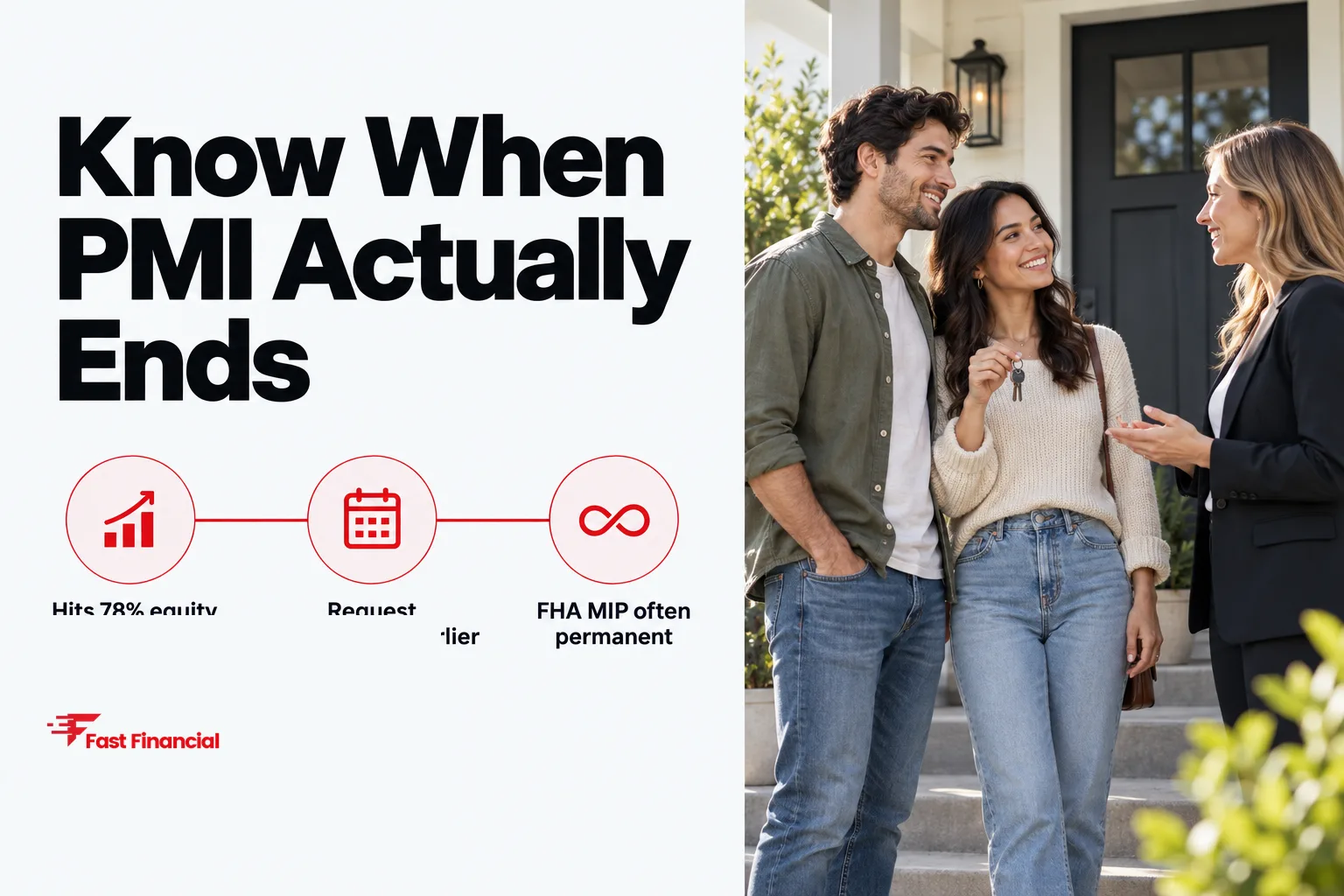
First, FHA charges both an upfront MIP (paid at closing or rolled into the loan balance) and an annual MIP collected monthly. Second, how long you pay the annual MIP depends on your loan term and down payment amount. For borrowers who put down less than 10%, MIP stays for the life of the FHA loan — it doesn't automatically fall off the way conventional PMI does. That's one of the most consequential factors in the conventional vs. FHA loan decision.
Is mortgage insurance the same as hazard insurance?
No — and this is one of the most common points of confusion on a Loan Estimate.
Hazard insurance (the property coverage inside your homeowner's policy) protects the physical structure of your home against fire, wind, and other covered events. Your lender requires it because the collateral — the house — needs to be insured.
Mortgage insurance protects the lender's financial position on the loan itself. The two cover completely different risks. If you're reviewing your Loan Estimate and see both listed, that's why. They're separate line items for a reason.
When can I drop PMI?
Under the federal Homeowners Protection Act, you have the right to request PMI cancellation once your equity reaches 20% of the home's original purchase value, based on your original amortization schedule. Your servicer is also required to automatically terminate PMI when your loan balance reaches 78% of the original value — as long as payments are current.
You can also get there faster through appreciation. If your home's value has risen since you bought, you may be able to eliminate PMI by refinancing into a new conventional loan at a lower LTV, or by requesting a formal reappraisal through your current servicer and demonstrating you've crossed the equity threshold.
One important exception: lender-paid PMI is typically baked into the rate and can't be cancelled mid-loan. For most borrowers in that structure, refinancing is the primary exit.
Can I avoid mortgage insurance entirely?
Yes — several paths get you there:
- Put 20% down on a conventional loan. You start above the PMI threshold from day one.
- Use a VA loan. VA loans carry no monthly mortgage insurance. There's a one-time funding fee, but no ongoing PMI — a significant long-term cost advantage. If you're buying in the Antelope Valley or near Edwards Air Force Base, this is worth understanding fully.
- Tap down payment assistance. Some programs help California borrowers bridge the gap toward a larger down payment. First-time homebuyer programs in the Antelope Valley are worth reviewing if you're in Lancaster, Palmdale, or Quartz Hill.
- Explore no-money-down options. Zero-down paths exist, but understand exactly how they work before assuming they're the right fit for your situation.
How does mortgage insurance affect your buying power?
Mortgage insurance adds to your monthly payment, which increases your debt-to-income ratio (DTI). If your DTI is already running close to the qualifying limit, the additional premium can reduce the purchase price you qualify for. That's worth modeling before you land on a target.
Use our mortgage calculators to see how PMI or MIP shifts the monthly number for your specific scenario. And if you're buying in the Antelope Valley, how much house you can afford in Palmdale is a useful reference for what the income-to-purchase-price math looks like in that market.
If you want a straight read on where you stand — whether mortgage insurance applies to your situation and what loan structure makes the most sense — get your rate reviewed with Fast Financial. NMLS #2226871.
Frequently asked questions
Is mortgage insurance tax deductible?
PMI deductibility has been subject to Congressional renewal and income-based phaseouts in recent tax years. The rules shift often enough that you should confirm current treatment with a tax professional rather than relying on general guidance.
Does mortgage insurance ever make sense to keep paying?
Sometimes. If eliminating PMI through a refinance means absorbing closing costs or trading into a higher rate, the short-term math may not favor pulling the trigger immediately. Run a break-even analysis before acting — here's how refinancing works as a starting reference.
Do all loan types require mortgage insurance?
No. Conventional loans with 20% or more down carry no PMI. VA loans carry no monthly mortgage insurance. USDA loans use a guarantee fee structure instead of traditional PMI. FHA loans always require MIP. The loan type is one of the biggest variables in your total monthly payment.
What's the difference between PMI and MIP?
PMI is private mortgage insurance on conventional loans — cancellable once you reach 20% equity. MIP is the FHA mortgage insurance premium — it includes both an upfront component and a monthly charge that may last the life of the loan depending on your down payment amount.
How do I find out if I'm currently paying mortgage insurance?
Check your monthly mortgage statement or the Closing Disclosure from your purchase. Mortgage insurance appears as a separate line item. If you're unsure, call your loan servicer — they're required to tell you the status and cancellation terms.