
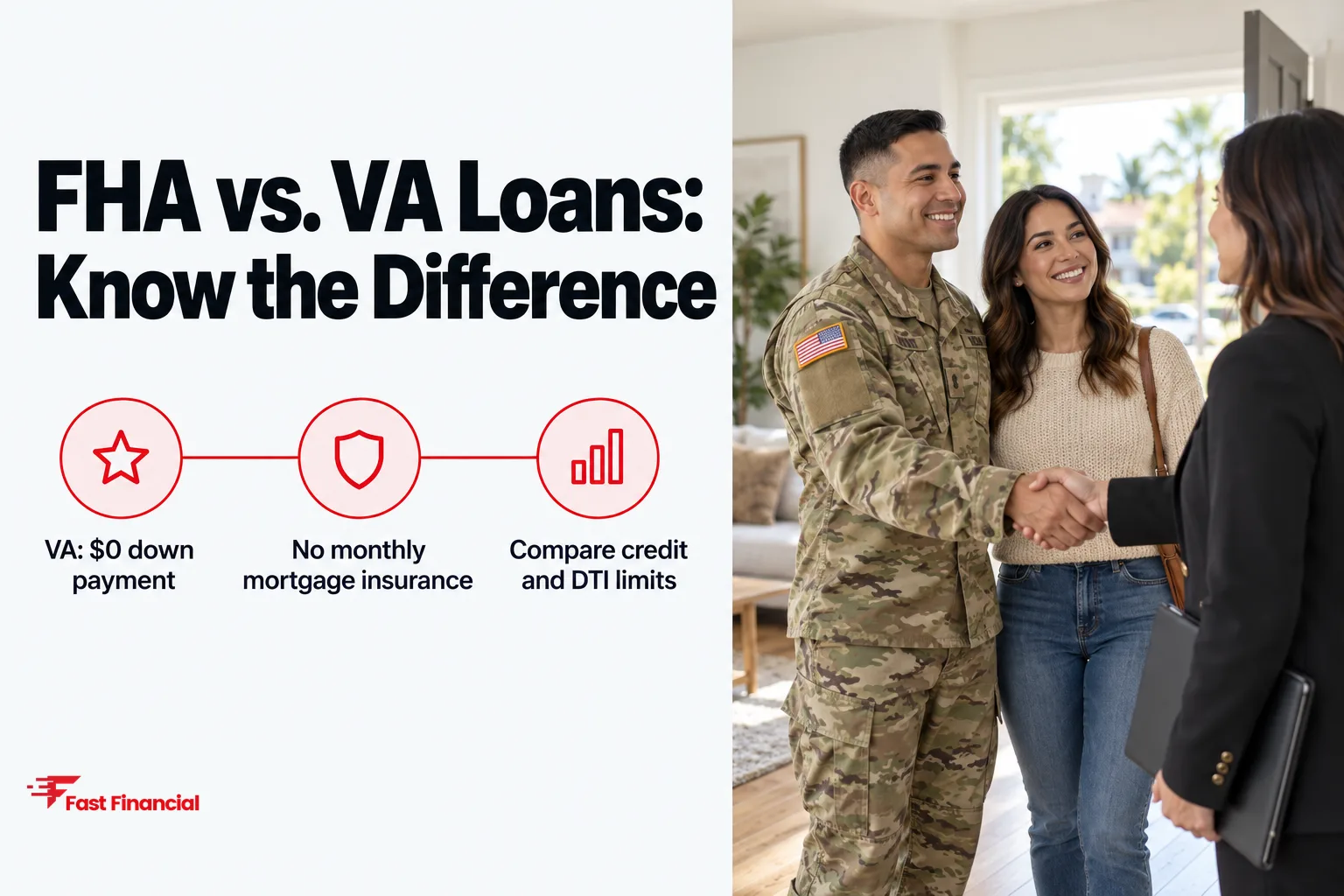
FHA vs. VA Loans: The Crucial Differences California Borrowers Need to Know
VA loans are available only to eligible veterans, active-duty service members, and qualifying surviving spouses — and they carry no ongoing mortgage insurance. FHA loans are open to nearly any borrower and set a lower bar on credit and down payment, but they come with mortgage insurance that sticks for the life of most loans. If you're VA-eligible, that distinction alone often makes the choice straightforward.
Both programs are government-backed. A federal agency — either the Department of Veterans Affairs or HUD's Federal Housing Administration — insures the lender against default. That guarantee is what allows both programs to offer terms that conventional loans typically can't match for the same borrower profile.
Who Qualifies for a VA Loan?
VA eligibility is tied to military service. You must be one of the following:
- An active-duty service member
- A veteran who served the minimum required period
- A National Guard or Reserve member meeting service requirements
- A surviving spouse of a service member who died in the line of duty or from a service-connected disability
If you're stationed near Edwards Air Force Base in the Antelope Valley, you almost certainly qualify — and a VA loan should be your first call. The full breakdown is in our VA loan guide for Edwards AFB homebuyers.
To use the benefit, your lender will pull a Certificate of Eligibility (COE) directly from the VA system. You don't need to chase it down yourself.
Who Qualifies for an FHA Loan?
No military requirement. FHA is built for borrowers who don't clear the stricter thresholds that conventional loans demand — particularly first-time buyers, those with shorter credit histories, or anyone who's had a credit event in the past few years.
Eligibility is based on:
- Credit score meeting FHA's minimum (lower than conventional program floors)
- A minimum down payment at the applicable tier
- The home must be your primary residence
- Debt-to-income within FHA guidelines
If you're buying your first home in Lancaster, Palmdale, or elsewhere in the Antelope Valley, check First-Time Homebuyer Programs in the Antelope Valley — there are down payment assistance programs that stack on top of FHA. For a straight FHA-vs-conventional comparison, see Conventional vs. FHA Loan: Which One Actually Saves You Money?
Down Payment: Zero vs. Minimum
VA loans allow eligible borrowers with full entitlement to purchase with no down payment. That's not a promo — it's a core program feature. It's also one of the few legitimate zero-down paths in residential lending.
FHA loans require a minimum down payment. The exact amount depends on your credit score tier — borrowers at the higher end of FHA's credit range access the lower requirement; those near the floor pay more. Either way, you will have a down payment requirement. It's lower than most conventional loan minimums for the same borrower profile, but it isn't zero.
Mortgage Insurance: The Long-Term Cost Hidden in the Monthly Payment
This is the most important cost difference between the two programs — and the one most borrowers underweight when comparing.
FHA loans carry two layers of mortgage insurance:
- Upfront MIP — due at closing or financeable into the loan
- Annual MIP — charged monthly, and it runs for the life of the loan in most cases
That ongoing MIP doesn't automatically cancel when you hit an equity milestone the way conventional PMI does. The exits are refinancing into a conventional loan once you've built enough equity, or selling. For a full explanation of how mortgage insurance works, read What Is Mortgage Insurance?
VA loans substitute a one-time VA Funding Fee for mortgage insurance. The fee varies based on whether it's your first use of the benefit, whether you make a down payment, and your service branch. Veterans receiving VA disability compensation are typically exempt from the funding fee entirely.
The bottom line: VA has no ongoing monthly mortgage insurance. Over a 30-year hold, that's a significant difference in total cost.
Loan Limits: How Each Program Sets Its Ceiling
VA loans have no loan limit for eligible borrowers with full entitlement — you can borrow up to what your income and DTI support. Borrowers with partial entitlement (from a prior unreleased VA loan) operate under a different calculation, but most first-time VA buyers have full entitlement.
FHA loans are capped by HUD's county-level limits, which are updated annually. Los Angeles County — which includes Lancaster, Palmdale, and the rest of the Antelope Valley — is a high-cost area, so it receives a higher ceiling than the national baseline. Even so, FHA limits cap out below VA in high-price markets, which matters when you're shopping in parts of LA County where prices push toward jumbo territory. See Jumbo Loan Requirements in Los Angeles County if you're close to those ceilings.
Property Requirements: Both Programs Have Standards
Neither FHA nor VA will fund a property that doesn't meet their condition benchmarks.
FHA appraisals combine market value with a property condition review — the appraiser flags safety and soundness issues (peeling paint in older homes, broken windows, missing handrails) that must be resolved before closing. How FHA Appraisals Work covers this in detail.
VA appraisals apply VA Minimum Property Requirements (MPRs) — similar focus on health, safety, and structural integrity. Both programs may require seller repairs before the loan closes, which can complicate offers in competitive markets.
Credit Score and DTI: The Qualifying Numbers
FHA: Sets a credit score floor with down payment tiers tied to score bands. It's more permissive than conventional underwriting, which is the point. For California-specific context, What Credit Score Do You Need for a Mortgage in California? is worth reading before you apply.
VA: The VA itself imposes no minimum credit score, but every lender sets an overlay. In practice, most VA lenders want to see scores in the mid-600s at minimum, with pricing improving as scores rise.
DTI: Both programs allow higher debt-to-income ratios than conventional loans, with compensating factors. VA also uses a residual income test — a calculation checking that you'll have enough left over each month after housing and major debt obligations. It's a borrower-protective guardrail that often works in applicants' favor.
Which Program Should You Choose?
The honest answer:
- VA-eligible? Start there. No ongoing MIP plus potential zero-down is a combination that's structurally hard to beat. Even if you have a down payment ready, the absence of monthly mortgage insurance changes the long-run math. Why VA Loans Are Worth a Close Look runs through the full advantage list.
- Not VA-eligible? FHA is a real path — especially if your credit isn't strong enough for conventional or you need to preserve cash. Understand the MIP going in and have a plan for your exit (usually a refi into conventional once you've built equity).
The closing costs picture differs between programs too — VA limits what veterans can be charged at close, which can reduce your total cash needed at signing.
If you want to see where you actually stand on either program — in Lancaster, Palmdale, or anywhere in Los Angeles County — get your rate reviewed at Fast Financial. We're a California-licensed mortgage broker (NMLS #2226871) who runs FHA and VA loans every week.
Frequently Asked Questions
Can a veteran use both an FHA loan and a VA loan?
Not on the same property. A veteran could theoretically hold an FHA loan on one property and a VA loan on another, but each individual purchase must use one program.
Does a VA loan always beat FHA for veterans?
Almost always on long-term cost, because there's no ongoing mortgage insurance. FHA can occasionally make sense when a veteran's VA entitlement is tied up or the property doesn't meet VA MPRs — but those are edge cases.
Can I use either program to buy a rental or investment property?
No. Both FHA and VA require the property to be your primary residence. For investment property financing, DSCR loans in California are the tool built for that purpose.
Are VA loans harder to get accepted in competitive markets?
Some sellers have misconceptions about VA loans causing delays, but an experienced VA lender mitigates most of them. The appraisal process adds a step, and the MPRs can flag repair conditions — but VA offers are not inherently weaker than FHA.
What happens to my VA loan benefit if I sell my home?
When you sell and pay off the VA loan, your entitlement is typically restored and you can use the VA benefit again on your next purchase. Your lender can pull your current entitlement status through the COE system before you apply.