
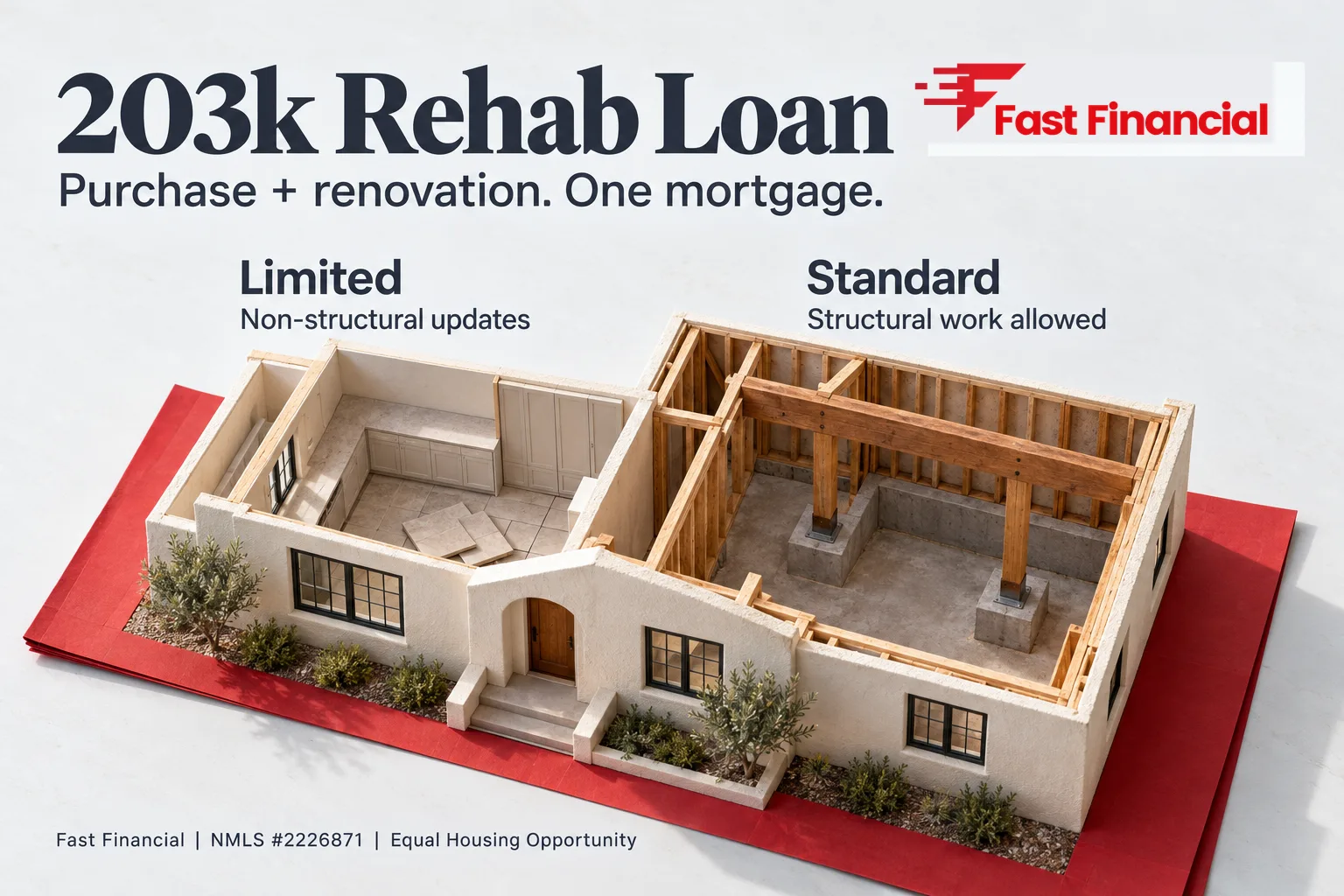
A 203k rehab loan is an FHA-insured mortgage that wraps the purchase price (or your current loan balance) and the cost of renovations into a single loan. You close once, repair funds are held in reserve, and the money is released as the work gets done. It is built for owner-occupants who find a house with potential but can't pay cash for the fixes.
Here is the move: pick the right version for the scope of your project, then build a clean budget before you write an offer.
What is a 203k rehab loan, exactly?
The FHA 203(k) program is run by HUD and delivered through approved lenders. Instead of buying a house with one loan and funding repairs with a second, pricier product, the renovation budget rides inside the mortgage.
Lenders size the loan around what the property will be worth after the work is finished, not just today's condition. That is why a tired house that wouldn't qualify for a standard purchase loan can still work here. For the full overview, see our guide to the FHA 203k loan.
What's the difference between Limited and Standard 203k?
There are two versions, and the right one depends on how deep the work goes.
| Limited 203(k) | Standard 203(k) | |
|---|---|---|
| Best for | Cosmetic and non-structural updates | Major rehab, structural work, big layout changes |
| Structural repairs | Not allowed | Allowed |
| HUD consultant | Not required | Required |
| Paperwork | Lighter | Heavier, with detailed plans and cost write-ups |
| Typical timeline | Shorter | Longer |
| Repair cap | Yes, set by HUD | Governed by loan limits and the property's after-repair value |
The Limited version used to be called the Streamlined 203(k). It covers things like flooring, paint, kitchens, bathrooms, roofing, new systems and accessibility fixes. The Standard version is the one for gut jobs, additions, foundation issues, or homes that need to be rebuilt in part.
What can a 203k rehab loan pay for?
A wide range of work qualifies. In practice, lenders see these most often:
- Kitchen and bathroom remodels
- Roof, windows, flooring and exterior repairs
- Electrical, plumbing, heating and cooling replacements
- Energy-efficiency upgrades and accessibility modifications
- Fixing health and safety problems the appraiser flags
- On Standard loans, structural repairs and room additions
Luxury add-ons are a different story. Items like a swimming pool are generally not eligible. Ask before you design your wish list around them.
What are the 203k rehab loan requirements?
The core rules are consistent, even though pricing and lender overlays vary:
- Owner-occupancy. You must live in the home as your primary residence. This is not an investor program.
- Eligible property. Typically a one-to-four unit home that meets FHA standards.
- Qualifying. You still go through underwriting: credit, income, assets and debt-to-income. Our breakdown of debt-to-income ratio for a mortgage shows what lenders weigh.
- Mortgage insurance. FHA loans carry upfront and annual mortgage insurance premiums.
- Contractor and plans. You need a detailed scope of work and cost estimates from qualified contractors, usually including a contingency reserve.
We cover each item in more depth in 203k loan requirements and FHA mortgage requirements. Credit score expectations are covered in FHA loan credit score requirements.
How does the 203k rehab process work?
The sequence matters. Skipping ahead is how deals stall.
- Get your numbers reviewed. Talk to a broker before you shop so you know your budget.
- Pick the property and the version. Decide whether the work is Limited or Standard.
- Collect bids. Get itemized estimates from licensed, insured contractors.
- Appraisal. The appraiser values the home as-is and as-improved, and flags anything that fails FHA standards. Learn what to expect in how FHA appraisals work.
- Close. Repair funds go into a holdback account.
- Draw schedule. Money is released in stages as work is completed and inspected.
- Finish. Final inspection, final draw, and you're in a renovated house.
The detailed walkthrough lives in our 203k loan steps article.
Is a 203k rehab loan better than other renovation financing?
Not always. It's a strong fit when you're buying a house that needs real work and you want one payment. It's a weaker fit when speed matters most or when you're an investor.
- Veteran buyers should compare it against a VA renovation loan.
- Existing homeowners with equity may do better with a HELOC or second mortgage, depending on their current first-loan terms.
- Ground-up building is a different animal. See construction loan requirements.
- Investors flipping a property can't use a 203(k). Look at fix and flip loans for Antelope Valley investors instead.
The honest tradeoff: a 203k loan is more paperwork and more coordination than a standard purchase. Many buyers accept that in exchange for financing the repairs at mortgage-style terms rather than short-term credit. Whether that math works for you depends on your credit, the home, the work, and current market pricing, none of which we can promise in advance.
Why does a 203k loan make sense in California?
California's housing stock includes plenty of older homes that need updating, and competition for move-in-ready listings is tough. In the Antelope Valley and across Los Angeles County, a dated home with good bones can be a way into a neighborhood you'd otherwise be priced out of. Local buyers should also review how FHA loans work in Palmdale, since county loan limits and local appraisal practices shape the deal.
Fast Financial is a California-licensed mortgage broker, and we work with borrowers on FHA purchases, renovations and refinances. We can walk through whether a Limited or Standard 203(k) fits your project before you make an offer.
Frequently asked questions
Can I use a 203k rehab loan to refinance my current home?
Yes. A 203(k) can be used to refinance an owner-occupied home and fund renovations in the same loan. Eligibility depends on your current loan, your equity position, and the property's after-improved value. See our refinance options.
Do I have to live in the house during the renovation?
It depends on the scope. On lighter projects many owners stay put. On Standard projects where the home is unlivable, the program can allow certain housing costs to be built into the loan, subject to lender and HUD guidelines.
Can I do the work myself?
Generally, lenders want licensed contractors handling the work. Self-performed labor is restricted, and where it's allowed, it is limited to what the lender and HUD permit. Check with your lender before you plan on it.
Is a 203k rehab loan the same as a construction loan?
No. A 203(k) renovates an existing home and you close on the finished value through an FHA mortgage. A construction loan finances building new, with different draws, underwriting and conversion steps.
How do I find out what I qualify for?
Start with a quick review of your credit, income and target property. You can get a rate quote and use our mortgage calculators to frame a budget. Rates and terms vary by borrower and market.
Ready to see where you stand?
If you're eyeing a fixer-upper, the best time to run the numbers is before you make an offer. Call Fast Financial at (661) 512-4141, or stop by our Palmdale office at 190 Sierra Ct Ste 324, Palmdale, CA 93550. If you live in the Antelope Valley, we're local to you. Get your scenario reviewed and see which renovation path fits.
Fast Financial, NMLS #2226871. Equal Housing Opportunity. Loan approval, rates and terms depend on borrower qualifications, property, and market conditions, and are not guaranteed.