
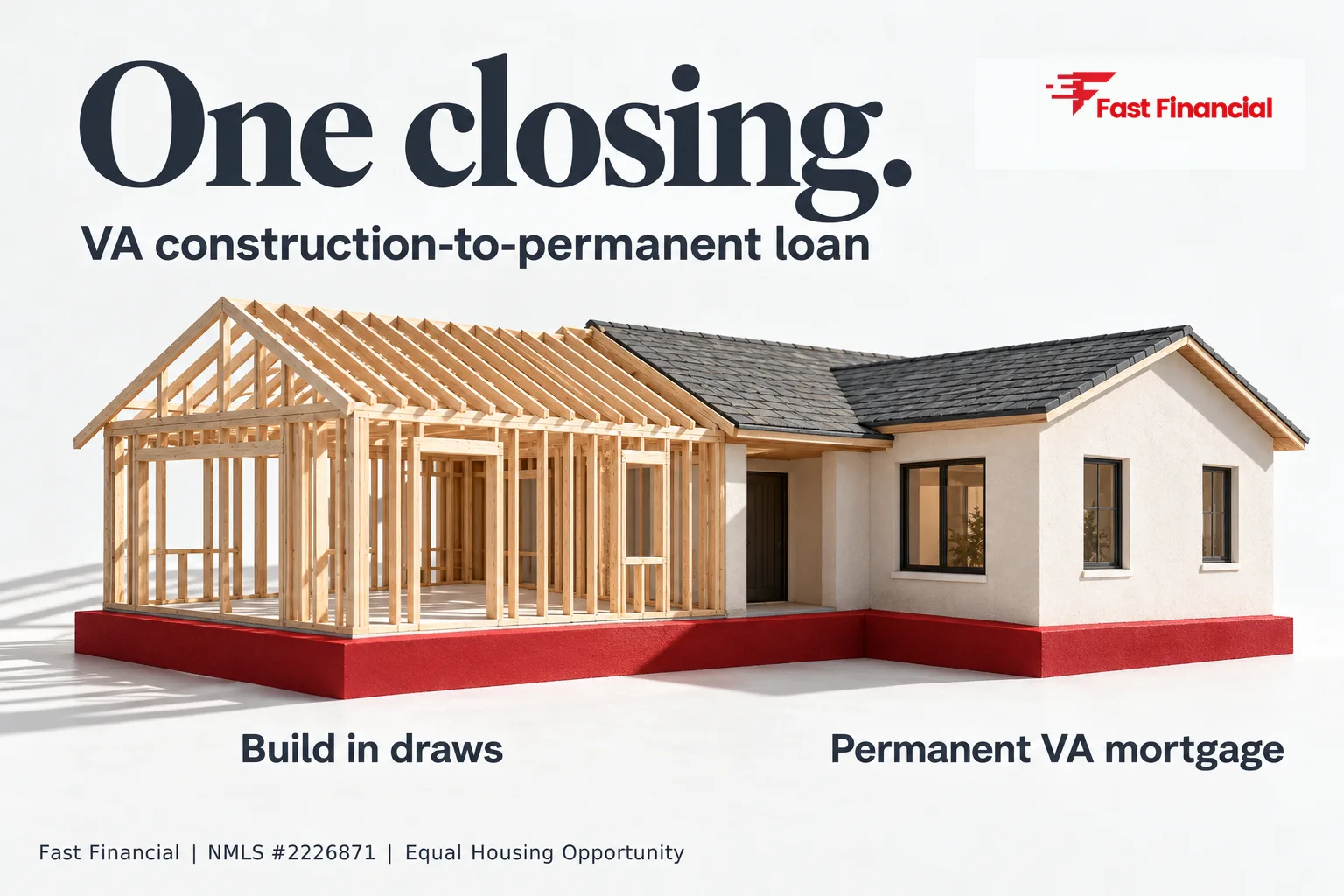
A VA construction-to-permanent loan is a single VA-backed loan that pays for building your home and then converts to a regular VA mortgage once the house is finished. The catch: the VA guarantees these loans, but it doesn't fund them, and plenty of lenders choose not to offer them. Knowing the rules up front saves you months.
At Fast Financial, this is a question we get from veterans who want new construction instead of competing for existing inventory. Here's the move-by-move version.
Can you build a house with a VA loan?
Yes, but the path is narrower than buying an existing home. The VA allows its guaranty to be used for construction, and some lenders package it as a one-time close (also called single-close) loan. Others will only do a two-step: a short-term construction loan first, then a separate VA purchase or refinance when the home is done.
Here's the practical difference:
| One-time close | Two-time close | |
|---|---|---|
| Closings | One | Two |
| Qualification | Once, before construction | Again at the end |
| Rate exposure | Terms set up front, per lender program | Permanent financing set later |
| Availability for VA | Limited, lender-dependent | More common |
The one-time close is the cleaner structure because you qualify once. The tradeoff is fewer lenders to choose from.
How does a VA construction-to-permanent loan work?
The sequence follows the build:
- Qualify. You need a Certificate of Eligibility, and the lender underwrites your credit, income, assets, and debt just like any VA purchase.
- Lock in the builder and plans. The lender reviews your builder, contract, plans, specifications, and budget.
- Close. One closing covers the construction phase and the permanent loan.
- Build in draws. Funds are released in stages as work is completed and inspected, not handed to the builder up front.
- Convert. When the home passes final inspection and receives its certificate of occupancy, the loan converts to your permanent VA mortgage.
During construction, payments are typically based on the amount drawn so far rather than the full loan. How that works varies by lender, so get it in writing.
What are the VA construction loan guidelines?
The VA sets the framework, and each lender adds its own conditions on top (called overlays). The pieces that matter most:
- A qualified builder. The VA generally expects a builder with a track record, and the lender will vet them. Building the home yourself as an owner-builder is typically not an option on a VA loan.
- VA appraisal and plans review. The home is appraised on the plans and specs, and the VA's appraisal process establishes the value the loan is based on. The home also has to meet VA minimum property requirements when finished.
- The lot. If you don't own land yet, the lot can usually be financed as part of the loan. If you already own it, any equity can count toward the project, depending on the lender.
- Primary residence. VA loans are for a home you intend to occupy, not a rental or flip.
- A realistic budget. Lenders look hard at the builder's cost breakdown and timeline, plus whether you have reserves for costs the loan doesn't cover.
For the broader checklist lenders use on ground-up projects, see our guide to construction loan requirements.
What do lenders actually look at to approve one?
The number that matters is whether the full picture holds together before a shovel hits dirt. In practice, lenders review:
- Credit and history. Lenders set their own floors above the VA's baseline. Our breakdown of the minimum credit score for a VA loan covers how that works, and veterans with a bumpy history may want to read about VA loan companies that work with lower credit scores.
- Debt-to-income. Your payment on the finished home, plus existing debts, against your income. Here's how that ratio is figured: debt-to-income ratio for a mortgage.
- Residual income. The VA looks at what's left each month after major obligations. This is a VA-specific test that sits next to DTI.
- The builder's file. License, insurance, references, and financial strength.
- Contingency planning. Construction costs shift. Lenders want to see room for it.
Rates and terms depend on your profile, the lender's program, and market conditions, so nobody can responsibly quote you a rate on a build before underwriting.
What if a lender won't do a VA construction loan?
You have three realistic alternatives:
- Buy a home that needs work. A VA renovation loan funds repairs and improvements with your purchase, which can get you close to a custom result with less complexity.
- Use a two-step approach. Finance the build with a construction loan, then take a VA loan at completion. You'll qualify twice, so plan for that.
- Compare other programs. If you're building and a VA one-time close isn't available, FHA construction loans are another route, and our FHA vs. VA comparison shows how the two stack up.
The VA benefit itself is still worth protecting. If you want the full picture on why, read VA loan benefits and advantages.
How should you prepare before you apply?
Do these before you talk to builders in earnest:
- Pull your Certificate of Eligibility.
- Get a VA loan pre-approval so you know your budget before you sign a build contract.
- Gather builder bids, plans, and a line-item budget.
- Set aside cash reserves beyond the loan for items it may not cover.
- Ask any lender you're considering, in plain words, whether they offer a VA one-time close and what their overlays are.
If you're stationed at or near Edwards AFB, our VA loan guide for Edwards Air Force Base homebuyers covers the local angles.
Get your options reviewed
If you're a veteran thinking about building, the fastest way to find out where you stand is to have your numbers reviewed before you commit to a lot or a builder. Get your rate reviewed online, call Fast Financial at (661) 512-4141, or stop by our walk-in office at 190 Sierra Ct Ste 324, Palmdale, CA 93550, which is local to Antelope Valley veterans. Fast Financial is a licensed California mortgage broker (NMLS #2226871). Financing is subject to credit approval and program availability.
Frequently asked questions
Does the VA offer its own construction-to-permanent loan?
No. The VA guarantees loans made by private lenders but doesn't lend directly. Whether you can get a VA construction-to-permanent loan depends on whether a lender chooses to offer one.
Can I act as my own general contractor with a VA loan?
Generally no. VA construction financing typically requires an experienced, qualified builder that the lender approves, and owner-builder arrangements are usually not permitted.
Can I use a VA loan to buy land and build?
Often yes, when the lot purchase and the construction are packaged together and the lender allows it. If you already own the land, the lender will look at how it fits into the project.
Do I qualify twice with a one-time close loan?
No, that's the point of a one-time close. You're underwritten once before construction starts, and the loan converts to the permanent VA mortgage when the home is complete.
Are VA construction loans harder to get than regular VA loans?
Usually, yes. There are fewer lenders offering them, and the builder, plans, and budget all get extra scrutiny on top of your own qualifications.